
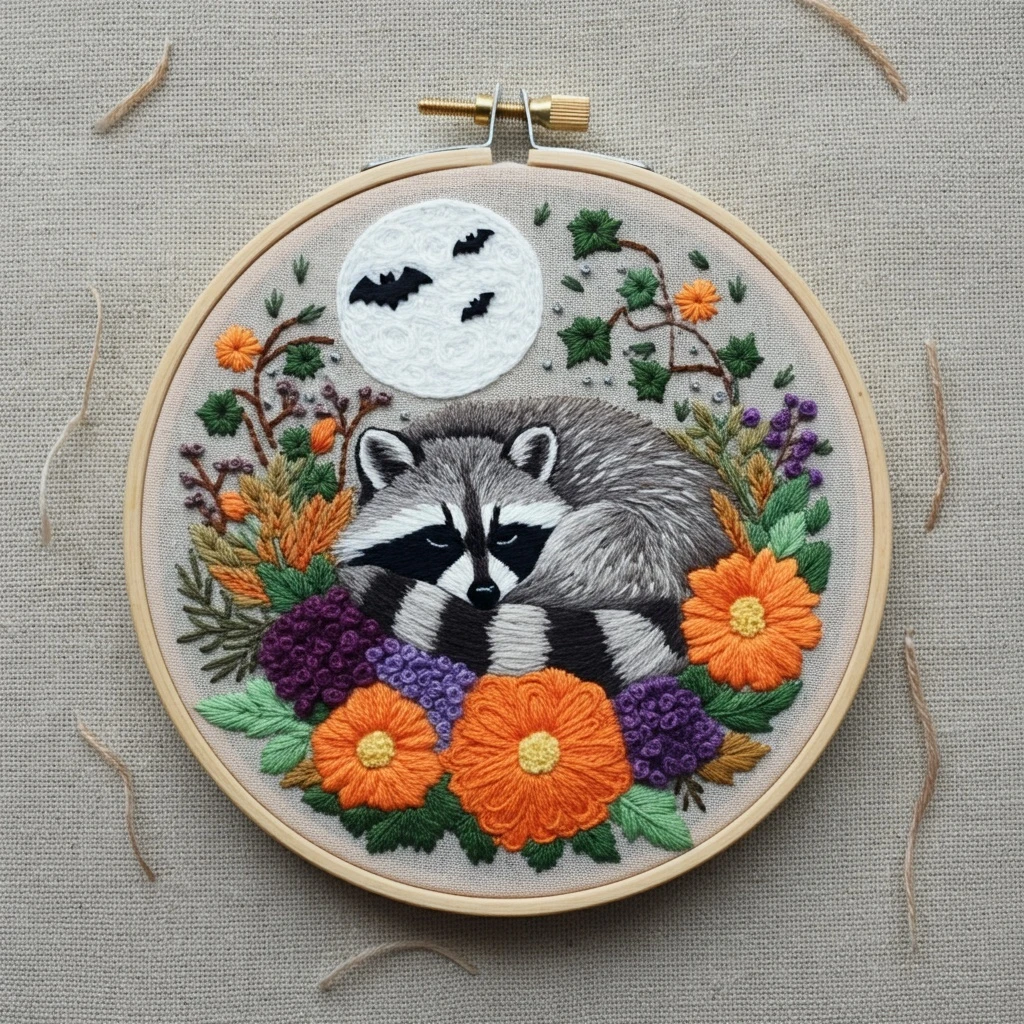
Nocturne Raccoon
A moonlit woodland hoop with a curled gray raccoon, bright orange blossoms, violet berry clusters, mossy leaves, curling brown vines, small bats, and a softly textured full moon. The palette balances quiet nocturne neutrals with saturated garden accents.
Design color read
The reference image uses a warm oatmeal linen ground and a natural wood hoop. The focal point is a sleepy raccoon rendered in directional gray fur strokes with a high-contrast black mask and striped tail. The surrounding wreath is lively: orange daisy-like flowers, yellow centers, emerald and mint leaves, olive grasses, brown vines, violet berry clusters, tiny gray stones or stars, and a pale moon with black bat silhouettes.
Polished DMC color palette
Use these flosses as a practical stitching palette. The notes describe where each color works best and how to combine it with neighboring shades for a soft, dimensional result.
Stitch map by design element
Raccoon fur
Use 1 strand long-and-short stitch in the direction of the body curve. Feather 762, 318, 414, and 3799 together; avoid making the rows too even.
Mask, nose & bats
Use 1–2 strands split stitch for clean outlines, then fill with short satin or long-and-short in 310. Add tiny B5200 eye glints last.
Moon texture
Fill with 2 strands Blanc or B5200 using loose split stitch spirals. Add 1-strand 762 curls and tiny seed stitches for crater texture.
Orange flowers
Use 2–3 strands satin stitch from petal tip to center. Shade with 740 at the base, 741 through the middle, and 742 on outer tips.
Berry clusters
Work French knots or colonial knots with 2 wraps and 2 strands. Mix 550, 552, and 209 so each cluster has depth rather than a flat block.
Leaves & vines
Use fishbone stitch for broad leaves, detached chain for small leaves, and stem stitch for vines. Layer 895 underneath brighter greens.
Thread-count, blending & shading guidance
Most important shading rule
Let stitch direction create the form. The raccoon should look curled and sleepy, so angle fur stitches around the back, cheeks, paws, and tail bands instead of filling everything in straight horizontal rows.
Outlining, texture & finishing details
Outlining details
- Use 1 strand 3799 split stitch around gray fur edges for a softer line than pure black.
- Reserve DMC 310 for the facial mask, nose, eyes, bats, and the darkest tail bands.
- Outline orange petals with couching or tiny split stitches only where shapes need separation.
Texture suggestions
- Add a few random 1-strand fly stitches through the body fur to break up large gray areas.
- Make berry clusters raised with French knots; vary wrap tension for a natural organic surface.
- Use seed stitch in olive greens and golds to make the grasses look wispy and layered.
Beginner-friendly order
- Transfer the design lightly; the pale moon and white fur can pick up dark transfer lines.
- Start with the moon and background sprigs, then stitch flowers and leaves, then the raccoon.
- Complete black details last to prevent dark fibers from catching in pale areas.
Hoop & fabric tips
- A warm beige linen or cotton-linen blend suits the nocturne palette and hides tiny travel threads.
- Keep fabric drum-tight for satin petals and smooth fur strokes.
- Use short thread lengths, about 14–16 inches, to reduce fuzzing in gray and black floss.
Practical stitching notes
- For soft gray fur: do not fully blend every boundary. Leaving a few visible directional strokes makes the raccoon look furry rather than painted flat.
- For bright flowers: stitch each petal as an individual unit and rotate the fabric so the satin stitch always runs neatly from outer edge to center.
- For the moon: keep the edges tidy with split stitch or whipped backstitch, then fill inside with gentle circular movement to echo the sample’s cloudy texture.
- For small vines: stitch branches before leaves and berries; this tucks greenery naturally over the stems.
- For balance: repeat a little 729 gold in flower centers and grasses so the oranges, greens, and purples feel connected.