
DMC palette & hand embroidery notes
Oceanic Mandala
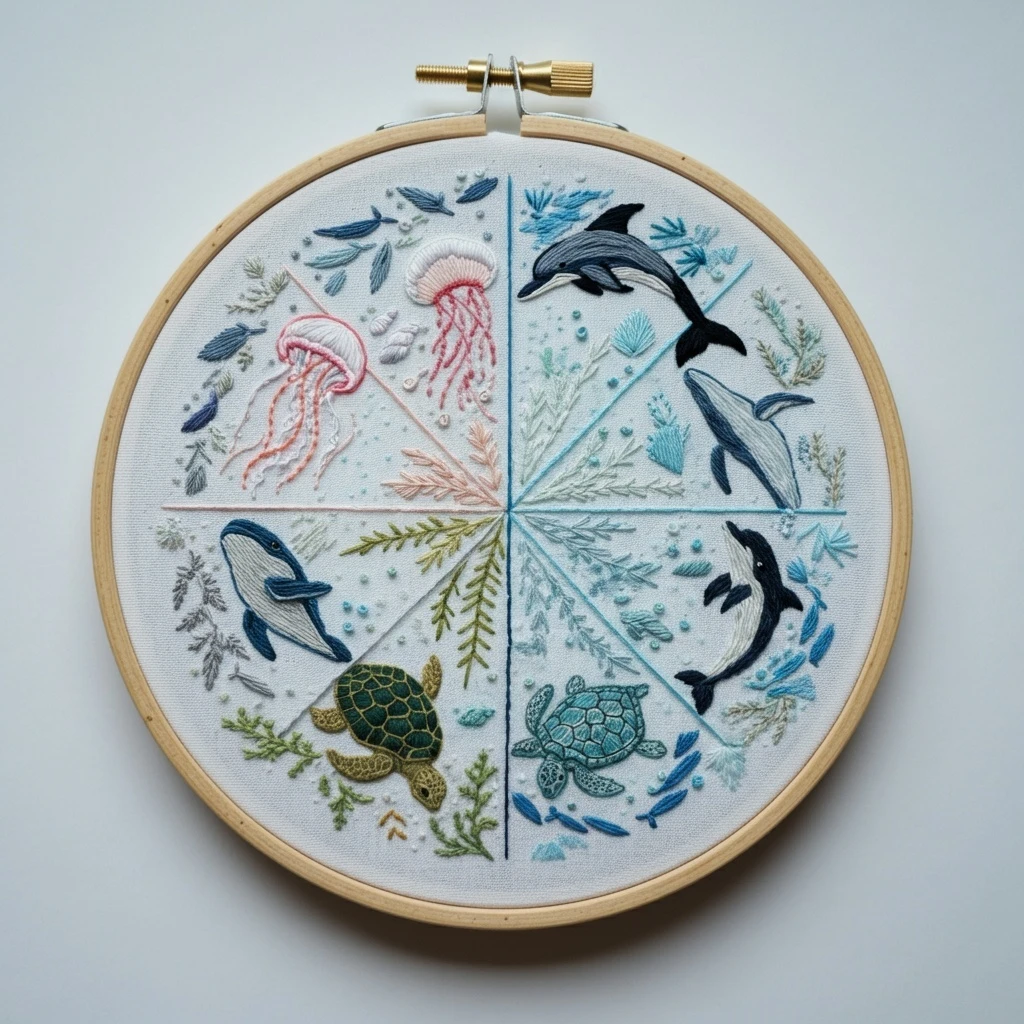
A circular sea-life mandala divided into delicate compass-like sections: pink jellyfish, deep blue whales and dolphins, teal turtles, wispy seaweed, tiny bubbles, feathers, shells, and icy aqua divider lines. The palette is cool, airy, and oceanic with just enough coral-pink warmth to make the jellyfish glow.
Suggested DMC Color Palette
Keep the ocean animals crisp with deep blue outlines, then soften the mandala with misty gray-greens, pale aquas, and light coral. Use the brightest turquoise only for focal sparkle: the radial center, bubbles, and select sea-creature highlights.
Stitch Map & Order
1. Establish the mandala geometry
Transfer the outer circle, center point, radial spokes, and each quadrant divider first. Stitch the spokes with 1–2 strands in stem stitch or whipped backstitch so the layout stays clean and balanced.
2. Work the large animals next
Use split stitch outlines for whales, dolphins, and turtles, then fill with satin stitch, long-and-short stitch, or directional straight stitches. Keep the animal bodies smoother than the surrounding plants.
3. Add jellyfish and soft shells
Build jellyfish caps with padded satin or long-and-short stitch in pale pink and pearl gray. Stitch tentacles as loose stem stitch, backstitch, and single-strand trailing straight stitches so they look translucent.
4. Fill seaweed, leaves, and feather shapes
Use fly stitch, lazy daisy, fishbone stitch, and tiny straight stitches. Vary sage, kelp, and gray-green shades so the plants frame the animals without competing with them.
5. Finish with bubbles and sparkle knots
Add French knots and colonial knots after all linework is done. Cluster them near the center and around creatures, using 747 and 3846 for shine and 927 for softer distant bubbles.
Blending & Shading Ideas
Whales and dolphins
Blend 823 + 3765 for dark backs, 3765 + 932 for mid-tone bodies, and 932 + 747 for pale bellies. Keep the belly curve soft by feathering short stitches into the darker top.
Jellyfish
Use 225 + 762 on the cap rim, 225 + 3712 for the warmer bell edge, and single strands of 3712 or 3831 for tentacle overlaps. Leave small gaps between tentacle lines for a watery, transparent look.
Turtles and kelp
Use 3809 for shell cell outlines, 3812 for the shell base, and 3846 or 747 for tiny shell highlights. Kelp looks natural when 3011 is used only at the stem base and 3013 takes over at the tips.
Texture Suggestions
- Bubbles: Mix French knots with small seed stitches. Place the brightest knots unevenly so they feel like drifting water, not polka dots.
- Whale bellies: Use long satin or split stitches that follow the body curve; one abrupt vertical stitch can flatten the animal.
- Sea fans: Fan out straight stitches from a shared base, then add a few 747 tip stitches for a frosted underwater look.
- Jellyfish caps: Pad the center lightly with one layer of split stitch before satin stitching if you want a raised, cushiony bell.
- Mandala balance: Repeat each color in at least three places around the hoop. This keeps the radial design harmonious even when one quadrant is busier.
Outlining Details
Use outlines to separate motifs without making the mandala heavy. Choose one strand of DMC 823 or 939 for the darkest animal edges, one strand of 3809 for turtle shell cells, one strand of 3712 for jellyfish tentacles, and one strand of 927 for pale shells and gray-green plants. For the radial spokes, stitch from the outer edge toward the center, stopping just short of the middle point; then cover the join with a tiny 3846 or 747 knot.
Needle & Fabric
Use a size 7 embroidery needle for most two-strand outlines and a size 9 or 10 needle for single-strand tentacles, spokes, and small eyes. A pale blue, white, or seafoam cotton/linen ground suits this design because the negative space is part of the mandala.
Hoop Strategy
Keep tension even and avoid carrying dark blue threads behind pale jellyfish areas. Because many motifs are separated by open fabric, weave tails carefully under matching colors only.
Finishing Tip
Steam from the back into a thick towel, protecting raised knots and padded jellyfish caps. When framing, align the main vertical spoke with the hoop screw so the mandala reads intentionally centered.