
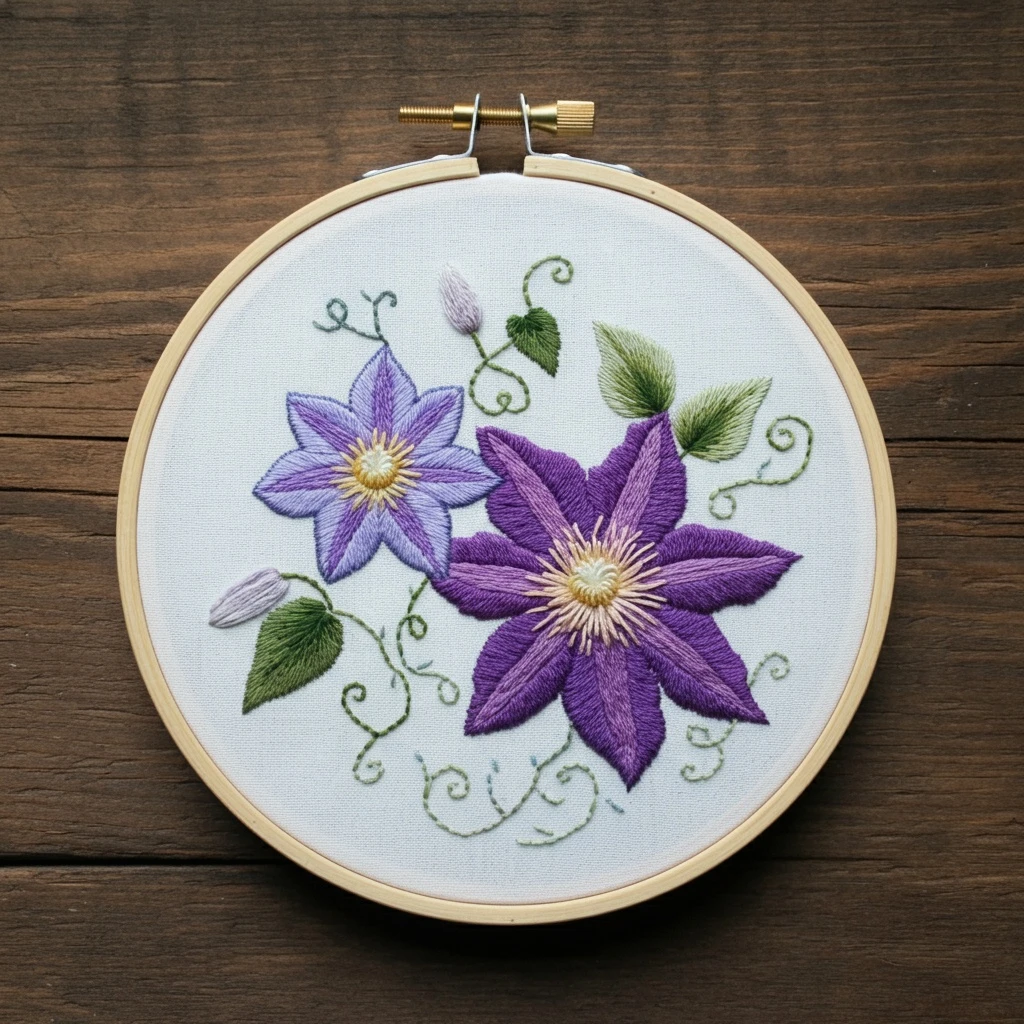
Purple Clematis Flowers
A refined floral embroidery with open star-shaped clematis blooms, layered purple petals, golden stamens, and winding green leaves. The design is most successful when the petals are shaded from deep plum centers to soft lavender tips, with clean vein stitches and a textured flower center that draws the eye.
Design color read
The clematis design is built around large purple blossoms with darker plum near the centers, medium violet petal bodies, mauve-lavender transitions, and pale lavender highlights along petal tips and vein ridges. Green leaves and stems frame the flowers, while warm yellow-gold stamens give the centers contrast and texture.
Suggested DMC floss palette
These DMC colors support rich purple flowers without becoming too dark. Use the deeper shades at the centers and vein shadows, then feather outward into lavender and mauve for a graceful clematis finish.
Deep clematis centers, petal bases, and the most shadowed vein lines.
Main petal shadow color and outer definition on the lower petals.
Primary petal body shade for smooth long-and-short fill.
Petal mid-light areas, lifted edges, and soft transitions toward tips.
Lightest petal highlights, especially on tips and raised central ridges.
Warmer mauve-violet transitions for petals that lean rosy purple.
Golden stamens and warm center accents that pop against purple petals.
Deeper stamen shadows and golden knots inside the flower centers.
Leaf bases, stem shadows, and darker greenery tucked beneath blooms.
Main leaves and stems; muted enough to support the purple flowers.
Leaf tips, stem highlights, and fresh new-growth accents.
Optional stem definition, tiny seed shadows, and subtle grounding details.
Stitch map by design element
Clematis petals
Use long-and-short stitch from the center outward, following each petal’s length. Let the stitches radiate like a star from the flower center.
Petal veins
Use one-strand split stitch or fine straight stitches in a slightly darker violet. Keep vein lines broken and delicate rather than continuous heavy outlines.
Petal tips
Add short satin or straight stitches in light lavender along the tips and upper edges to give the petals a soft lifted look.
Flower centers
Use French knots, colonial knots, or tiny pistil stitches in straw and golden yellow. Vary knot size for a natural stamen cluster.
Leaves
Use fishbone stitch for large leaves, detached chain for small leaves, and stem stitch for the veins.
Stems and tendrils
Use stem stitch or whipped backstitch with one strand so the curling botanical lines remain graceful.
Thread-count and blending guidance
| Area | Strands | Blending idea | Practical note |
|---|---|---|---|
| Purple petals | 1 strand for detailed shading; 2 strands for larger petal fills | Start with 550/333 near the center, blend through 340, then add 341 and 211 toward the tips. | Shade each petal separately so the flower keeps its star shape and does not become one purple mass. |
| Petal veins and outlines | 1 strand | Use 333 for deeper veins and 340 for softer tonal outlines along petal edges. | Avoid black outlines; tonal purple lines look more refined and botanical. |
| Flower centers | 2 strands for knots, 1 strand for tiny pistil lines | Mix 742 and 3820 knots, adding a few 839 shadows at the base if the center needs depth. | Stitch centers after petals so the knots sit cleanly on top. |
| Leaves and stems | 1–2 strands | Use 3362 at leaf bases, 3012 through the center, and 3013 on outer tips. | Keep green values muted so they support the purple flowers rather than competing with them. |
Recommended stitching order
- Transfer the petal outlines, center circles, leaf shapes, and main stem curves with a fine removable mark.
- Stitch stems and background leaves first, especially any greenery that tucks behind petals.
- Fill clematis petals one at a time, working from the center outward toward the tips.
- Add petal veins, tonal outlines, and light lavender tip highlights.
- Finish with raised flower-center knots and any tiny botanical filler stitches.
Beginner-friendly practical tips
- Work one petal fully before moving to the next so color placement stays controlled.
- Use shorter stitches near the flower center where petal shapes are narrow.
- Rotate the hoop so every petal is stitched outward from the center; this helps keep the radial shape clean.
- Keep knots in the center compact. A large center can overwhelm the open petal shape.
- Press the finished piece from the back on a towel to protect raised knots and textured centers.
Texture, shading, and finishing notes
The finished clematis should feel open and graceful. Use smooth petal fill, fine vein work, and clustered golden knots to create contrast between broad silky petals and textured centers.
Petal dimension
Imagine each petal as a long tapered oval with a raised center ridge. Place darker purple near the center and underside edges, then use lavender on the ridge and tip. Leave the lightest color sparse for a more natural glow.
Botanical softness
Use muted greens in varied stitch lengths around the flowers. Small detached-chain leaves and thin tendrils add movement without crowding the star-shaped blossoms.