
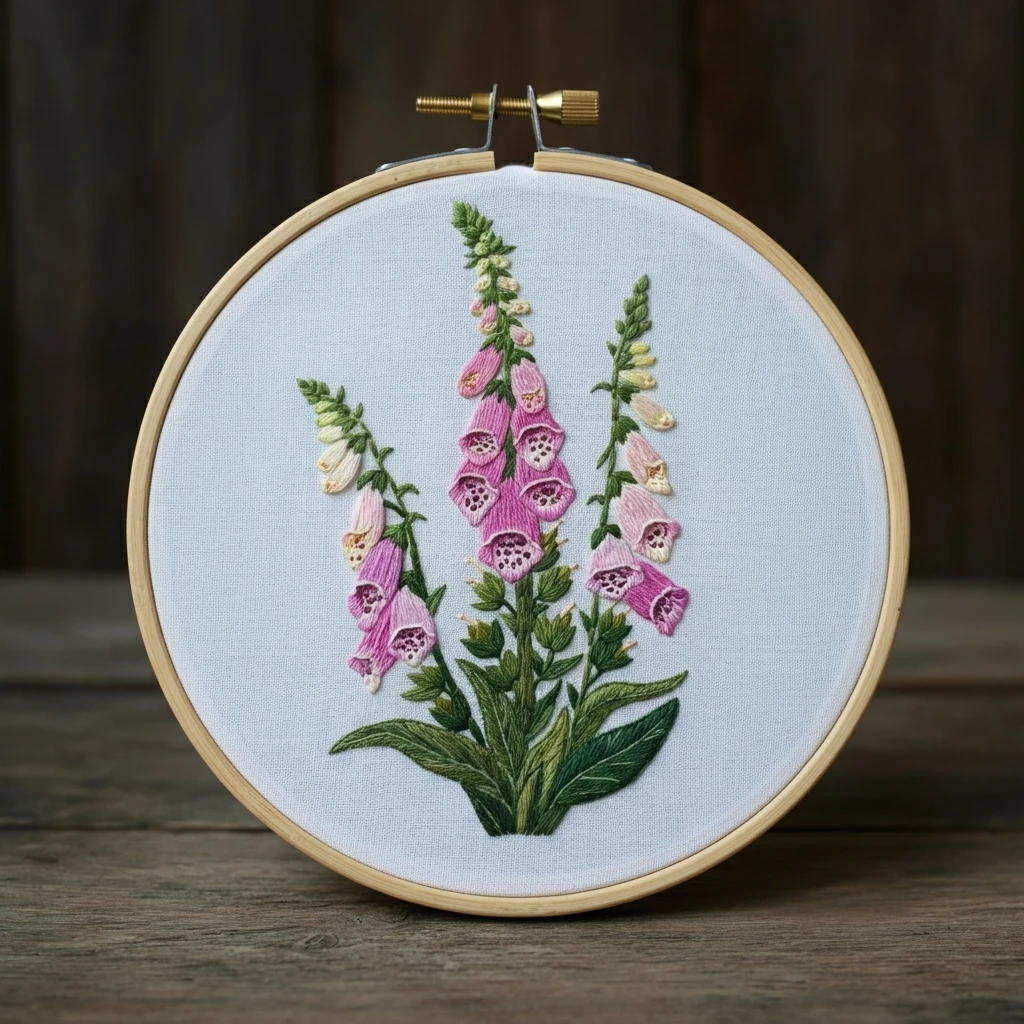
Realistic Foxglove
A polished stitching guide inspired by the reference hoop: tall green foxglove spikes with drooping bell-shaped blossoms, creamy buds, deep pink throats, speckled interiors, and layered dark leaves on a pale linen ground. The embroidery goal is botanical realism with soft petal translucency and crisp garden texture.
Color focus
Rose-pink bells, burgundy throat shadows, ivory spotted interiors, yellow-cream buds, and layered blue-green foliage.
Suggested DMC Floss Palette
Use this as a practical working palette for a realistic foxglove. Keep the darkest burgundies inside the bell openings and under petal lips; save the palest pinks and creams for the upper blossom faces and buds.
Stitch Map & Texture Suggestions
Foxglove bells
- Outer petals: work long-and-short stitch from the rim inward, following each bell’s curve. Move from 902/915 in the tucked shadow to 3685, 3687, and 3688 on the rounded face.
- Bell lips: use padded satin stitch or closely packed split stitch so the lip looks raised. Add 3689 and 3865 along the brightest edge.
- Interior throats: fill with short directional satin stitches in 3865 and 677, then glaze with one strand of 3688 where the pink reflects inward.
- Speckles: add tiny French knots, seed stitches, or single straight stitches in 814 and 902. Keep them irregular and concentrated near the throat.
Stems, buds & leaves
- Main stems: stem stitch with 895, then couch or whip one side with 3347 for a lit edge.
- Buds: padded satin stitch in 677 and 3865, with 3828 at the base and 3013 for green sepals.
- Leaves: use fishbone stitch on larger lower leaves, alternating 890, 895, and 699 to create ribbed botanical texture.
- Small top leaves: one-strand straight stitches in 3347 and 3013 keep the upper spike light and delicate.
Thread Counts, Blending & Shading
| Area | Recommended strands | Practical notes |
|---|---|---|
| Petal faces | 1 strand for realism; 2 strands for faster coverage | Blend 3685 + 3687 for rich pink, then feather in 3688 and 3689. Keep stitch direction curved around each tubular bell. |
| Bell throats and dots | 1 strand | Use 902 and 814 sparingly. Too many dark dots can flatten the flower; cluster them near openings and leave some pale breathing room. |
| Cream interiors and buds | 1-2 strands | Use 3865 as the clean highlight, 677 for warmth, and 3828 for the smallest tan shadows at sepals and recesses. |
| Stems and fine leaves | 1 strand | Fine stems look best in stem stitch or split back stitch. Add small breaks of 3347 on the light side instead of outlining the whole stem. |
| Large leaves | 2 strands for body, 1 strand for veins | Build dark-to-light from the base outward. A final single-strand vein in 3013 or 3347 gives crisp natural structure. |
Suggested Stitching Order
Lay the green structure
Begin with the main stems and lowest leaves so the floral bells can sit naturally on top. Keep lower leaves darker and denser.
Block petal shadows
Place 902 and 915 in the deepest bell throats and underside folds before adding the main pinks. This preserves the 3D form.
Fill petals directionally
Work long-and-short stitch in curved rows, letting colors overlap slightly. Avoid hard stripes by staggering each shade.
Add lips and interiors
Use 3865 and 677 for the cream openings; pad the lip lightly where the flower curls toward the viewer.
Speckle and refine
Add irregular dots last with one strand. Then sharpen key edges with split stitch only where contrast is needed.
Final highlights
Place a few single-strand 3689, 3865, and 3013 stitches on the brightest petal rims, buds, and leaf tips.
Outlining & Finishing Details
Outlining guidance
- Use split stitch rather than backstitch for most petal edges; it blends into long-and-short shading more naturally.
- Outline only the shadowed side of a blossom with 915 or 902, not the entire bell, to avoid a cartoon effect.
- For pale bell rims, use 3689 or 3865 with tiny broken stitches so the edge looks soft and curled.
- Separate overlapping leaves with 890 placed in short, tucked strokes at the base.
Beginner-friendly tips
- Work one flower bell at a time from dark to light; completing a single bell helps you understand the shading pattern.
- Use a sharp needle and short lengths of floss, especially for one-strand long-and-short stitch.
- If the speckles feel intimidating, mark a few dot positions with a removable fabric pen and stitch them after all filling is complete.
- Step back often: foxglove realism depends more on overall value placement than perfect individual stitches.
Texture tip: For a soft botanical finish, combine smooth satin lips with slightly irregular long-and-short petal bodies and ribbed fishbone leaves. This contrast makes the bell flowers feel velvety while the foliage stays crisp.