
DMC Palette & Stitching Notes
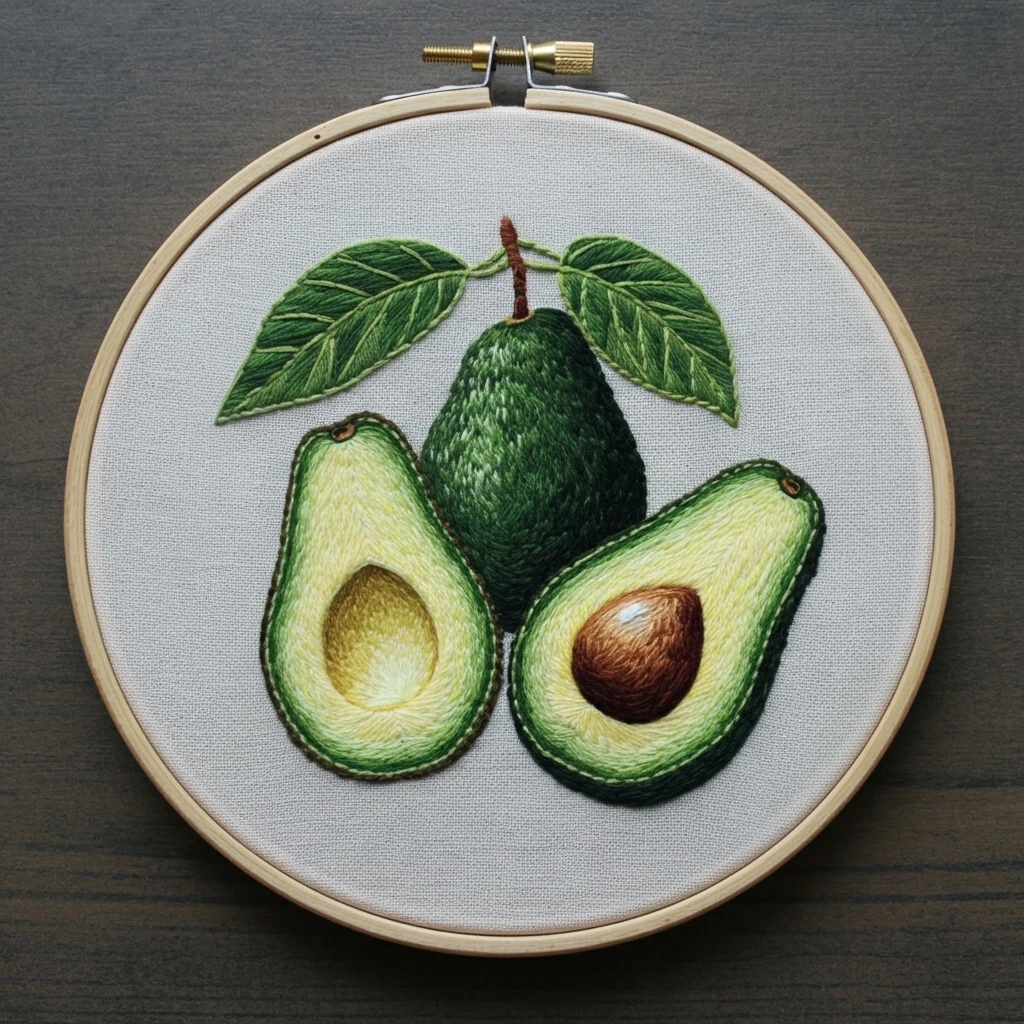
Realistic Whole and Sliced Avocados
A dimensional avocado study with a dark pebbled whole fruit, two creamy sliced halves, a glossy raised stone, branching leaves, and quiet linen negative space. The design depends on smooth green-to-yellow blending, curved stitch direction, crisp dark rind edges, and small textured marks that suggest bumpy avocado skin without overwhelming the soft flesh.
Color read from the design
The reference shows deep blue-green rind on the whole avocado, brighter mossy highlights on its textured surface, pale yellow-green flesh in the sliced halves, a warm brown pit with a small glossy highlight, and leaves in forest green with light yellow-green veins.
Stitch map and technique suggestions
Avocado flesh
Use long-and-short stitch with 1–2 strands. Work from the peel toward the pit so the stitches radiate naturally. Keep DMC 746 and 3823 closest to the brightest center, then blend outward through 734, 472, 471, and 469.
Dark rind edges
Use split stitch or whipped backstitch around the peel with 367, 895, and tiny touches of 934. Let the outline vary in weight: thick and shadowed at the bottom, thinner and greener on the lit top edge.
Whole avocado skin
Block the form with curved long-and-short stitches in 469 and 367, then scatter small seed stitches, short straight dashes, and tiny detached chain marks in 470, 895, and 934 to create the pebbled texture.
Raised pit
Pad the oval with 2 strands before covering it in satin or closely packed long-and-short stitches. Use 3858 as the base, 420 for the warm highlight, 898 for the lower rim, and a single small 746 or 762 stitch for shine.
Leaves
Fishbone stitch works well for the leaves. Start at the central vein with 471 or 472, fill each side with 469 and 367, then add 895 along the far edge to make the leaves recede behind the fruit.
Stem and branch
Use wrapped stem stitch or compact slanted satin in 898, 420, and 3858. Keep the branch slightly raised so it visually sits in front of the linen but behind the leaves.
Thread-count and blending guidance
1 strand
Best for final flesh feathering, bumpy skin speckles, leaf veins, pit cracks, and delicate highlight strokes that should not look bulky.
2 strands
Use for most avocado flesh and leaf fill. Two strands give enough coverage while still allowing smooth color changes and curved thread painting.
3 strands
Reserve for padding under the pit or a slightly raised stem. Avoid heavy strand counts on the pale flesh because they can make the surface look ropey.
Beginner-friendly stitching order
Practical tips for a polished result
- Use directional stitches as shading. The sliced flesh should radiate toward the pit; the whole fruit should curve vertically around its pear shape.
- Keep pale floss clean. Wash hands before using 746, 3823, and 734, and use shorter thread lengths to prevent fuzzing.
- Do not over-outline the flesh. A heavy dark ring can flatten the avocado. Let the lower edge be darkest and the upper edge stay green and soft.
- Build texture after the base fill. Skin speckles look best when added on top with single strands rather than mixed into the first layer.
- Use a sharp needle for thread painting. It lets you split earlier stitches and blend the creamy green gradients smoothly.
- Press from the back only. Place the embroidery face down on a towel so the raised seed and pebbled rind keep their dimension.