
Romantic Floral Arch And Bouquet

Romantic Floral Arch And Bouquet - DMC Palette & Stitching Guide
DMC Palette & Hand Embroidery Notes

Romantic Floral Arch And Bouquet

A warm folk-floral composition with a peach center bloom, terracotta side foliage, olive sprigs, deep navy leaves, dotted berries, and a symmetrical bouquet silhouette that looks elegant when stitched with clean directional texture.
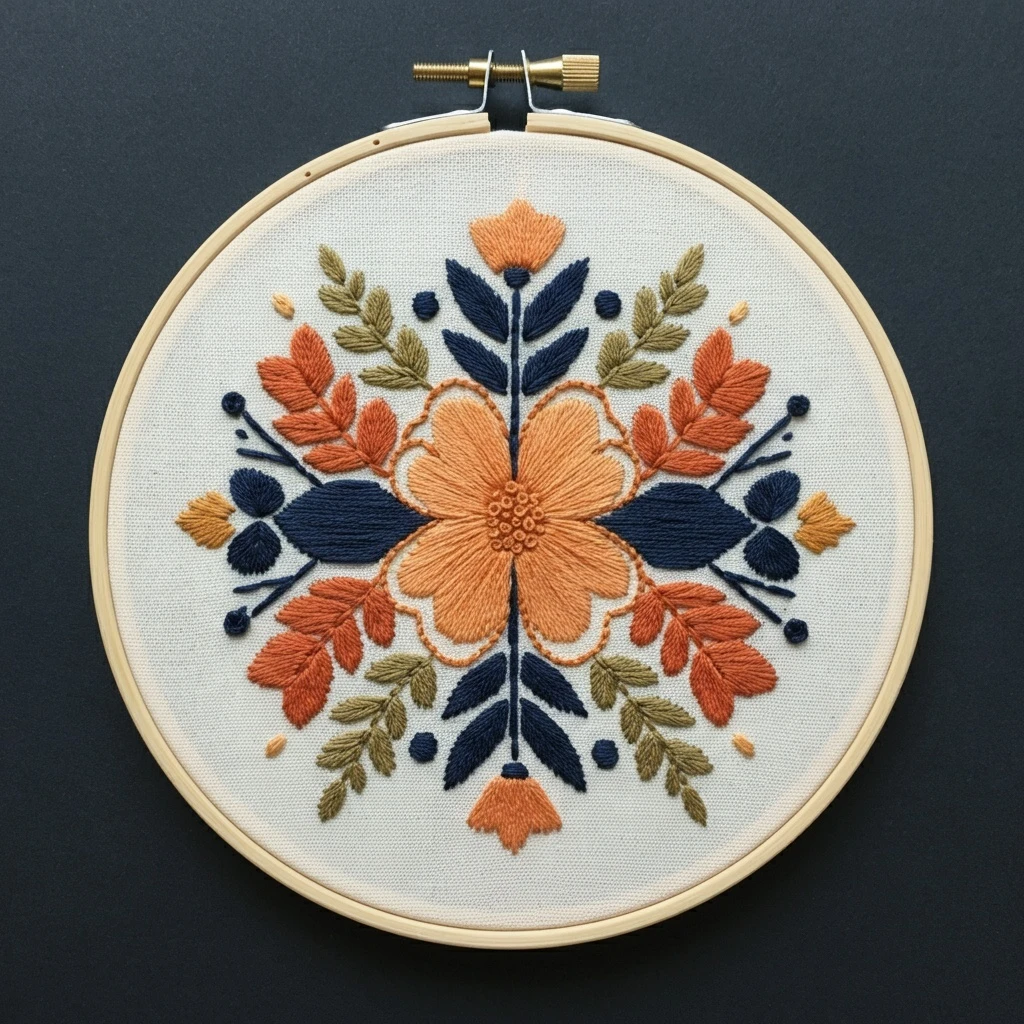
Romantic Floral Arch and Bouquet

Design read

This pattern is built around a large soft peach flower framed by mirrored navy leaves, rust-orange leaf sprays, muted olive greenery, small golden accents, and dark berry dots. The charm comes from the contrast: airy cream fabric, bold blue structure, and warm coral-to-copper florals.

Keep the center bloom smooth and radiant, then let the surrounding leaves carry more ribbed stitch direction. A slightly raised center and crisp navy stems will help the bouquet look balanced rather than busy.

Main moodRomantic, symmetrical, folk-inspired floral bouquet.
Key contrastDeep navy leaves against warm peach and terracotta petals.
Best fabricNatural linen, ivory cotton, or cream cotton-linen blend.

Suggested DMC color palette

Use this as a practical thread-shopping palette. The design can be stitched beautifully with 8-10 colors; add the optional shades if you want extra shading in the flower and leaves.

DMC 3856 - Mahogany Ultra Very Light
Soft peach-orange
Main central flower fill, top and bottom bell flowers, and warm petal highlights.
DMC 722 - Orange Spice Light
Clear warm coral
Petal edges, flower base shadows, and blended transitions with 3856.
DMC 921 - Copper
Terracotta copper
Side leaf clusters and deeper warm foliage; excellent for satin-stitch veins.
DMC 920 - Copper Medium
Burnt rust shadow
Use sparingly at leaf bases and underside shadows to give the orange sprigs depth.
DMC 823 - Navy Blue Dark
Inky navy
Bold leaves, stems, berry dots, outlines, and anchoring details.
DMC 939 - Navy Blue Very Dark
Blue-black depth
Deepest leaf bases, tiny berry centers, and selective outline accents where contrast is needed.
DMC 3011 - Khaki Green Dark
Muted olive
Primary green sprigs; stitch each leaflet from base to tip for a natural ribbed look.
DMC 3012 - Khaki Green Medium
Soft olive highlight
Upper leaflet highlights and blended green stems when the wreath needs more light.
DMC 3820 - Straw Dark
Golden ochre
Small side buds, warm flower-center rings, and decorative gold accents.
DMC 712 - Cream
Ivory highlight
Optional petal glints, center knots, or softening blends on cream fabric.

Stitch plan by design area

Center flower

Long & short satin shading

Work each petal from the outer edge toward the center using 2 strands. Blend 3856 with touches of 722 near petal folds. Keep stitch angles radiating like sunbeams so the bloom stays soft and rounded.

Flower outline

Split stitch or stem stitch

Use 722 for the scalloped outline. Split stitch gives a fine illustrated edge; stem stitch gives a corded folk-art line. Use 1-2 strands so the outline does not overpower the fill.

Flower center

French knots + tiny rings

Make clustered French knots with 3820, 722, and a few 920 shadows. Wrap once for small dots or twice for a raised seed texture. Keep knots close but not stacked.

Navy leaves

Fishbone stitch

Use 823 with a few 939 stitches at the leaf base. Fishbone stitch creates the center vein automatically and suits the bold dark leaves in the design.

Rust foliage

Satin stitch leaves

Stitch the terracotta leaves individually with 921, adding 920 at lower edges. Change stitch direction on every leaflet to mimic the photo's lively embroidered texture.

Olive sprigs

Detached leaf or lazy daisy

For small leaflets, use detached chain with 3011 and a straight stitch vein in 3012. This is quick, beginner-friendly, and gives the greenery a delicate wreath effect.

Thread-count and blending guidance

Petal fills: Use 2 strands for the central flower and larger orange leaves. For a smoother, more painterly fill, stitch with 1 strand and work more rows.
Outlines and stems: Use 1 strand for delicate inner outlines and 2 strands for the main navy stems. Keep stem stitch tension even so the mirrored bouquet stays crisp.
Berries and dots: Use 2 strands for French knots. For larger navy berries, make a small padded satin circle or cluster three knots tightly together.
Blending: Thread one strand of 3856 with one strand of 722 for transitional peach-coral petals. Blend 3011 + 3012 for softer olive sprigs, and 823 + 939 for very dark leaf bases.
Fabric scale: On a 6-inch hoop, 2 strands will look close to the reference. On a smaller hoop, reduce stems and outlines to 1 strand to avoid crowding.

Texture and shading tips

  • Keep symmetry first: Stitch the central vertical navy stem, then alternate left and right sections so color density stays balanced.
  • Pad only the focal points: Add one layer of straight stitches under the central flower center and the largest navy leaves before satin stitching if you want a plush raised look.
  • Vary leaf direction: The design looks handmade and dimensional when every leaflet has its own stitch angle, especially in the rust and olive sprays.
  • Outline last: Complete fills first, then add the peach scalloped outline and navy stem lines at the end for a clean graphic finish.

Beginner-friendly workflow

1. Transfer lightly: Use a fine water-erasable pen. Mark petal direction lines only where helpful, not every fill stitch.
2. Start in the center: Stitch the flower center and central bloom first, then work outward to the navy leaves and side foliage.
3. Use short thread lengths: Cut floss around 14-16 inches to reduce fuzzing, especially with dark navy and rust shades.
4. Rotate the hoop: Turn the hoop as you stitch so satin and fishbone stitches always pull comfortably in the direction of the leaf or petal.
5. Press from the back: After removing transfer marks, let the fabric dry flat and press face-down on a towel to protect the raised knots and satin texture.
Romantic Floral Arch And Bouquet - DMC palette and stitching suggestions for hand embroidery.

Leave a Reply

Your email address will not be published. Required fields are marked *