
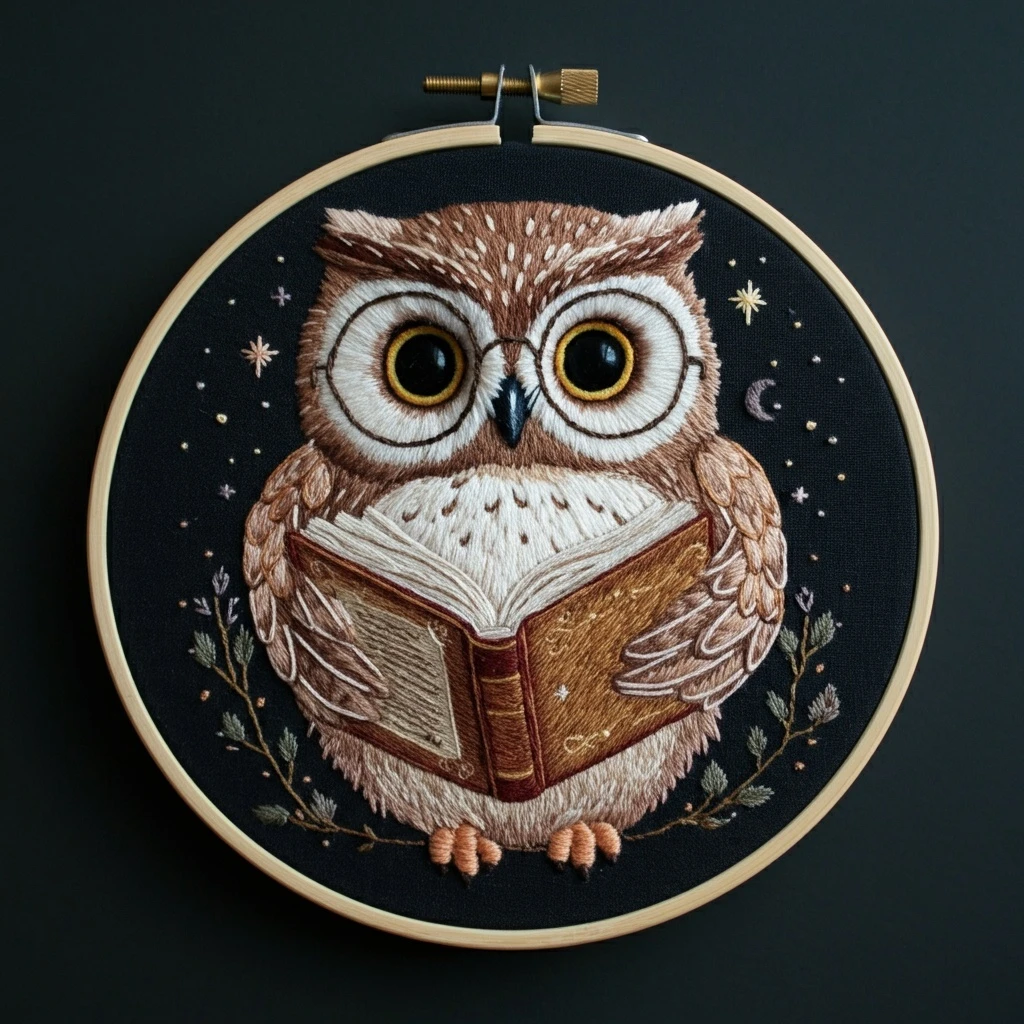
Scholarly Owl
A polished embroidery-planning page for a wise woodland owl motif with layered tawny feathers, bright attentive eyes, academic book-and-parchment details, and warm rustic shading suitable for a hoop display.
Suggested DMC Color Palette
Use this as a practical thread map rather than a strict formula. The owl reads best when the browns shift gradually from dark outline to mid-feather warmth to pale facial highlights.
Deep pupils, beak creases, wing separations, talon tips, and the strongest final outlines.
Main shadow brown for underside feathers, book-edge shadows, and textured branch details.
Warm owl body midtone, outer wings, ear tufts, and rustic autumn warmth.
Chestnut feather accents, warm cheek markings, and lively strokes through the breast.
Amber eye rings, golden book trim, and light-catching strokes on feather tips.
Soft facial disk shading, lighter belly feathers, and page edges.
Parchment pages, cream highlights around the face, and tiny reflective touches near the eyes.
Brightest facial highlights, page highlights, and small separation stitches where beige areas need lift.
Iris glow, decorative book corners, and small golden scholarly accents.
Catchlights and the brightest golden flecks; use sparingly so the eyes stay expressive.
Muted leaf, moss, or background foliage details without pulling focus from the owl.
Spectacles, tiny ink lines, title marks, and subtle cool contrast in deepest shadows.
Stitch Types by Design Area
Keep the owl soft and dimensional by changing stitch direction with the form: feathers radiate downward, facial disk stitches curve around the eyes, and book stitches stay straighter and flatter.
Feather layering
Use short-and-long stitch with 1–2 strands. Work from DMC 3371/801 shadows into 975, 920, 436, and 739 highlights. Vary stitch length so the feather surface does not look striped.
Facial disk
Use satin stitch or closely placed split stitch in a curved direction around each eye. Blend 739 with 436, then add 712 on the highest brow and cheek highlights.
Eyes and beak
Use padded satin for the iris with DMC 783 and 725, one strand of 3371 for pupils, and a tiny 712 catchlight. The beak works well in split stitch using 975 shaded with 801.
Book and pages
Use stem stitch for book outlines, satin stitch for small covers, and straight stitches for page lines. Keep page marks in one strand so they remain delicate.
Branch and claws
Use stem stitch, split stitch, or whipped backstitch in 801 and 3371. Add random straight-stitch bark marks in 975 and 436 for rustic texture.
Fine scholarly details
For glasses, scroll lines, book titles, and tiny accents, use a single strand of 3799 or 3371 in backstitch. Stitch slowly and keep curves short.
Thread-count guidance
- 1 strand: pupils, glasses, page lines, tiny book marks, delicate feather veins, and all facial outlining.
- 2 strands: most feather fill, book covers, branch texture, and medium outlines.
- 3 strands: only for bold outer silhouette, heavy branch areas, or decorative accents that need raised definition.
- Padded areas: use a low underlayer for the eyes and beak, then cover with smooth satin stitches.
Blending & shading ideas
- Blend one strand DMC 801 with one strand DMC 975 for natural feather shadow transitions.
- Blend DMC 975 + 920 for warm chestnut areas across the wings and breast.
- Blend DMC 436 + 739 for soft beige facial shading without harsh color jumps.
- Place DMC 725 only at the inner eye highlight or gold trim; too much will flatten the focal glow.
Texture, Outlining & Practical Tips
The charm of a scholarly owl comes from contrast: soft layered feathers beside neat academic details. Use texture where the design is organic and precision where the design is symbolic.
Feather texture
Add scattered single-strand straight stitches over filled areas using 920, 975, and 436. Keep them uneven and directional for a natural plumage effect.
Clean outlines
Use split backstitch for the owl silhouette, then add selective darker accents only under wings, beneath the chin, and where the book overlaps the body.
Soft face shading
Do not outline every facial highlight. Let 739 and 712 meet softly, then use just a few 801 stitches near the brow to define expression.
Bookish details
For page texture, use one strand and leave tiny gaps between stitches. Slightly uneven page lines look more handmade and less rigid.
Hoop management
Because browns can muddy together, park darker threads away from cream areas and wash hands before stitching the light facial disk or pages.
Finishing polish
After stitching, lightly steam from the back over a towel. Avoid crushing padded eyes or raised branch stitches.