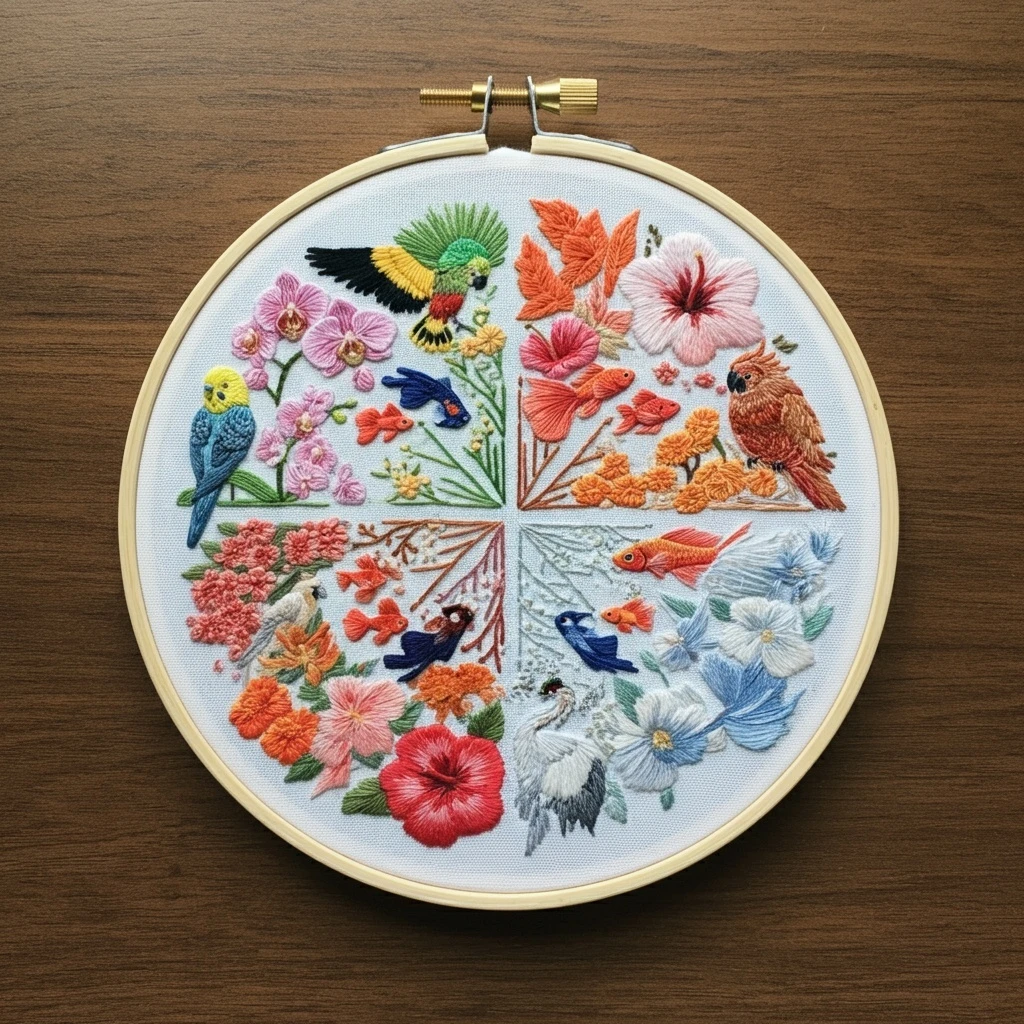

Seasons of Life: Nature's Harmony
A balanced hoop sampler divided into four seasonal quadrants: spring blossoms and budgerigar blues, summer greens and gold birds, autumn maple leaves and orange fish, and wintery pale florals with cranes and cool water tones. Use this guide to choose floss, plan texture, and keep the design lively without overcrowding the center.

Design read: the image is organized like a circular seasonal wheel, with strong radial stems and branches meeting at the center. The most important visual contrast is warm coral/orange autumn against cool blue-white winter, softened by spring pinks and fresh greens.
Stitching approach
Treat each quadrant as a miniature scene, but keep thread thickness consistent so the sampler feels unified. Work pale background details first, then stems/branches, then flowers and animals, and save dark beaks, eyes, outlines, and centers until the end.
Suggested DMC floss colors
These selections match the visible seasonal motifs: soft pink orchids, red hibiscus-like blooms, orange leaves and fish, golden birds, leafy greens, blue feathers, pale winter flowers, grey cranes, and warm brown branch outlines.
Keep each quadrant distinct
- Use brown stem stitch for the central cross and main branch lines so the wheel reads clearly.
- Repeat a small amount of green in every quadrant to tie the design together.
- Balance bright reds and oranges by placing them in small, separated areas instead of filling every motif heavily.
Strand guidance
- 1 strand: eyes, beaks, tiny fish mouths, flower veins, crane legs, and final definition lines.
- 2 strands: most stems, leaves, petals, wing feathers, and fish bodies.
- 3 strands: raised flower clusters, autumn leaf fills, large red blossom petals, and textured orange blooms.
- 4 strands only if needed: French knot clusters or very bold foreground flower centers; test first to avoid bulky knots.
Recommended stitch types by design element
Radial branches & stems
Use stem stitch or split stitch with DMC 898, 699, and 3348. Keep the central joins neat by ending threads just before the hub, then covering the join with a tiny satin dot or French knot.
Large flowers
Use long-and-short stitch for red, pink, and pale blue petals. Shade from DMC 3865/963 on the outer edges into 605, 321, or 814 near the throats.
Small blossoms
Try lazy daisy stitches for simple petals, French knots for centers, and small straight stitches for pollen. Use 2 strands for petals and 1 strand for veins.
Bird feathers
Layer short straight stitches following the feather direction. Blend 3760 with 823 for blue birds, 743 with 699 for the green-yellow bird, and 900 with 898 for warm brown feathers.
Fish & fins
Satin stitch the bodies in 741 or 321, then add 1-strand fin lines in 900 or 814. Leave tiny fabric gaps or add 3865 highlights to suggest shine.
Crane & pale feathers
Use loose long-and-short stitches in 3865, 3753, and 318. Keep stitches directional and slightly broken so the feathers look soft rather than flat.
Color transitions that suit the image
- Pink flowers: blend 963 + 605 in the needle for mid-tones; add single 814 or 321 stitches only at the deepest center lines.
- Red focal blossom: start with 321, shade petal bases with 814, and add fine 3865 or 963 edge highlights for dimension.
- Autumn leaves: mix 741 + 900 for glowing orange; add 898 at stems and fold lines for rustic definition.
- Blue birds: use 3760 for body fill, 823 for wing tips and eyes, and tiny 3753 stitches for feather shine.
- White/blue winter flowers: keep most stitches pale with 3865, then use 3753 and 318 sparingly to define petal folds.
Clean finishing lines
- Outline major petals with 1 strand split stitch in a slightly darker related color, not black.
- Use DMC 898 for branch structure, but reserve DMC 310 or very dark navy only for tiny eyes and the deepest wing marks.
- Backstitch around fish and small birds after filling them so outlines sit cleanly on top.
- For the central meeting point, avoid crossing too many threads; stitch each quadrant toward the middle and bury ends on the back.
Make the sampler feel hand-rendered
Raised flower clusters
Use French knots and colonial knots in 605, 321, 741, and 743. Vary strand count and knot wraps to create natural clusters.
Leaf ribbing
Fill leaves with satin stitch, then add a 1-strand straight stitch vein in 699 or 898. Angle side veins outward from the stem.
Feather direction
Do not outline every feather. Instead, overlap small stitches in rows, changing color every few stitches for lively texture.
Practical tips before you start
- Transfer lightly: use a fine washable pen or pencil; the design has many small lines, so heavy transfer marks may show through pale winter flowers.
- Stitch in layers: background stems first, then leaves, then flowers/animals, then final knots, eyes, and outlines.
- Rotate the hoop: turn the hoop as you work each quadrant so satin and long-and-short stitches always follow the motif direction comfortably.
- Control tension: avoid pulling tightly on long satin stitches, especially in the center wheel and pale petals, to prevent puckering.
- Test blends: make a small sampler strip with 963+605, 741+900, 3760+3753, and 3865+318 before committing to the final hoop.
- Finish gently: press face-down on a towel after washing so raised knots and feather textures stay dimensional.