
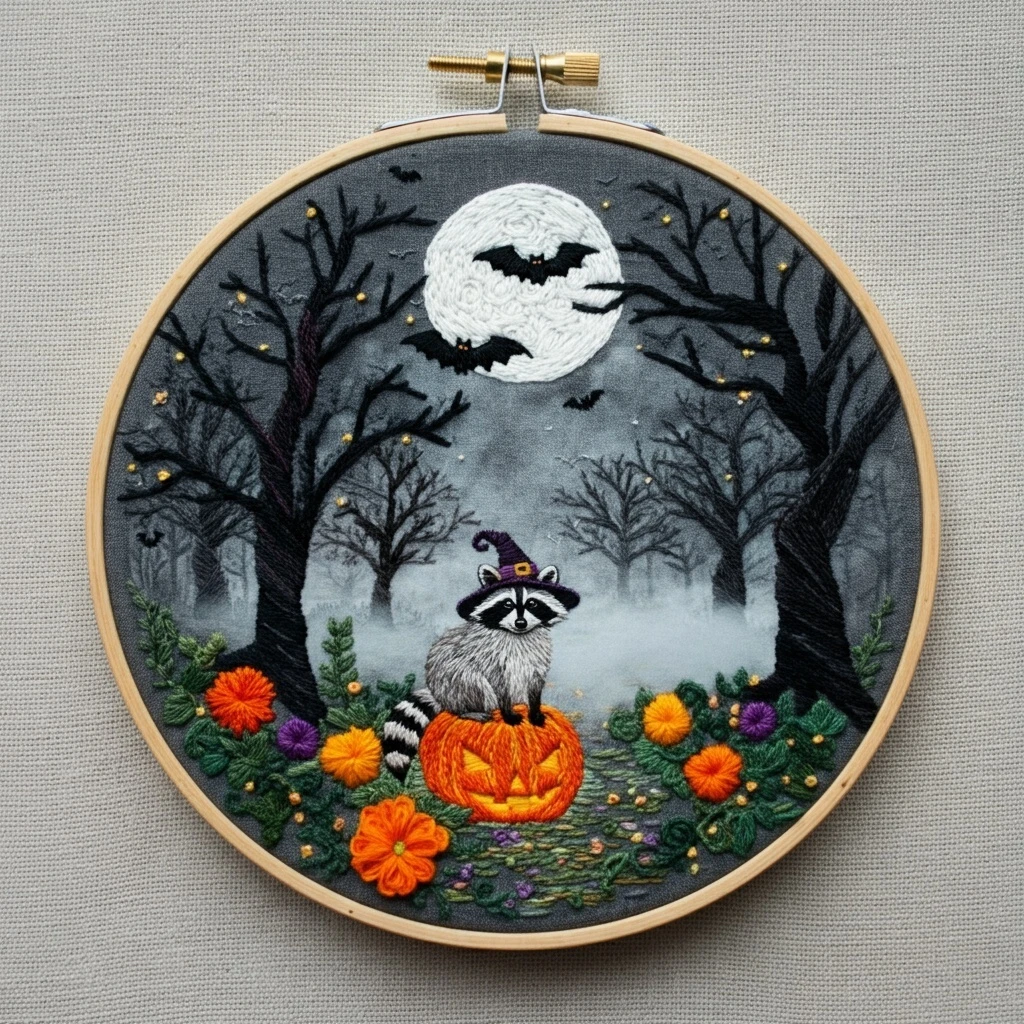
Spooky Raccoon Halloween
A moonlit forest hoop with bare black trees, drifting fog, bats, tiny golden lights, autumn flowers, a glowing jack-o'-lantern, and a masked raccoon in a tiny witch hat. The palette should feel smoky and nocturnal, with bright pumpkin-orange and marigold accents keeping the scene playful rather than gloomy.
Halloween woodlandglowing pumpkinfurry raccoon texturemisty background
Full moon, black silhouettes, silver-gray fog, orange pumpkins, purple flowers, and deep green ground cover.
Color Story
The design is built around strong value contrast: a dark blue-gray night sky, nearly black tree silhouettes and bats, a creamy textured moon, a gray-and-white raccoon, and saturated orange/yellow flowers and pumpkin highlights. Keep the background subdued so the raccoon face, pumpkin glow, and moon stay crisp and readable.
Tree trunks, branch tips, bats, raccoon mask, deepest pumpkin cuts. Use sparingly for clean drama.
Night-sky shadows, soft tree distance, raccoon body shadows, branch texture blended with black.
Mid-gray sky, raccoon fur base, pathway stones, distant trunks softened with one strand.
Fog banks, raccoon cheek shading, cool highlights around the moonlit path.
Full moon, raccoon face stripes, eye shine, lightest mist. Mix with 318 for a moonlit gray-white.
Warm moon ridges, tiny highlights in the pumpkin face, softened stars over dark fabric.
Main pumpkin body, orange flowers, warm accents. Ideal for satin and long-and-short shading.
Pumpkin grooves, flower shadow petals, lower pumpkin edge, and the deepest orange folds.
Marigold flowers, pumpkin glow, candle-like dots, and bright centers on orange blossoms.
Firefly dots, star knots, hat buckle, and golden flecks among leaves.
Deep foliage mass, dark leaf undersides, shadowed path edges, and evergreen stems.
Leaf mid-tones, fern sprigs, moss on the forest floor, and path texture.
Muted leaf highlights and background shrubs where bright green would look too cheerful.
Witch hat shadows, purple flowers, and optional cool shadows in tree bark.
Flower highlights and the curled hat tip; blend with 550 for dimensional purple.
Raccoon warm shadows, branch undertones, pumpkin stem, and neutral path details.
Element-by-Element Stitch Plan
| Design area | Recommended stitches | Thread guidance |
|---|---|---|
| Full moon | Whipped back stitch spirals, split stitch rings, or tight stem stitch curves following the circular grain. | 2 strands of 3865; add occasional 746 and 318 to avoid a flat white disk. |
| Bats | Tiny satin stitch wings with a single straight-stitch body; back stitch for small distant bats. | 1-2 strands of 310. Keep wing edges sharp and avoid bulky knots. |
| Dark trees | Stem stitch or split stitch trunks, couching for heavy curved limbs, single-strand back stitch for fine branches. | 3 strands for foreground trunks, 1 strand for distant branches; blend 310 + 3799 for bark depth. |
| Fog and sky haze | Loose horizontal long-and-short stitches, seed stitch, or very light couching with widely spaced threads. | 1 strand of 318, 414, or 3865; keep stitches airy so the fabric color can show through. |
| Raccoon fur | Short-and-long stitch, split stitch fur strokes, and directional straight stitches that follow the chest and tail curves. | Use 1 strand for fine fur. Alternate 414, 318, 3799, 839, and 3865; do not fill every area solidly. |
| Raccoon face and tail rings | Satin stitch for white facial patches, back stitch for mask lines, short straight stitches for tail bands. | Use 3865 for white areas, 310 for mask and rings, with 318 as a soft transition. |
| Witch hat | Satin stitch or padded satin for the hat body; stem stitch for the curled tip; tiny satin rectangle for buckle. | 2 strands of 550/552; buckle in 725. Outline the brim with 310 for definition. |
| Jack-o'-lantern | Long-and-short stitch on curved pumpkin sections, satin stitch for glowing eyes/mouth, split stitch grooves. | Base 947, shadows 900, glow 972/725. Use 310 only inside the deepest cut lines. |
| Flowers and leaves | Lazy daisy, woven wheel, satin petals, fishbone leaves, detached chain leaves, French knot centers. | 2-3 strands for foreground blooms; 1-2 strands for smaller leaves and background greenery. |
| Path and ground | Seed stitch, fly stitch, tiny straight stitches, and scattered French knots for stones, moss, and fallen petals. | Mix 895, 469, 3011, 414, 839, and small flecks of 725/947. |
Shading & Blending Ideas
- Raccoon fur: Work in small directional strokes rather than rows. Blend one strand 414 with one strand 318 for middle fur, then add single-strand 3799 in the shadowed belly and under the chin.
- Pumpkin glow: Place 972 near the carved face and top ridges, 947 through the main sections, and 900 along grooves and lower edges. A few tiny 725 straight stitches can imitate reflected light.
- Moon texture: Stitch the moon in curved paths. Switching between 3865 and 746 gives a hand-worked crater effect without needing many colors.
- Forest depth: Foreground trees should be bold with 3 strands; background trees should be thinner and grayer with 1 strand of 3799 or 414.
Outlining Details
- Outline the raccoon mask, ears, paws, pumpkin cuts, and hat brim with one strand of 310 for control.
- Use whipped back stitch on the pumpkin outline if you want a smooth cartoon edge.
- Keep the tiny face features minimal: two small black stitches for eyes, a short vertical nose line, and a soft split-stitch muzzle.
- For branches crossing the moon, use crisp 310 back stitch so they read as silhouettes against the pale circle.
Thread Counts
Use 1 strand for fur texture, distant trees, fog, and small facial details. Use 2 strands for the moon, raccoon body fill, hat, pumpkin grooves, and most leaves. Use 3 strands only for foreground tree trunks, bold flowers, and the brightest pumpkin sections.
Texture Suggestions
Combine woven wheel flowers with French-knot centers, fishbone leaves, and seed stitch ground cover. For the raccoon tail, stitch each ring with short strokes rather than satin bands so the tail still looks furry.
Fabric & Hoop Notes
A medium charcoal, smoky gray, or tea-dyed linen/cotton makes the whites and oranges shine. If using pale fabric, add more 414 and 3799 sky stitching behind the moon and trees to preserve the nighttime effect.
Beginner-Friendly Practical Tips
- Start with the moon and main tree silhouettes, then stitch the raccoon and pumpkin. Save flowers, stars, and tiny gold dots for last so they stay clean.
- Use shorter lengths of black floss for trees; dark thread can look fuzzy when dragged repeatedly through fabric.
- When stitching over dark fabric, mark the moon, raccoon face, and pumpkin with a removable light pencil or white transfer pen.
- For the fog layer, do not overfill. Sparse stitches create a better mist effect than solid gray bands.
- Anchor thread tails carefully behind dark areas so they do not shadow through the pale moon or raccoon face.
- Use a sharp needle for dense satin areas and a slightly larger needle for woven flowers or padded sections.
- French knots in 725 can become fireflies, flower centers, or magical sparks around the forest floor.
- Step back often. The design relies on contrast, so check whether the raccoon face and pumpkin remain visible from a distance.