
DMC palette & hand embroidery guide
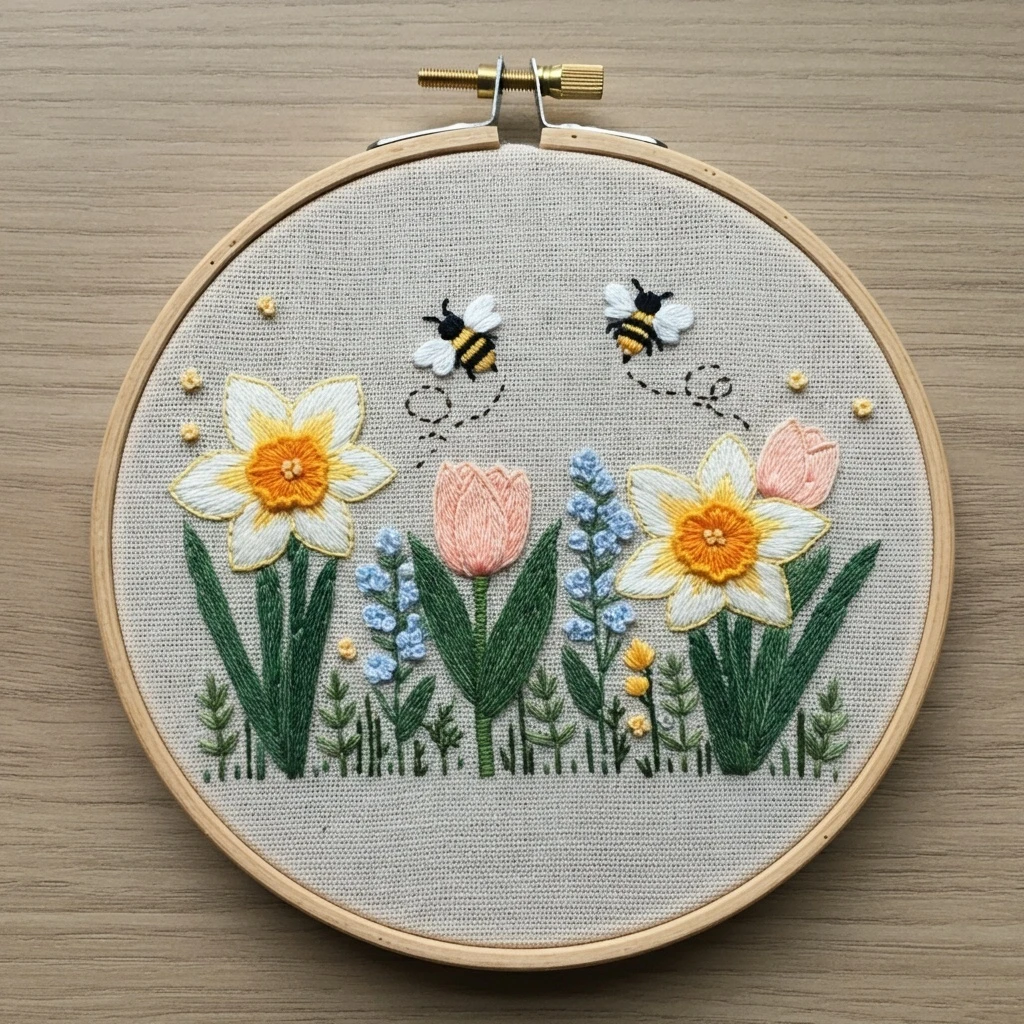
Spring Garden
A cheerful hoop with daffodils, tulips, blue grape-hyacinth style blooms, fresh green grasses, tiny yellow buds, and two buzzing bees. The palette is bright but gentle: creamy petals, golden flower centers, peach-pink tulips, soft sky blue blossoms, deep spring greens, and crisp black-and-yellow bee stripes.
Likely DMC Color Palette
Colors are estimated from the visible stitched sample and matched to practical DMC floss choices. Use these as close equivalents, adjusting one shade lighter or darker if your fabric is very warm, grey, or bright white.
Use for the main pale petals and wing highlights; keep stitches smooth and directional so the white areas do not look flat.
Add near the base of daffodil petals and around petal edges for the soft yellow tint visible in the sample.
Perfect for the golden flower trumpets, tiny yellow buds, and clean bee bands.
Blend into the center of each daffodil for orange-gold depth; also useful for slightly darker knot accents.
Use as the main tulip fill, especially on petal tips and rounded outer shapes.
Add narrow shadow strokes inside tulips and along lower petal seams to create folded form.
Best for the small rounded grape-hyacinth blooms; combine with a darker blue for dimensional clusters.
Place at the base or lower edge of blue knots and buds for a gentle shaded effect.
Use sparingly for the darkest leaves, bee trails accents if desired, and the deepest base foliage.
A strong match for the rich vertical leaves around the daffodils and tulips.
Use for lighter grass, feathery stems, and the airy garden texture across the bottom.
Use one strand for dotted flight trails and antennae; two strands only for solid bee bodies.
Optional fabric note: on natural linen, the whites and pale yellows stay soft and springlike. On bright white fabric, consider swapping DMC 3865 for B5200 only on the bee wings, while keeping petals creamier.
Stitching Suggestions by Design Element
| Element | Suggested stitches | Practical notes |
|---|---|---|
| Daffodil petals | Long and short stitch, satin stitch, split-stitch outline | Work each petal from the center outward. Use 3865 for the main body, then add 745 near the base and a single-strand pale yellow outline for definition. |
| Daffodil trumpets | Woven wheel, padded satin, French knots | Build a raised golden center with 726, shade with 743 near the lower rim, and finish with tiny 743 or 3821 knots in the center. |
| Tulips | Long and short stitch, fishbone stitch, stem stitch for seams | Keep the stitch direction following the cup shape. Use 761 on the outer petal surfaces and 352 in the inner folds. |
| Large leaves | Fishbone stitch or long satin stitch | Start with a center vein and angle stitches toward it. Alternate 895 and 890 to avoid a flat block of green. |
| Grass border | Straight stitch, seed stitch, detached chain | Vary the height of grass blades. Use one strand for distant stems and two strands for foreground blades. |
| Blue flower spikes | French knots, colonial knots, tiny detached chain | Cluster 827 knots along the stem, then add a few 813 knots on the shadow side. Leave small spaces between knots for an airy spring look. |
| Tiny yellow buds | French knots, pistil stitch, small satin dots | Use 726 for bright buds. One-wrap knots look delicate; two-wrap knots create more raised pollen-like texture. |
| Bees | Satin stitch, split stitch, backstitch | Stitch black body segments first, then add yellow stripes over or beside them. Wings can be 3865 with one strand of pale blue shadow if you want transparency. |
| Bee flight trails | Running stitch or tiny backstitch | Use one strand of 310 and keep the dashes irregular. A dotted line looks lighter than a continuous curve. |
Thread Count, Blending & Shading Guidance
General strands
Use 2 strands for most flower petals, tulips, bee bodies, and medium leaves. Use 1 strand for outlines, flight trails, small stems, and fine grass.
Raised centers
Use 2 strands with padded satin or woven wheel centers for the daffodils, then finish with 1–2 wrap French knots for pollen texture.
Soft blending
For petal shading, blend one strand 3865 with one strand 745 at the base of white petals. For tulips, blend one strand 761 with one strand 352 in fold areas.
Leaf dimension
Use 895 as the main green, add 890 at the lower edges, and switch to 3363 for fine background herbs so the garden has depth.
Blue blossoms
Scatter darker 813 knots mostly on the lower-left side of each blue flower spike. This makes the clusters look rounded instead of like flat dots.
Outlining restraint
Outline only the most important shapes: daffodil edges, tulip seams, bee silhouettes, and a few large leaves. Too much outlining can make the spring design feel heavy.
Suggested Stitching Order
Work from anchor shapes to detail stitches so the design stays neat and the small bees and knots do not get snagged while you handle the hoop.
Start with stems and leaf centers
Mark the main vertical structure using stem stitch and center veins. This establishes the garden rhythm before filling petals.
Fill large flowers
Stitch daffodil petals and tulips next, keeping stitch direction consistent. Add flower centers only after petals are complete.
Add grasses and blue spikes
Layer straight stitches at the bottom, then build the blue blossom clusters with knots so they sit visibly on top of the greenery.
Finish with bees and accents
Stitch bee bodies, wings, flight trails, tiny yellow buds, and final outline touches last for crisp detail.
Beginner-Friendly Practical Tips
- Keep fabric drum-tight in the hoop; loose linen makes satin petals and bee stripes uneven.
- Use shorter thread lengths for black and yellow bee stripes so the colors stay clean and do not fuzz.
- When stitching long leaves, do not carry dark green thread behind pale petals; it may shadow through lighter fabric.
- For tidy daffodil petals, outline first with split stitch, then fill up to the outline with long and short stitch.
- Practice French knots on scrap fabric before working the blue flower clusters; consistent tension matters more than perfect size.
- Step back often. The bottom grass should feel lively and varied, not perfectly symmetrical.
Encouraging Finish
The charm of this Spring Garden design comes from contrast: smooth pale daffodil petals, rounded tulips, textured blue knots, lively grass, and playful bees. Build the garden in layers and save the tiny accents for the end; those final knots, wing highlights, and dotted flight paths will make the hoop feel fresh, dimensional, and full of movement.