
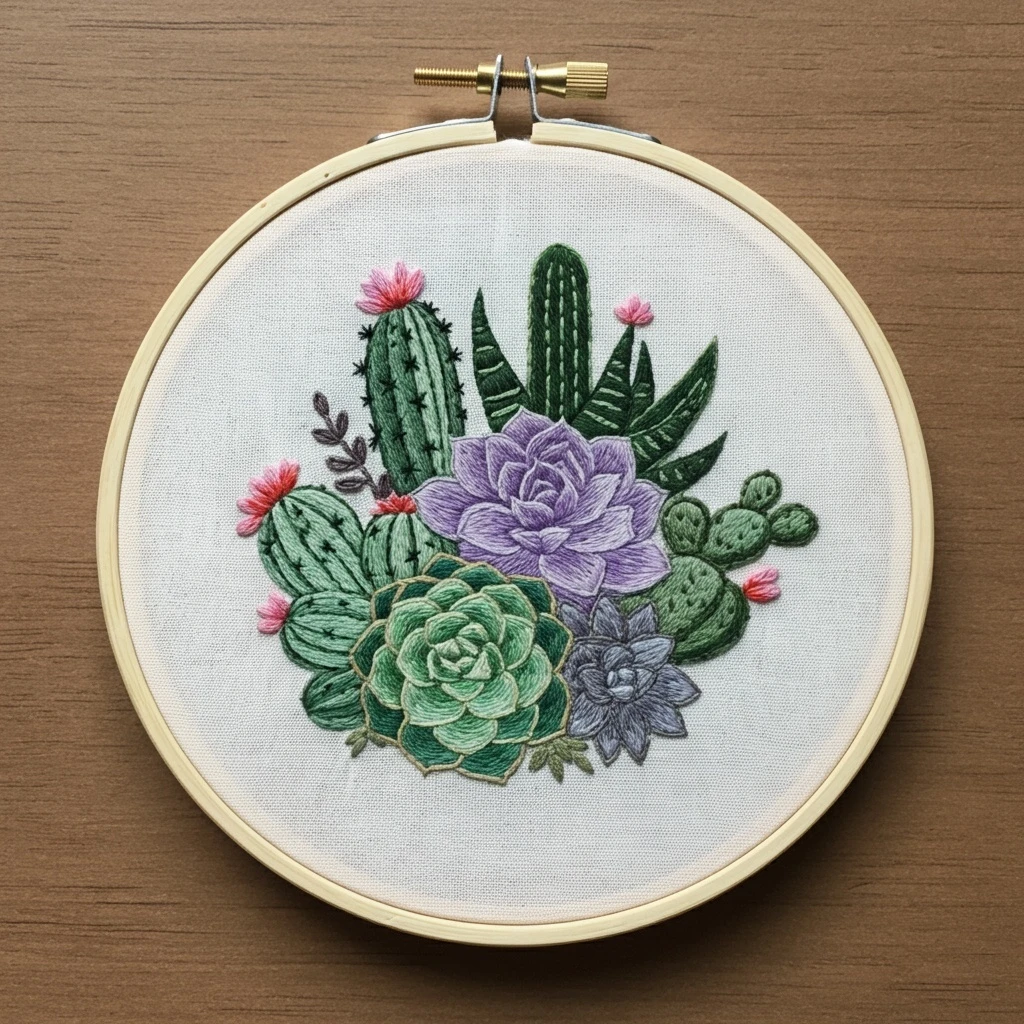
Succulent Cactus
A fresh desert-garden embroidery plan for plump cactus pads, clustered succulents, tiny blooms, terracotta warmth, and clean botanical outlines. Use this guide to choose floss, plan strand counts, and stitch texture that feels dimensional but beginner-friendly.
Design color read
The artwork is built around rounded cactus and succulent forms: deep green shadowed pads, sage and blue-green highlights, warm pot or soil accents, creamy flower centers, and small pink-coral blossoms. The palette should feel sunlit and natural rather than neon, with enough contrast to separate overlapping leaves and cactus lobes.
Use split stitch first
Outline cactus pads with 1 strand of DMC 895 or 3345 in split stitch. The split line gives a tidy edge that also guides satin or long-and-short fill inside the shape.
Direction matters
Work each succulent leaf from base to tip so the stitches mimic natural growth. Alternate 3052, 3364, and 472 on neighboring leaves for a layered rosette effect.
Keep flowers raised
Use detached chain petals or small satin petals in 963, then add one French knot in 3733 or 746. This gives the flowers a lifted accent against the matte greens.
Stitch suggestions by element
- Cactus pads: use long-and-short stitch for larger pads, blending 3345 into 3052 and finishing with narrow 472 ridge highlights.
- Cactus ribs: add curved stem stitch or whipped back stitch with 1 strand. Keep ribs slightly uneven so the plant feels organic.
- Spines: place tiny straight stitches or single-strand seed stitches in 746. Avoid overfilling; a few well-spaced spines look cleaner.
- Succulent rosettes: satin stitch each leaf separately, changing stitch angle on every leaf to make the cluster dimensional.
- Pot or base: use brick stitch, horizontal satin, or rows of split stitch in 3856 and 922 for a handmade terracotta texture.
- Soil pebbles: scatter French knots in 839, 922, and one strand of 3856 for a sandy, tactile base.
Blending & shading plan
For the green plant bodies, blend by families rather than by random stripes. Start each large shape with the darkest green tucked into the lower edge or overlap, bring the middle green into the center, and reserve the pale green for short top-edge strokes.
- Smooth cactus blend: 1 strand 3345 + 1 strand 3052 for a soft midtone; use pure 895 only at deepest contact shadows.
- Dusty succulent blend: 1 strand 3364 + 1 strand 472 for cool sunlit leaves.
- Warm pot blend: 1 strand 3856 + 1 strand 922 where the pot curves away from the light.
- Flower depth: place 3733 at the petal base and 963 toward the tips, using very short satin stitches.
Outlining details
Use outlines selectively. A full heavy outline can flatten the cactus, so outline the outer silhouette and main overlaps, then switch to lighter internal lines for ribs and leaf veins.
- Use 1 strand DMC 895 for the outermost cactus edge.
- Use 1 strand DMC 3052 or 3364 for inner leaf separations.
- Use 1 strand DMC 839 only where the pot or soil needs definition.
- For a softer botanical finish, whip dark outlines with a lighter green on the lit side.
Beginner-friendly workflow
- Transfer the full outline lightly; mark only the most important internal leaf divisions.
- Stitch the pot or ground first so the plant sits visually on a stable base.
- Outline major cactus pads next, then fill from dark edge to light edge.
- Work succulent leaves one at a time, rotating the hoop to keep stitch direction comfortable.
- Add flowers, spines, knots, and tiny highlights last so they stay clean and raised.
Texture and finishing notes
Succulents and cacti look best when the surface has a mix of smooth and raised details. Keep the cactus pads mostly smooth, then add spines, knots, and flower centers as dimensional accents. For a modern hoop-art finish, leave some open fabric between plant shapes; the negative space helps the greens feel fresh and prevents the design from becoming visually dense.