
DMC palette & hand embroidery guide
Sweet Bee Fairy
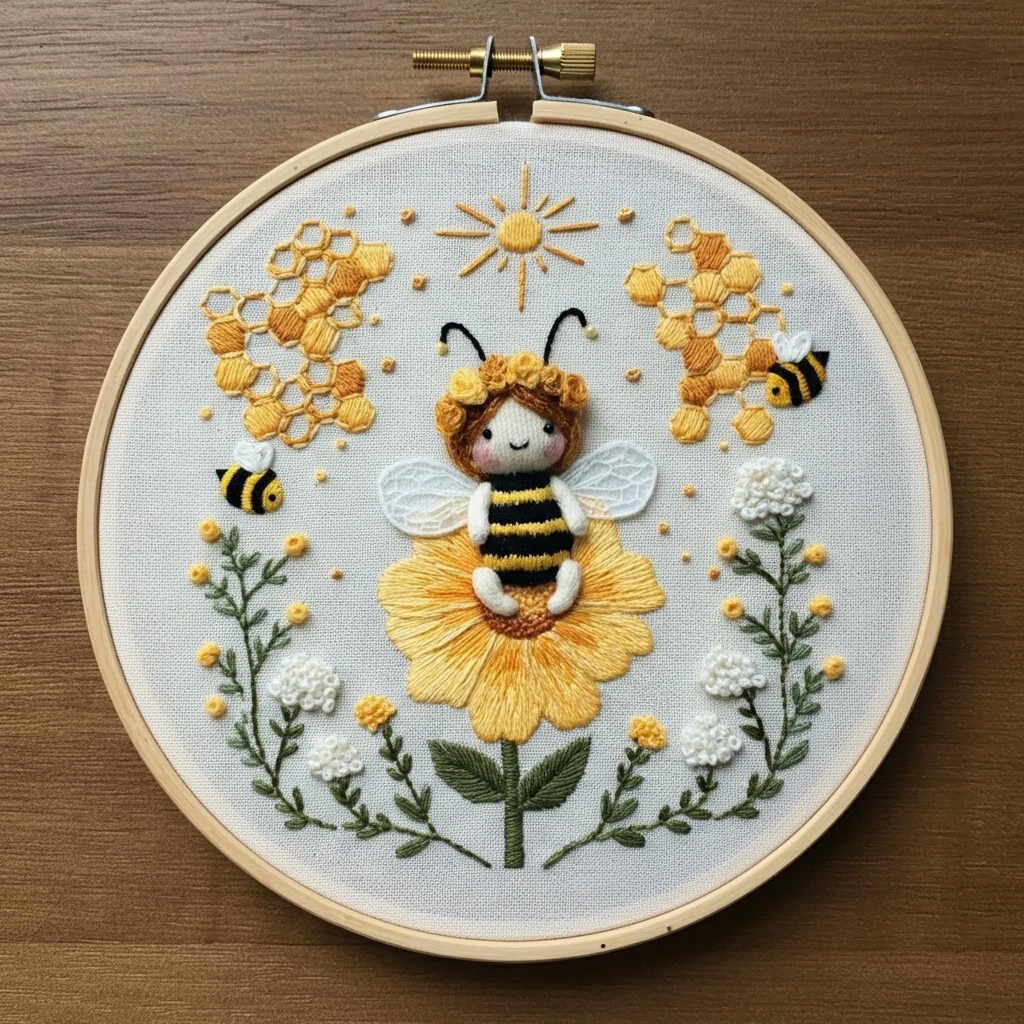
A cheerful hoop design built around a tiny bee fairy perched on a sunny flower, with honeycomb clusters, buzzing bees, lacy wings, golden French-knot blooms, white floral puffs, and soft green garden sprigs.
Design Read
The strongest colors are honey yellow, amber gold, warm brown, black bee stripes, creamy white wings and flower clusters, and muted botanical greens. The design will look best when the fairy and central flower are stitched with smooth directional filling, while honeycomb, blossoms, and wings stay more textured and airy.
Likely DMC Color Palette
Colors are visually matched from the reference preview. Coverage percentages are practical estimates, not exact thread yardage.
Stitching Suggestions
| Element | Best stitches | Practical notes |
|---|---|---|
| Large yellow flower | Long and short stitch, split-stitch outline | Work each petal from the center outward. Blend DMC 725 and 744 at the tips, then introduce 783 and 782 near the base for a rounded sunlit look. |
| Flower center | French knots, seed stitch, tiny satin stitches | Use 977 and 782 with a few 898 touches at the lower edge. Cluster knots unevenly so the center looks raised and pollen-rich. |
| Bee fairy body | Satin stitch, backstitch, couching | Stitch the black and yellow stripes horizontally with 2 strands. Keep the black edges crisp; add a one-strand backstitch if the stripes need tidying. |
| Face and limbs | Satin stitch, single-strand backstitch | Use 948 with very light tension. Add eyes and smile last with one strand of 310 so the expression remains delicate. |
| Hair and crown | Stem stitch, whipped backstitch, French knots | Layer 977 with 898 shadow strands for curls. Crown flowers can be small French knots in 744, 725, and 783. |
| Fairy wings | Split stitch, couching, light backstitch | Outline in 3865, then add interior veins with one strand of 927 or a pale 3865/927 blend. Avoid heavy filling to keep the wings transparent. |
| Honeycomb clusters | Backstitch, whipped backstitch, satin fill | Outline hexagons with 783 or 782. Fill selected cells with satin stitch in 725 and 744, leaving some open cells to preserve the airy honeycomb pattern. |
| Small bees | Satin stitch, backstitch, detached chain | Use 310 for stripes and 725/783 for bodies. White wings can be tiny lazy daisies or two small satin stitches. |
| Leaves and stems | Stem stitch, fishbone stitch, straight stitch | Work stems with 1–2 strands of 3363. Leaves look neat with fishbone stitch in 3052, adding darker one-strand midribs if needed. |
| White flower puffs | French knots, colonial knots | Cluster 3865 knots at different sizes. Mix one strand of 927 into a few lower knots for soft shadow and dimension. |
Thread Count, Blending & Shading
Strand plan
Use 2 strands for most satin, long-and-short, flower, bee, and honeycomb work. Use 1 strand for faces, antennae, wing veins, fine stems, and small outlines. Use 3 strands only for raised knots or bold flower-center texture.
Honey blends
For warm transitions, thread one strand of 725 with one strand of 744 for glowing petal tops, or one strand of 783 with one strand of 782 for honeycomb and lower-petal shadows.
Wing softness
Keep wing stitches light and open. A single-strand 927 vein over 3865 outlines gives a translucent look without making the wings feel gray.
Beginner-Friendly Working Order
- Stitch the central flower stem and petals first so the fairy has a clean base.
- Add the flower center texture before placing the fairy body, keeping knots compact.
- Work the fairy face, hair, striped body, limbs, and wings from back to front.
- Complete the honeycomb clusters with outlines first, then fill only selected cells.
- Finish with small bees, white knot flowers, yellow pollen dots, and the sun rays.
Texture & Outlining Details
- Outlines: Use split stitch for soft fairy and petal edges; use backstitch for graphic bee stripes and honeycomb geometry.
- Raised accents: Save French knots for the final pass so they do not snag while you fill larger sections.
- Petal direction: Angle stitches like sun rays from the flower center. This makes the flower look dimensional even with only three yellows.
- Open spaces: Leave parts of the honeycomb unfilled and keep wing interiors sparse; the contrast makes the fairy feel lighter.
- Black details: Use DMC 310 sparingly. One strand is usually enough for facial features, antennae, and bee outlines.