
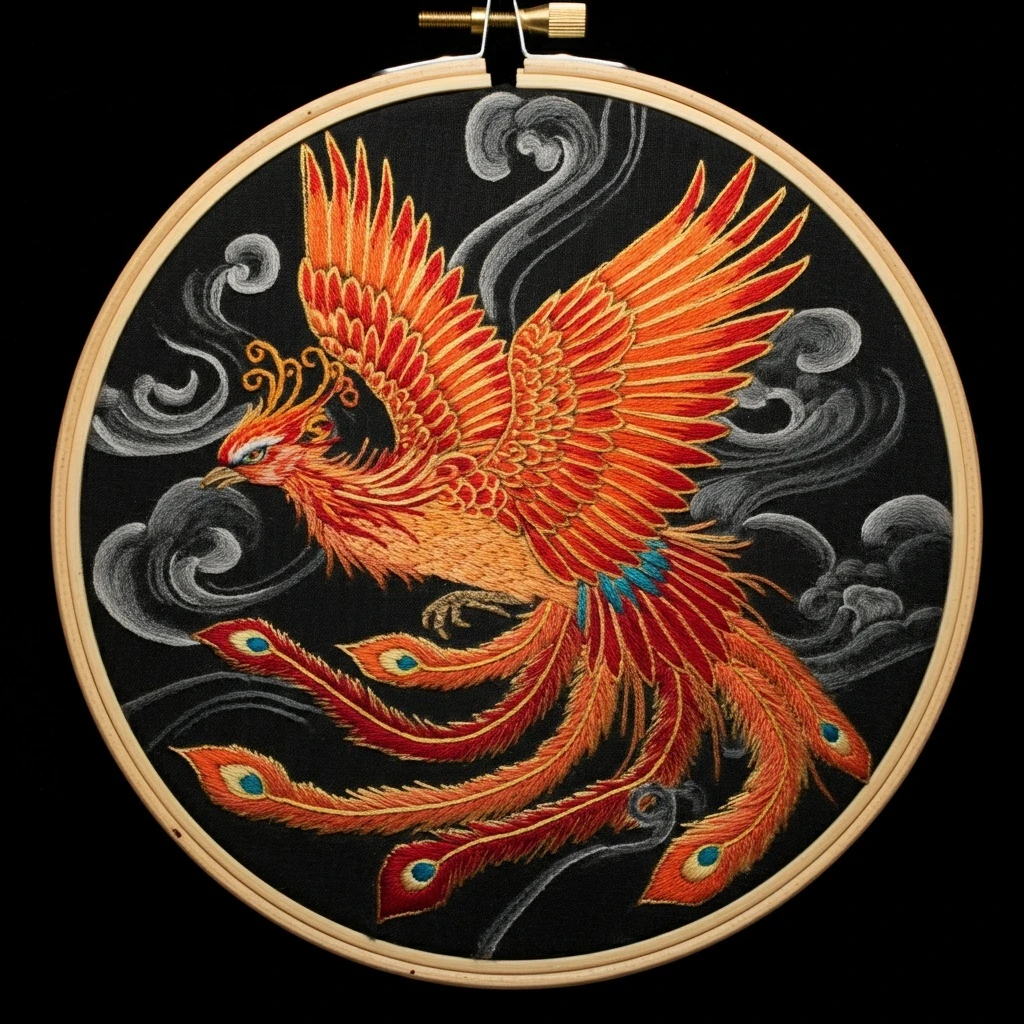
The Ascending Fenghuang Hand Embroidered Chinese Phoenix
Colors are estimated from the visible hoop preview and matched to close DMC embroidery floss shades. This design is rich with flame-red wing feathers, golden linework, teal eye accents, warm peach body shading, sweeping tail plumes, and smoky gray cloud scrolls over a black ground.
Likely DMC Color Palette
Palette based on the phoenix wings, layered chest feathers, long tail plumes, teal feather eyes, smoky cloud scrolls, golden outlines, beak and claw details. Coverage percentages are visual estimates from the preview, not exact thread usage.
Main red wing feathers, tail plume centers, and the brightest flame shapes. Use where the phoenix needs immediate impact.
Deep red shadows between feathers, underside of tail curls, and darker scale-like feather sections.
Orange feather transitions, wing tips, throat texture, and warm outer edges of long plumes.
Bright orange highlights on the raised wing and tail, especially where stitches curve toward the feather tips.
Golden-orange feather veins, crest curls, narrow bright strokes, and blended highlights over red/orange fills.
Warm gold outlining, beak shadow, claw details, feather bases, and the darker side of ornamental linework.
Fine luminous outlines around feathers and tail eyes; excellent for couching or whipped backstitch over red edges.
Peach chest and belly highlights. Blend with orange for the soft body feathers under the wing.
Rusty feather shadows, neck strokes, and warm shading inside the lower tail sections.
Teal-blue accents in the tail eyes, wing flash, and tiny facial details. Keep it crisp so the peacock-like spots sparkle.
Smoke cloud shadows, spiral interiors, and soft background scroll movement on the black fabric.
Cloud highlights and pale wisps. Use sparingly with one strand to keep the smoke soft rather than heavy.
Stitching Suggestions
Work the design as layered feathers rather than flat color blocks: first establish directional fills, then add gold edges, deep red shadow lines, and small bright accents.
Large wing feathers
Use long and short stitch with 2 strands, aiming every stitch from the feather base toward the tip. Alternate 666, 741, 740, and 742 for a fire-gradient effect.
Feather outlines
Use split stitch or backstitch in 783, then add selective 815 on the shadow side. A whipped backstitch in gold gives the raised, decorative look visible in the preview.
Chest and neck texture
Use short directional straight stitches and tiny split stitches. Mix 3824 with 921 and 741 so the breast looks fluffy, not satin-smooth.
Scale-like shoulder feathers
Work small detached chain stitches or scalloped backstitches in rows. Shade the base with 815 and edge the top with 742 or 783.
Long tail plumes
Use stem stitch for the central spine, then add long directional straight stitches along each side. Keep the stitches flowing with the curve of the plume.
Tail eye spots
Fill the center with 3846 satin stitch, surround with 742 or 783, and frame with 666 or 815. Keep each ring narrow to preserve the jewel-like shape.
Crest curls and facial details
Use 1 strand for fine curls, eye lines, and beak details. Stem stitch and tiny backstitch will keep the face expressive without becoming bulky.
Smoke and cloud scrolls
Use 1 strand of 414 and 318 in loose stem stitch, split stitch, and feather stitch. Let black fabric show between strokes to create smoky transparency.
Thread Count, Blending & Texture Plan
Thread-count guide
Use 2 strands for most wing and tail filling, 1 strand for outlines, face, cloud wisps, and tiny feather separations, and 3 strands only for raised gold accents or bold plume edges.
Blending combinations
For glowing feathers, blend one strand 666 with one strand 741. For deeper red shadows, blend 666 with 815. For peach body shading, blend 3824 with 921 near the underside.
Directional shading
Place darker colors at feather bases and along undersides, then graduate to orange and gold at the tips. Keep every stitch angled with the feather shape so the bird appears to rise upward.
Raised metallic effect without metallic thread
Use 783 over 742 as a final outline pass. A second, slightly offset gold stitch can mimic the bright rim of traditional decorative embroidery while staying beginner-friendly.
Beginner-Friendly Practical Tips
- Use black or very dark fabric for the strongest contrast; if using a lighter fabric, stitch the background only where necessary and keep the phoenix colors saturated.
- Separate each floss strand before recombining. This helps long and short stitch lie smoother, especially across the large wing feathers.
- Do not fill every feather perfectly flat. A few visible stitch directions add the lively, textured look shown in the reference.
- Mark the feather spines lightly before stitching so all wing and tail strokes flow in the same upward direction.
- Save the gold edging for the end. It cleans up transitions between red, orange, and peach sections and gives the phoenix a polished ceremonial finish.
- For smoke scrolls, use loose tension and fewer strands. Dense gray stitching can overpower the phoenix and flatten the airy cloud effect.