
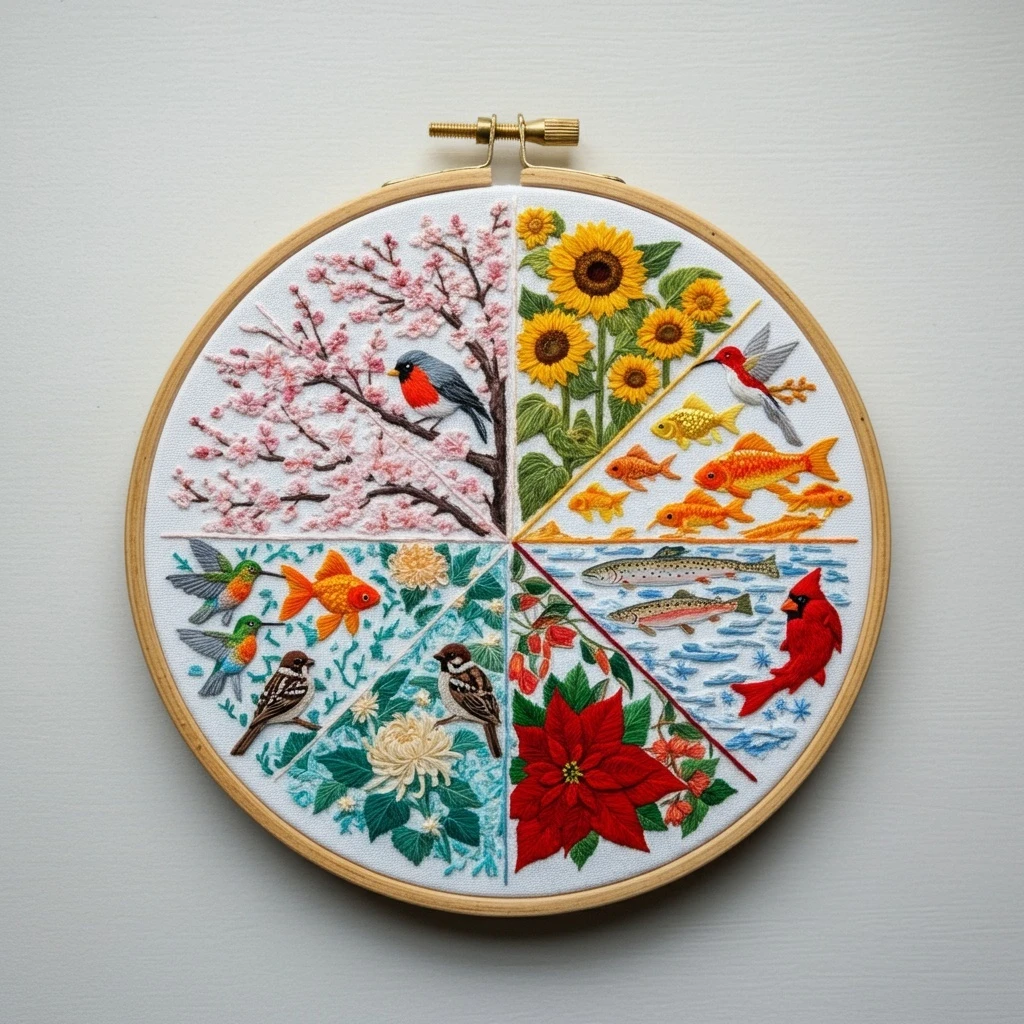
The Four Seasons Natures
A lively circular nature sampler divided into seasonal wedges: cherry blossoms and birds, sunflowers with hummingbird energy, golden fish and blue water, trout and winter cardinal, poinsettia reds, and cool leafy garden details. Colors are estimated from the stitched preview and matched to practical DMC floss choices for hand embroidery planning.
Design read
The artwork is arranged like a nature wheel, with each triangular section carrying its own mood and stitch texture. The main visual rhythm comes from crisp dividing lines, dense floral clusters, small birds, orange-gold fish, blue water ripples, and strong red winter blooms. Because the preview has many tiny elements, the best embroidery approach is to simplify detail while preserving color contrast and clear silhouettes.
Thread-count overview
- 1 strand: bird beaks, eyes, fish scales, twig tips, water ripple ends, feather lines.
- 2 strands: most outlines, blossom knots, leaves, stems, fish bodies, small flower petals.
- 3 strands: sunflower petals, poinsettia petals, cardinal body, larger goldfish fins.
- 4 strands or perle cotton: optional raised flower centers, thick section dividers, or extra bold fish texture.
Likely DMC color palette
Coverage percentages are visual estimates from the hoop preview, not exact thread usage.
Snow White
Black Brown
Coffee Brown Dark
Cranberry Very Light
Baby Pink
Lemon Dark
Tangerine Medium
Burnt Orange Dark
Red
Garnet
Green
Kelly Green
Turquoise Very Dark
Bright Turquoise Medium
Pewter Gray Dark
Tan Ultra Very Light
Stitching suggestions
| Element | Stitch type | Practical notes |
|---|---|---|
| Section dividers | Whipped backstitch or couching | Use 2 strands of a pale neutral, teal, or warm brown depending on the nearby wedge. Keep these lines smooth so the circular layout reads clearly. |
| Cherry blossoms | French knots, colonial knots, lazy daisy | Build clusters with 818 and 605. One-wrap knots make buds; two-wrap knots create fuller blossom centers. |
| Branches & twigs | Stem stitch, split stitch, backstitch | Use 801 for main lines and 3371 only at the deepest joints. Vary stitch length so twigs look organic. |
| Sunflowers | Detached chain, satin stitch, French knots | Work petals from center outward in yellows and tangerine. Fill centers with brown French knots or seed stitch for a raised, textured disk. |
| Fish | Long-and-short stitch, satin stitch, tiny straight stitches | Shade bodies from 444 to 741 and 900. Add scale marks with 1 strand after the body fill is complete. |
| Water ripples | Running stitch, whipped running stitch, fly stitch | Use broken blue lines rather than solid bands. Leave white space between ripples to keep the water light and sparkling. |
| Cardinal & birds | Satin stitch, split stitch, single-strand feather marks | Outline the bird silhouette first, then fill with angled satin stitches. Add dark eyes and wing marks last with one strand. |
| Poinsettia and leaves | Long-and-short stitch, fishbone stitch, backstitch veins | Use garnet at petal bases and bright red toward tips. Green leaves look cleanest with fishbone stitch and a single central vein. |
Blending & shading guidance
- Blend one strand 321 with one strand 816 for cardinal wings and poinsettia petal shadows.
- Use separate knot colors in the blossom wedge rather than blended needle colors; this keeps the pink clusters lively.
- For goldfish, start with 444 on the highlight side, move into 741, and place 900 under the belly and fins.
- For water, blend one strand 3845 with one strand white or light gray when a softer ripple is needed.
- For hummingbird throats, pair bright green with a tiny orange-red accent, but keep the beak and eye in one strand.
Texture suggestions
- Raised flower centers: use tight French knots for sunflower disks and cream flower centers.
- Feather texture: add short single-strand straight stitches over filled bird bodies, following feather direction.
- Fish scales: use tiny offset straight stitches or seed stitches after the fill, not before.
- Leaf depth: alternate fishbone stitch direction slightly so foliage does not look flat.
- Water sparkle: leave intentional gaps between blue ripple stitches and add a few white highlights last.
Beginner-friendly stitching plan
Lightly transfer the circle and wedge dividers before any motifs. A clean structure makes the detailed design feel manageable.
Outline birds, fish, large flowers, and major leaves with 1-2 strands so your satin and long-and-short stitches stay inside the shapes.
Add light blossoms, water, and cream flowers first, then introduce dark browns, reds, and black-brown accents near the end.
Complete each seasonal scene before moving on. This prevents color confusion and reduces thread carry on the back.
Use 14-18 inch lengths, especially around knots and dense fish details, to avoid fuzzing bright floss colors.
Final white highlights, eyes, fish scales, flower-center knots, and water glints make the finished hoop look crisp.