
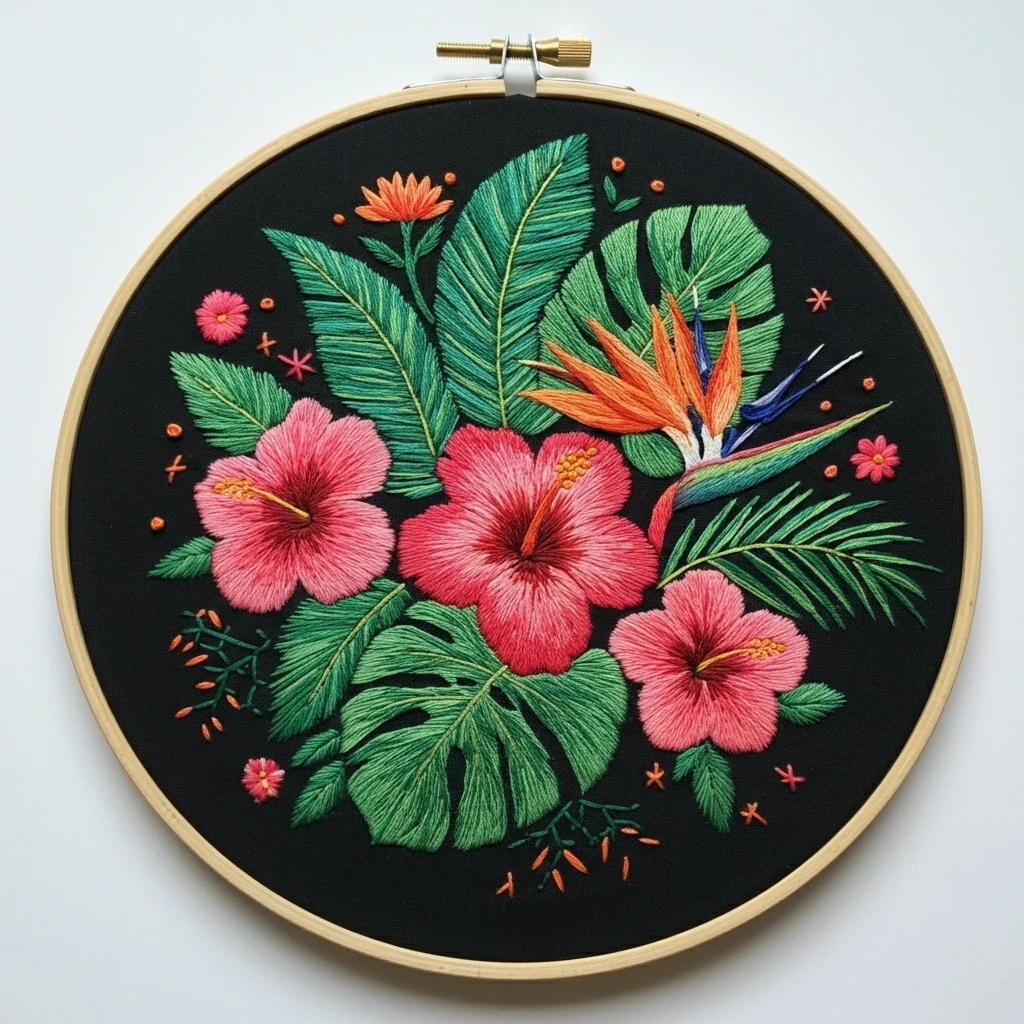
DMC palette & embroidery guide
Tropical Paradise
A lush black-ground hoop with hibiscus blossoms, bird-of-paradise petals, palm fronds, monstera leaves, tiny coral accents, and layered jungle greens. Colors below are practical DMC matches estimated from the visible design preview.
Likely DMC Color Palette
The dominant story is bright coral-pink hibiscus against deep black fabric, balanced with cool emerald foliage, yellow-gold stamens, orange tropical petals, and a small royal-blue accent. Use the darker shades sparingly to carve shadows and keep the tropical colors luminous.
Stitching Suggestions
Work from the largest background leaves toward the most decorative flowers. The design relies on directional thread movement: petals should radiate from flower centers, while leaves should fan outward from their central veins.
| Element | Recommended stitch | Practical notes |
|---|---|---|
| Hibiscus petals | Long and short stitch | Use 2 strands. Blend 956 and 351 through the petal body, then pull 814 from the throat outward in short tapered strokes. |
| Flower throats | Dense short satin stitches | Keep the darkest garnet concentrated at the base so the petals look cupped rather than flat. |
| Stamens and pollen | Stem stitch plus French knots | Use 1 strand for the stamen line and 2 strands for raised yellow knots. Add knots after petal work is complete. |
| Bird-of-paradise bloom | Long satin and split stitch | Follow each narrow petal from base to tip. Add 820 as a cool side accent and 741/742 for fiery orange blades. |
| Monstera leaves | Fishbone stitch or long and short stitch | Stitch each leaf segment separately around the cut shapes, alternating 909, 911, and 912 for natural veins. |
| Palm fronds | Straight stitch and stem stitch | Use 1 strand for slim frondlets. Keep the center rib steady, then angle each leaflet evenly outward. |
| Tiny dots and star accents | French knots, straight stitches | Use orange and coral as scattered sparkles. Vary knot size with one-wrap and two-wrap knots. |
| Leaf veins | Split stitch or backstitch | Use chartreuse sparingly. A single clean line over darker green makes the foliage look crisp. |
Thread Count, Blending & Shading
Strand plan
- Use 2 strands for most petal and leaf fills.
- Use 1 strand for fine palm fronds, veins, and sharp outlines.
- Use 3 strands only for bold French knots or tiny raised orange berries.
Blending ideas
- For hibiscus: combine one strand 956 + one strand 351 for a lively coral transition.
- For foliage: blend 911 + 912 on sunlit sections and 909 + 911 in shadow.
- For orange petals: mix 741 + 742 near tips for a tropical glow.
Outlining details
- Avoid heavy black outlines on the flowers; let the black fabric create the edge.
- Use dark green split stitch where overlapping leaves need separation.
- Backstitch only the most important veins so the foliage remains soft.
Texture suggestions
- Make hibiscus petals smooth and slightly glossy with closely packed long-and-short stitches.
- Keep palm fronds airy with visible spacing between stitches.
- Use raised French knots for pollen and small background dots to add dimension.