
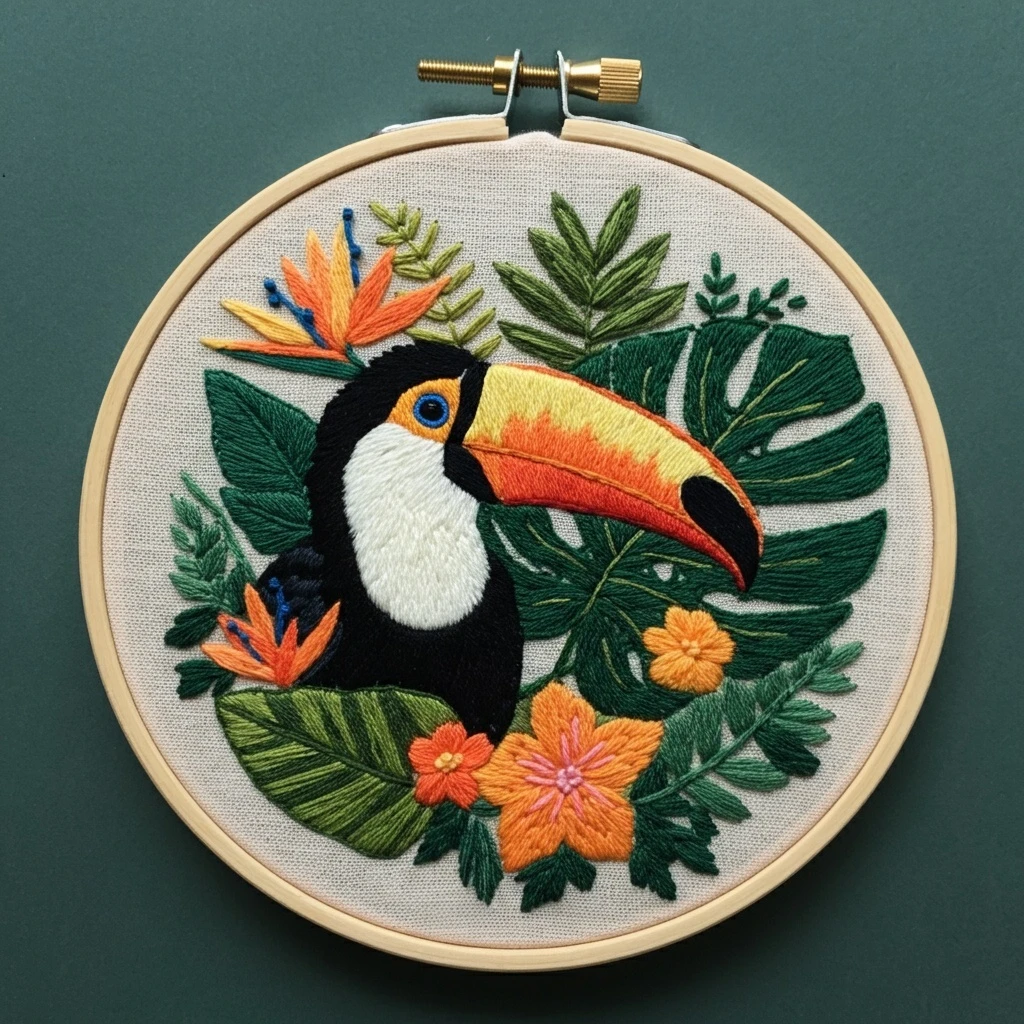
Tropical Toucan
A bright hoop-art guide inspired by a perched toucan surrounded by lush tropical foliage: glossy black plumage, a creamy throat, a vivid orange-yellow beak, turquoise accents, and layered jungle greens.
Design read
The artwork centers on a bold toucan silhouette with an oversized warm beak and crisp eye details. Large leaves frame the bird, so the embroidery should balance smooth satin areas on the beak with textured green foliage and clean dark outlines.
Best working order
Stitch background leaves first, then the body, beak, feet, and final outlines. Leave the eye and tiny highlights until the end so they stay sharp and clean.
Suggested DMC palette
Use these shades as a practical match for the tropical toucan image. The palette includes saturated beak colors, dense greens, soft cream, black-brown shading, and a turquoise pop for cool accents.
Color placement & blending
- Beak: blend 742 into 741 for the broad golden-orange face of the beak; add 721 along the lower curve and under the tip for dimension.
- Yellow highlights: use 307 sparingly with 1 strand over finished satin stitches, especially where the beak catches light.
- Body: keep most body areas in 310, but use 3371 on feather edges so the shape does not become a flat black block.
- Throat and facial patches: use 746 with tiny touches of 742 where cream meets the warm beak.
- Foliage: alternate 895, 699, 704, and 907 leaf by leaf; darker colors tuck behind the bird, lighter colors come forward.
- Turquoise accents: reserve 3846 for small areas only so it reads as a jewel-like contrast.
Thread-count guidance
- 2 strands: default for outlines, split stitch, leaf veins, and most fill work on cotton or linen.
- 1 strand: eye ring, beak highlight lines, small facial curves, and delicate feather separation.
- 3 strands: bold leaf edges, thicker stems, branch details, and graphic outer contour lines.
- 4–6 strands: use only for decorative knots or chunky accent flowers if your fabric can support the texture.
Recommended stitches by area
| Area | Best stitches | Practical notes |
|---|---|---|
| Large beak | Long and short stitch, padded satin stitch, split stitch borders | Pad the central beak lightly with horizontal running stitches, then cover with smooth satin or long-and-short strokes following the curve. |
| Black body and wing | Satin stitch, fishbone stitch, directional long stitch | Change stitch direction between chest, back, and wing so black areas catch light differently. |
| Cream throat | Short satin stitch, split stitch fill | Use shorter stitches than the beak to keep the throat soft and feathery. |
| Eye and face | Tiny back stitch, single French knot, straight stitch | Work the eye last with 1 strand of 310 and one pinpoint 746 highlight. |
| Palm leaves | Fishbone stitch, fly stitch, stem stitch veins | Use a central vein first, then stitch angled leaf sections outward for a natural tropical frond texture. |
| Branches and stems | Stem stitch, whipped back stitch | Whip darker stems with a lighter green or brown to create a rounded branch effect. |
Outlining details
Use 1–2 strands of 3371 for most internal feather lines and reserve 310 for the strongest outer silhouette. Around the beak, a narrow split-stitch outline in 721 keeps orange edges clean without looking too harsh.
Shading strategy
Shade from dark to light on leaves and from light to dark on the beak. This makes the bird feel sunlit while the surrounding foliage recedes into a jungle frame.
Texture ideas
Add tiny straight stitches in 3371 over the black wing, scatter a few 704/907 leaf vein highlights, and use one or two French knots near the branch for a handcrafted botanical finish.
Beginner-friendly workflow
- Use a sharp transfer line for the toucan outline and beak divisions; these shapes define the whole design.
- Start with the rear leaves so later stitches can overlap them neatly.
- Keep satin stitches under 1 cm where possible; split larger areas into curved sections.
- Rinse or cover hands before stitching 746 cream areas so the light thread stays clean.
- Step back often: the toucan should read clearly from a distance, with the beak as the strongest color focal point.
- Press finished work face down on a towel to preserve raised satin, knots, and leaf texture.
Finishing suggestion: mount in a natural bamboo hoop or a dark green painted hoop. The neutral frame lets the orange beak and layered foliage stay bright without competing for attention.