
Vibrant Bold Modern Floral
A punchy contemporary floral hoop built from saturated red blossoms, deep teal foliage, coral-orange petals, navy accent leaves, pale blush petals, creamy highlights, yellow centers, and raised bead-like knot clusters.
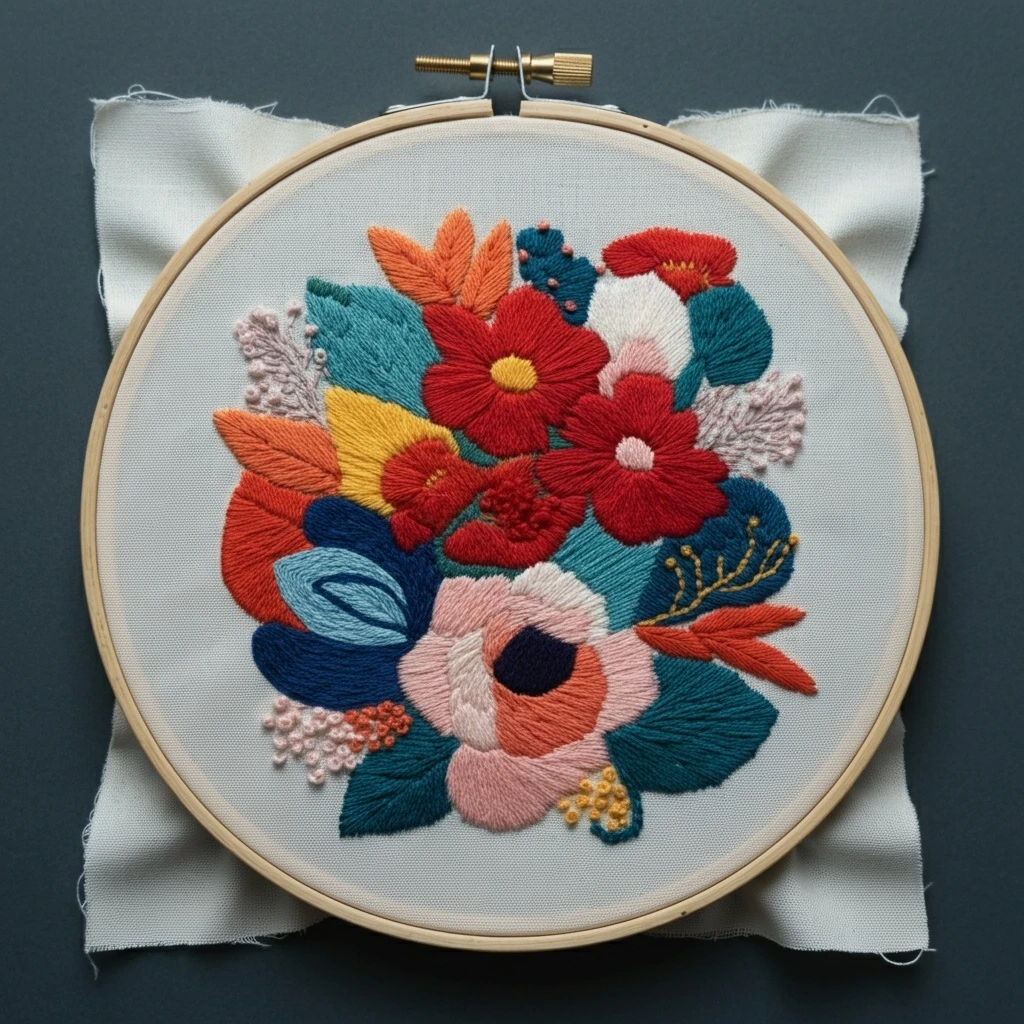
Preview image used for visual color and design-element matching.
Likely DMC Color Palette
Colors are estimated from the visible hoop preview and matched to close DMC embroidery floss shades. The design benefits from high contrast: warm florals sit against dark teal and navy leaves, with yellow and pale blush details keeping the bouquet bright.
Red
Main red daisies, rounded petals, and the strongest modern floral focal points. Use as the dominant flower shade.
Garnet
Deep red petal roots, inner folds, flower overlaps, and shadow accents in the red blossoms.
Turquoise Very Dark
Large teal leaves, shadowed tropical foliage, and the dark blue-green backing shapes behind flowers.
Bright Turquoise
Brighter leaf highlights and turquoise petal-like shapes; blend sparingly into dark teal for sheen.
Navy Blue Dark
Deep navy leaves, central dark flower eye, and crisp contrast under pale blue/teal accents.
Antique Blue Ultra Very Light
Pale blue accent leaf and cool highlight stitching on the navy section.
Copper
Orange-coral petals and leaf sprays, especially the pointed upper-left and right-side accents.
Copper Medium
Darker coral shading on orange petals, red-orange curves, and warm outlines around petal bases.
Salmon Light
Soft pink petal areas in the large lower flower and delicate highlights around cream petals.
Coral Light
Warm shading on the peach-pink petal and transitions where blush petals deepen toward the center.
Winter White
Creamy white petal sections, bright negative-space highlights, and lift on the lower central flower.
Topaz Medium Light
Yellow flower centers, small sprigs, French knots, and the sunny yellow block tucked behind leaves.
Antique Violet Light
Muted mauve-gray background sprigs and soft textured fillers behind the bold flowers.
Dusty Rose Very Light
Tiny pink knot clusters and gentle blush dots that soften the strong red, teal, and navy palette.
Stitching Suggestions
Work the bouquet in layers: large leaves first, main blossoms second, then small sprigs, French knots, and final outlines. This keeps the composition clean while still allowing the bold shapes to overlap naturally.
| Element | Suggested Stitch | Practical Notes |
|---|---|---|
| Large red flowers | Long and short stitch or padded satin stitch | Use 2 strands. Direct stitches from petal tip toward the center so the flower feels radial. Add DMC 816 at petal bases for depth. |
| Yellow centers | Satin stitch, woven circle, or tight French knots | Use DMC 725 with 2 strands. Keep centers raised but tidy so they pop against the red petals. |
| Teal tropical leaves | Fishbone stitch and long directional satin | Use 2–3 strands for broad leaves. Split the leaf with a center vein, then angle stitches outward in 3809 and 3846. |
| Navy accent leaves | Satin stitch with split-stitch outline | Use DMC 823 for the base, then add pale blue 3753 lines or a single curved vein for the luminous modern contrast. |
| Orange-coral petals | Straight stitch, fishbone, or long and short stitch | Blend 922 and 920 in alternating stitches. Keep pointed petals crisp by ending every stitch neatly at the tip. |
| Blush and cream lower flower | Long and short stitch | Use 3865 for the lightest petal planes, 761 for blush petals, and 352 near folds or where petals tuck under the dark center. |
| Muted filler sprigs | Fly stitch, detached chain, and French knots | Use 3042 and 151 with 1–2 strands. Let these airy accents sit behind the bold flowers rather than competing with them. |
| Gold twig sprigs | Stem stitch plus French knots | Use 1 strand for fine stems and 2 strands for knots. Add these last so they remain clean on top of dark leaves. |
| Fine outlines | Split stitch or backstitch | Outline only where needed: dark red on red petals, dark teal on leaves, and navy around the central dark eye. Avoid outlining every edge. |
Thread Count, Blending & Shading
Thread-count guide
- Use 2 strands for most flower and leaf fills.
- Use 3 strands only for padded, chunky satin petals.
- Use 1 strand for fine outlines, veins, and gold sprigs.
- Use 2 strands with 1–2 wraps for neat French knots.
Blending ideas
- Blend one strand 321 + one strand 816 for red petal shadows.
- Blend one strand 3809 + one strand 3846 for teal leaf transitions.
- Use 761 + 3865 for soft pink-to-cream petal highlights.
- Alternate 922 and 920 stitch-by-stitch for orange petal texture.
Shading approach
- Keep the deepest colors closest to flower centers and overlaps.
- Angle leaf stitches to imply veins without heavy backstitching.
- Leave the pale cream sections clean and smooth for contrast.
- Use dark navy sparingly; it makes the bright colors look bolder.
Texture & Beginner-Friendly Tips
Raised texture
French-knot clusters are ideal for the tiny pink, coral, and yellow dotted areas. Vary the number of wraps slightly so the fillers look organic, but keep each cluster within its printed shape.
Smooth bold petals
For modern floral impact, keep satin sections smooth and intentional. If a petal is wider than about 8 mm, switch to long-and-short stitch so the floss does not snag.
Clean edges
Use a split-stitch border before filling large shapes. Stitch over that border with your fill stitches for rounded edges on red flowers and crisp tips on orange leaves.
Suggested Stitching Order
Begin with the largest background leaves in dark teal and navy so the bouquet has structure. Add the red flowers next, followed by the blush-and-cream lower flower, then the orange accent petals. Finish with yellow centers, mauve filler sprigs, French-knot clusters, and the fine gold twig details. Press only from the back on a towel so the raised knots and padded satin stay dimensional.