
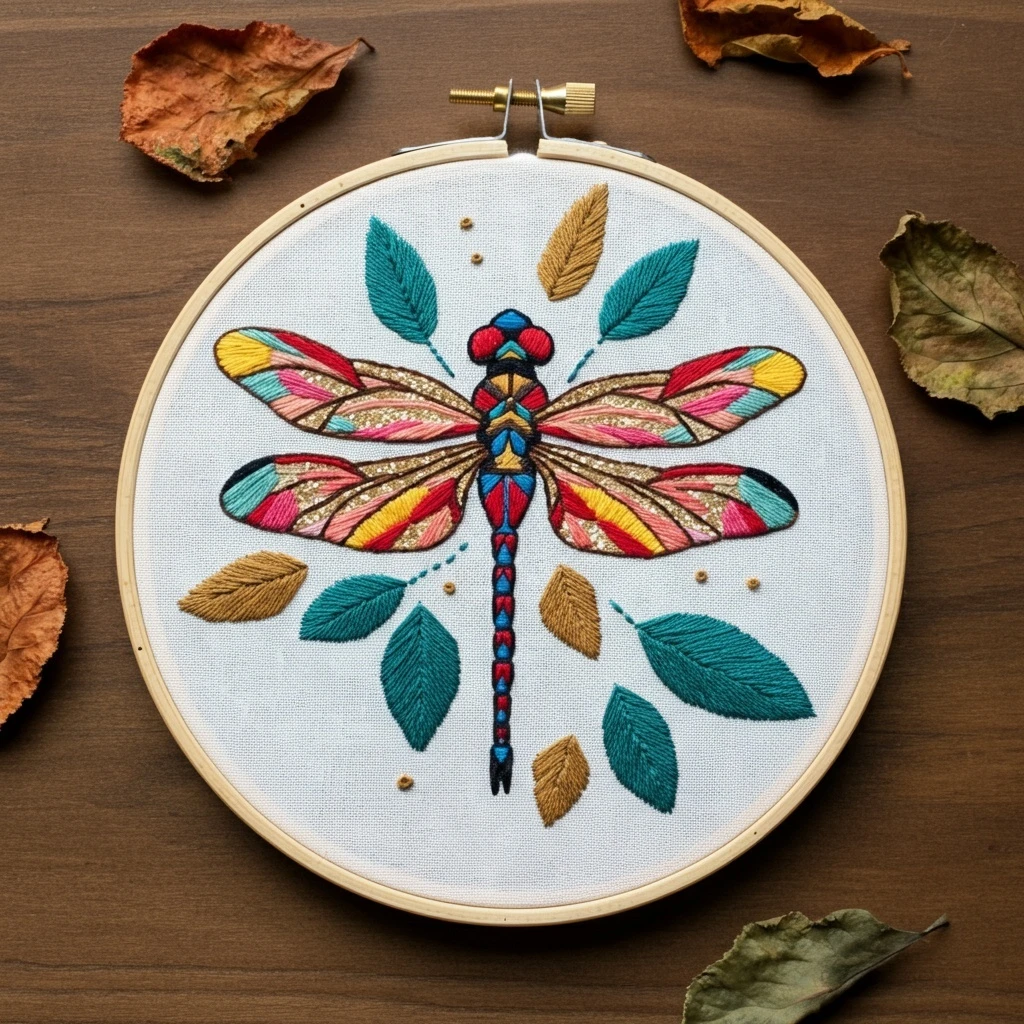
Vibrant Dragonfly Autumn
A warm autumn hoop with a jeweled dragonfly hovering among russet blossoms, golden leaves, berry accents, and soft teal wing glints. This guide translates the design into practical DMC choices, stitch direction, thread counts, shading blends, and beginner-friendly order of work.
Observed Color Story
The artwork reads as a lively autumn garden scene: a central dragonfly with blue-green body and airy pale wings, surrounded by rounded flowers and foliage in pumpkin orange, marigold, cranberry red, olive green, dusty mauve, and warm brown. The palette should feel saturated but natural, with deeper outlines to keep the delicate insect and botanical shapes crisp.
Thread Count Snapshot
- Dragonfly body: 2 strands for satin/long-short, 1 strand for segment lines.
- Wings: 1 strand for veins, 1–2 strands for pale fill stitches.
- Flowers: 2–3 strands for petals; 3 strands for bold woven roses.
- Leaves/stems: 2 strands for leaves, 1 strand for thin tendrils.
- Outlines: 1 strand for refined detail, 2 strands for graphic emphasis.
Suggested DMC Palette
Stitch Plan by Element
| Design area | Recommended stitches | Practical notes |
|---|---|---|
| Dragonfly body | Satin stitch, split stitch, tiny back stitch | Work body segments vertically. Alternate 3809 and 3846 so the abdomen looks rounded rather than flat. |
| Wings | Fly stitch, straight stitch veins, loose long-and-short | Keep stitches sparse. Let fabric show through for transparency; avoid heavy satin fill. |
| Rounded blooms | Lazy daisy, woven wheel, satin stitch, French knots | Use 721 and 742 for orange flowers, then tuck 347 or 902 into the underside for depth. |
| Leaves | Fishbone stitch, detached chain, stem stitch veins | Angle stitches toward the leaf center vein and mix 730/734 for natural variation. |
| Stems & tendrils | Stem stitch, whipped back stitch | Use 433 for warm stems; add 730 where stems pass behind leaves. |
| Berries & centers | French knots, colonial knots, seed stitch | Use 902 with a single wrap for small berries; two wraps for prominent centers. |
Blending & Shading Ideas
- Dragonfly body blend: thread one strand DMC 3809 with one strand DMC 3846 for a jewel-toned teal. Add single-strand 3371 segment lines after the fill is complete.
- Wing shimmer: combine one strand DMC 964 with one strand DMC 747 for the faint interior stitches, then add isolated DMC 746 straight stitches near the outer tips.
- Orange petals: start with DMC 721 at the base, shift to DMC 742 at the tips, and add a few DMC 347 stitches on petals that sit behind the dragonfly.
- Autumn foliage: pair DMC 730 with DMC 734 in alternating fishbone rows; add a short DMC 433 base stitch where leaves meet stems.
- Mauve accent blooms: use DMC 3731 sparingly so the warm orange flowers remain the focal color.
Outlining Details
Use one strand of DMC 3371 for the dragonfly body, select petal overlaps, and the darkest berry centers. Keep the wing outline softer with DMC 3809 or 964; black-brown is best saved for the abdomen and tiny legs so the wings stay airy.
Texture Suggestions
Combine smooth satin on the dragonfly, open airy stitches on the wings, nubby knots for berries, and directional fishbone leaves. This contrast makes the hoop feel dimensional without requiring complex stumpwork.
Order of Work
- Stitch background stems first.
- Add leaves and larger flowers.
- Work the dragonfly body next.
- Finish with wing veins, knots, highlights, and outlines.
Beginner-Friendly Practical Tips
- Transfer lightly: the wing veins are delicate, so use a fine washable pen or very pale transfer line.
- Keep tension gentle: tight wing stitches can pucker the fabric. Rest the needle on the surface before pulling the thread fully through.
- Use shorter satin stitches: if a dragonfly body segment is wide, split it into two or three smaller satin groups to prevent snagging.
- Test knots first: practice French knots with the exact fabric and thread count so berry sizes stay consistent.
- Balance the color: repeat each warm orange or cranberry color in at least two places around the hoop so the composition feels intentional.
- Preserve open space: do not overfill every flower or wing. The design’s charm comes from light, decorative stitching.
- Needle choice: use a size 7 or 8 embroidery needle for 2–3 strands, and a size 9 or 10 needle for single-strand wing details.
- Finishing: press from the back on a towel so knots and satin stitches remain raised.