
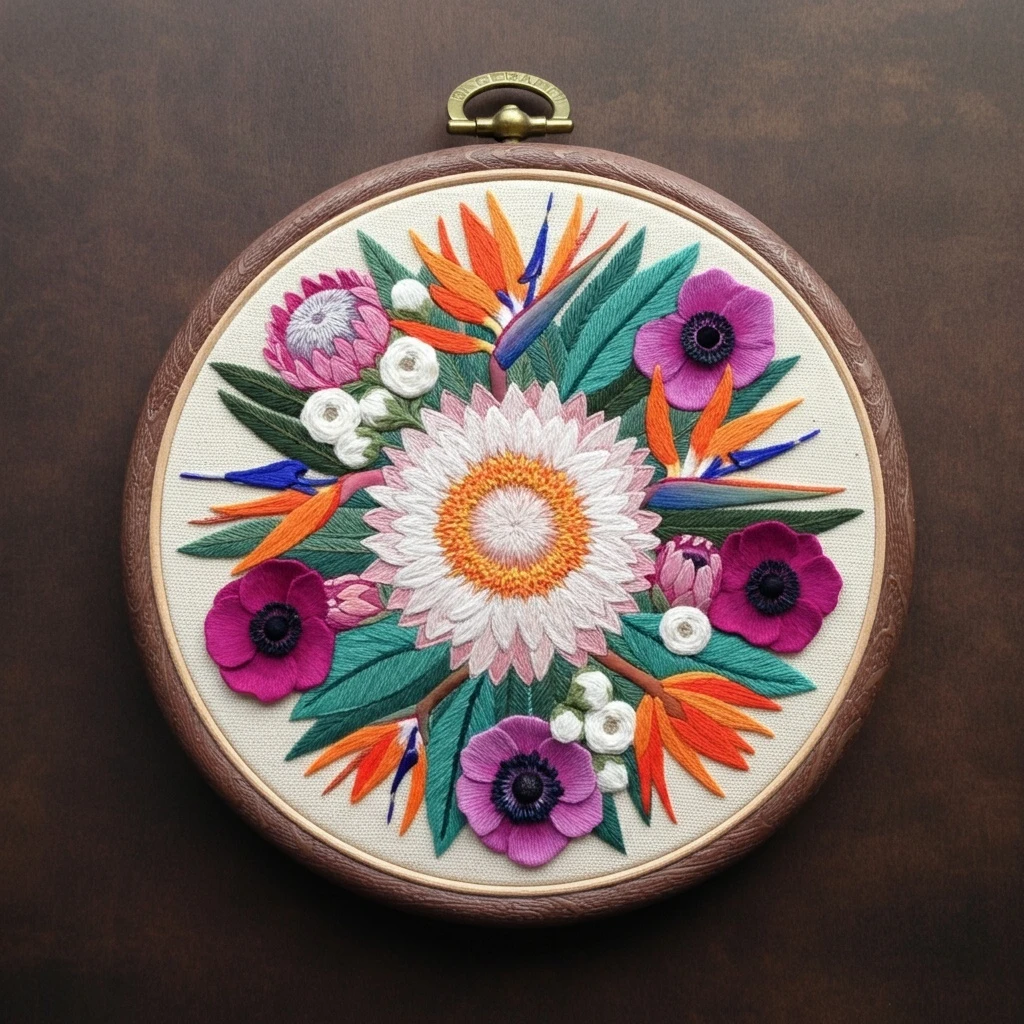
Vibrant Floral Hoop
A polished DMC color palette and practical hand-embroidery plan for a lush modern hoop: a large pale daisy-style centerpiece, saturated magenta flowers, white rosettes, orange bird-of-paradise shapes, deep teal foliage, royal blue accents, and warm wood-toned framing.
Likely DMC Color Palette
The design reads as a high-contrast floral hoop: creamy fabric, a soft white-and-blush central flower, bright orange tropical petals, jewel-toned magenta blooms, dark flower centers, cool blue accents, and layered teal-green leaves. Coverage percentages are visual estimates, not exact thread usage.
Central flower petals, white rosettes, bright highlights, and tiny lifted accents.
Blush shading on the central petals and pale pink petal bases.
Golden ring around the center flower, bright pollen dots, and warm accents.
Bird-of-paradise petals and orange transitions in tropical flowers.
Hot petal tips, deepest flame-orange details, and vivid tropical accents.
Bright magenta petals, flower highlights, and lively outer petal strokes.
Deep magenta petal bases, shadow folds, and rich floral contrast.
Dark flower centers, deepest outlines, small seed knots, and visual anchors.
Deepest leaf undersides, vein shadows, and background foliage depth.
Main teal leaves and broad tropical foliage fill.
Leaf highlights, lighter blade edges, and cool transitions.
Blue bird-of-paradise spines, small accent strokes, and cool contrast lines.
Muted blue shadows on tropical petals and subtle blended outlines.
Branching stems, warm hoop-adjacent shadows, and structural lines.
Stem highlights and optional warm wood-toned accents.
Soft leaf bases, buds, and muted green transitions near white flowers.
Stitching Suggestions
Work this hoop as layered botanical embroidery: smooth petal fills for the main flowers, crisp directional leaf stitches, raised knots for centers, and thin outlining only where definition is needed.
Large central flower
Use long and short stitch for the large pale petals. Start with 3865 at the tips, add 3716 near the petal bases, and keep each petal stitched from tip toward center so the flower radiates naturally.
Golden center ring
Build the center with small satin stitches, seed stitch, and French knots in 742. Add a few 741 knots close to the petal base for warmth and dimension.
Magenta flowers
Fill petals with satin or long and short stitch. Blend 602 into 915 from edge to base, then outline only the deepest folds with one strand of 915 or 310.
Dark flower centers
Use padded satin stitch or clustered French knots in 310. A ring of tiny 915 stitches around the black centers keeps them soft instead of flat.
White rosettes and buds
Use woven wheel stitch or whipped backstitch spirals in 3865. Shade the lower edge with a single strand of 3052 or 3716 so the white flowers remain visible on pale fabric.
Bird-of-paradise accents
Use long straight stitches or narrow satin stitches in 741 and 606. Add a fine 796 line for the blue spine, keeping the stitches sleek and pointed.
Tropical leaves
Use fishbone stitch for leaf blades and split stitch for midribs. Place 500 on the shadow side, 3810 through the body, and 3808 along the light edge.
Stems and structure
Work stems in stem stitch with 801, adding 975 on upper edges. For very narrow brown lines, use one strand and keep the tension relaxed.
Thread Count, Blending & Texture
Thread-count guide
- 1 strand: fine leaf veins, blue accent lines, petal outlines, and delicate shadows.
- 2 strands: most satin stitch, long and short fill, stems, and medium leaves.
- 3 strands: raised French knots, bold flower centers, and extra-full rosette details.
Blending ideas
- For orange petals, blend one strand 741 with one strand 606 for hot tropical tips.
- For magenta petals, blend 602 + 915 where the petal curves inward.
- For teal leaves, blend 3810 + 3808 on leaves that sit in front, and 3810 + 500 on leaves behind flowers.
Outlining details
Outline sparingly. Use split stitch in one strand for central flower petal separations, backstitch for the blue accents, and stem stitch for curved brown stems. Heavy outlines can flatten the design, so reserve 310 for centers and the deepest creases.
Texture suggestions
Mix smooth satin petals with raised knots and woven rosettes. Leaves should have directional ridges, while the center flower should stay soft and airy. This contrast is what gives the hoop its polished dimensional look.
Where to Start
Beginner-Friendly Practical Tips
- Use a sharp embroidery needle for woven cotton and a hoop tight enough that the fabric sounds lightly drum-like.
- Keep satin stitches short on curved petals; if an area is wide, switch to long and short stitch to prevent snagging.
- Thread lengths of 14–18 inches are easiest to control and help keep bright colors from looking fuzzy.
- When stitching light petals next to dark centers, complete the pale area first and add black knots last to avoid accidental dark fibers catching in the white floss.
- Step back often. This design relies on bold contrast, so the colors should read clearly from arm’s length before tiny details are added.