
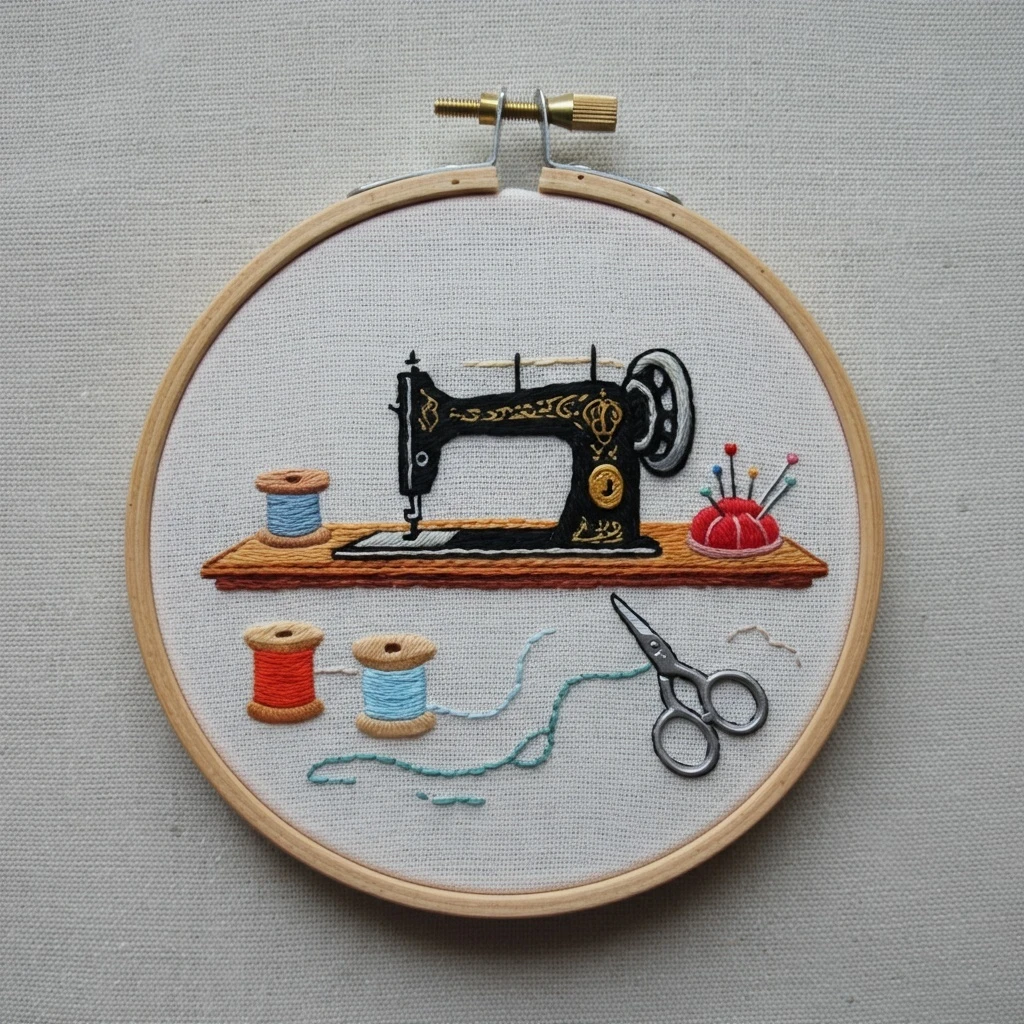
DMC Palette & Stitching Suggestions
Vintage Sewing Machine Notions
A warm, nostalgic embroidery guide for a classic sewing-machine composition: aged ironwork, golden brass details, wooden tones, cotton spools, needles, scissors, measuring tape, and soft fabric accents. The palette below keeps the design antique and readable while giving the notions just enough color to feel lively.
Vintage neutralsMetallic-look shadingWoven thread textureBeginner friendly order
Design read
Key elements to preserve while stitching
- Main silhouette: the sewing machine should read first, so keep its outer frame crisp with dark outlines and shaded inner panels.
- Notions: spools, bobbins, thread trails, scissors, buttons, tape measure, and pins work best as small pops of color around the machine.
- Vintage mood: use cream fabric, softened browns, tarnished brass, charcoal, muted reds, faded blues, and sage greens rather than overly neon accents.
- Detail balance: choose a few highly textured areas, such as the spool thread and machine scrollwork, and keep tiny background notions simpler.
Best overall approach: stitch the dark machine outline first, then fill the metal body with directional long-and-short shading. Add notions afterward so the smaller shapes sit cleanly on top of the composition.
Suggested DMC palette
Approximate floss matches with practical use notes
DMC 310 - Black
Final machine silhouette, needle point, scissor holes, deepest cog shadows, and high-contrast linework.
DMC 3799 - Very Dark Pewter Gray
Softened black for antique iron, side shadows, and areas where pure black would look too flat.
DMC 645 - Very Dark Beaver Gray
Mid metal shading on the sewing-machine body, hand wheel, plate, and presser-foot details.
DMC 646 - Dark Beaver Gray
Highlights on worn metal edges, curved machine panels, and raised ornament shapes.
DMC 898 - Very Dark Coffee Brown
Wooden base, spool cores, antique table shadows, and deep brown outlines.
DMC 975 - Golden Brown
Warm wood grain, old spool rims, and the warmer side of leather or cardboard notion labels.
DMC 3820 - Straw Dark
Measuring tape, brass highlights, gold decals, and aged decorative flourishes.
DMC 725 - Medium Light Topaz
Small shine accents on brass, tape-measure numbers, and bright thread catches.
DMC 3721 - Shell Pink Dark
Muted rose thread spool, pin cushion, flowered fabric, or a warm accent button.
DMC 3713 - Salmon Very Light
Soft highlights on pink notions and gentle petal-like or fabric-print details.
DMC 924 - Very Dark Gray Green
Faded teal spool, shadowed blue fabric, cool contrast in the machine’s darker reflective areas.
DMC 926 - Medium Gray Green
Light teal thread, bobbin highlights, and soft cool notes that keep the palette balanced.
DMC 3011 - Dark Khaki Green
Sage accent fabric, muted leaves if present, and vintage green thread wraps.
DMC 739 - Ultra Very Light Tan
Linen labels, fabric scraps, pale spool ends, and soft highlights against cream background cloth.
Stitch choices by area
| Machine outline | Use back stitch or split stitch with 1 strand of 310/3799. Keep curves short and even so the vintage silhouette stays elegant. |
| Metal body | Long-and-short stitch with 1-2 strands, blending 3799, 645, and 646. Follow the curves of the machine arm and base. |
| Scrollwork & decals | Stem stitch, tiny chain stitch, or couching in 3820. For ornate curls, use 1 strand and turn the hoop often. |
| Spools & bobbins | Satin stitch for spool ends; horizontal stem stitches or laid threads for wrapped thread. Add one lighter strand along the top edge. |
| Measuring tape | Satin stitch or split stitch in 3820/725, then add tiny dark ticks with a single strand of 898 or 3799. |
| Scissors, pins, needle | Fine back stitch in 3799/646. Place one or two pale gray highlights only where the metal should catch light. |
| Buttons | Padded satin stitch or small woven wheel. Add two tiny straight stitches for holes instead of trying to fill every detail. |
Blending & shading plan
- Antique iron: blend 1 strand 3799 + 1 strand 645 for the main machine body; switch to 645 + 646 on raised edges.
- Brass decals: use 3820 for the main line, then touch the light-facing side with 725. Keep gold accents sparse for an aged finish.
- Wood base: alternate short lines of 898 and 975, then add a few broken 739 highlights to imitate worn varnish.
- Thread spools: blend color families gently rather than making hard stripes: rose 3721 into 3713, teal 924 into 926, sage 3011 into 739.
- Fabric scraps: use light tan as the ground, then add simple one-strand stripes, dots, or checks in muted rose/teal/green.
Shading tip: leave a narrow unstitched or pale-tan highlight on dark machine panels where possible. That tiny breathing space makes the metal look curved instead of solid black.
Suggested stitching order
Transfer the design with the thinnest clean lines you can manage; mark only essential inner details so the notions do not become crowded.
Work the main sewing-machine outline in 1 strand, then stitch the internal metal shading before adding decorative gold curls.
Fill the wooden base and large notion shapes next, keeping stitch direction consistent within each object.
Add spools, buttons, measuring tape, scissors, and thread trails, saving the smallest tick marks and highlights for the end.
Finish with selective outlining: reinforce only the outside edges and the details that need definition from a viewing distance.
Texture suggestions
- Raised spool thread: couch two parallel laid strands with a matching single strand for a wound-thread effect.
- Machine plate: use close split stitch rows, then add tiny horizontal highlights for a rubbed metal surface.
- Old labels: stitch in 739, outline lightly in 975, and avoid overfilling small text areas.
- Thread trails: use whipped back stitch for a smooth curling line; it looks cleaner than chain stitch on tight curves.
- Pincushion: try seed stitch over satin stitch to suggest soft fabric texture.
Beginner-friendly practical tips
- Use a sharp embroidery needle for dense machine details and a slightly larger needle only when working padded areas or 3-strand accents.
- Do not carry dark thread behind pale tan fabric areas; it can shadow through the cloth. End and restart instead.
- For tiny notions, simplify: a button can be a filled circle with two stitches, and a spool can be a rectangle with two darker ends.
- Keep satin stitches short. For larger machine panels, long-and-short stitch is more forgiving and prevents snagging.
- Press from the back on a towel after stitching so raised spools, buttons, and gold decals keep their dimension.