
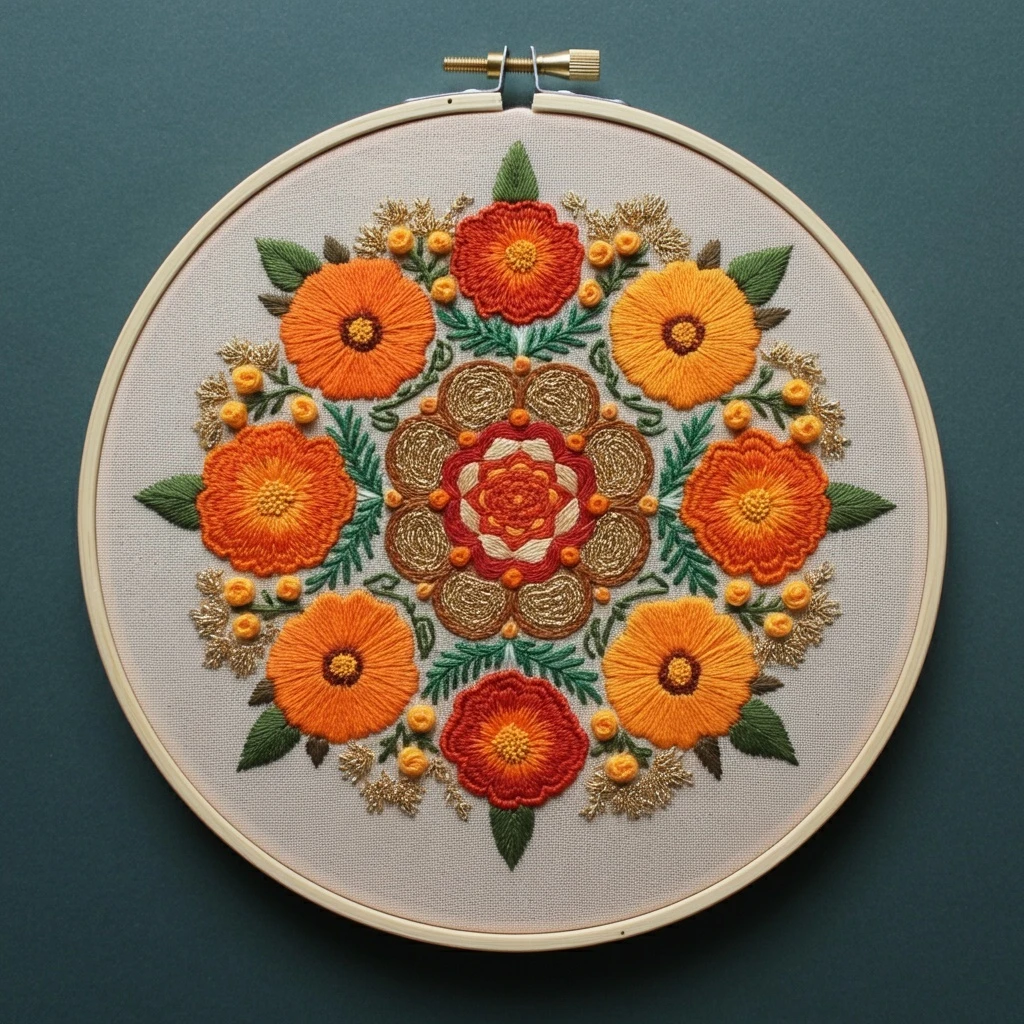
Warm Toned Mandala Floral Hoop Art
A polished DMC floss palette and practical hand-embroidery plan for a symmetrical hoop design with marigold-orange blooms, red-orange scalloped flowers, golden textured medallions, ferny green spokes, and soft metallic-looking accents.
Preview & Color Reading
Colors are estimated from the visible hoop preview and matched to close DMC embroidery floss shades. The design relies on clean symmetry: repeated flower units around a central rosette, warm petal gradients, crisp green foliage, and small raised knots that make the mandala feel dimensional.
Likely DMC Color Palette
Stitching Suggestions
| Element | Stitch Type | Practical Notes |
|---|---|---|
| Large orange flowers | Long and short stitch or padded satin stitch | Work from the petal edge toward the center, following each petal’s curve. Blend 721 with 742 toward the light edge and add 720 at the base for depth. |
| Red scalloped blooms | Split stitch outline plus long and short fill | Outline the wavy petals first so the scallops stay crisp. Use 720 on the outer ridges and 347 near the petal folds and center. |
| Central mandala rosette | Satin stitch, chain stitch, and tiny backstitch | Keep each repeated petal the same length. Stitch opposite petals in pairs so the motif stays balanced rather than drifting to one side. |
| Golden medallion petals | Whipped backstitch spirals or couching | Build spiral texture with 3826, then whip or couch with 783 or 676 for a soft metallic impression without needing metallic floss. |
| Flower centers | French knots or colonial knots | Use 1-2 wraps in 783, then add a few 975 knots in shadowed centers. Keep knots small and clustered for a raised seed texture. |
| Small orange buds | Woven wheel roses or French knots | For round buds, use 742 as the main color and tuck a single 721 stitch at the lower edge for shade. |
| Ferny greenery | Stem stitch plus straight stitches | Use 500 for the main stems and 699 for fine angled fronds. Keep frond stitches light and separated so the mandala does not feel crowded. |
| Outer dark leaves | Fishbone stitch | Start at the leaf tip and work toward the base with 3364, adding a few 699 stitches along the top ridge to catch light. |
| Lacy gold filler sprigs | Straight stitch, fly stitch, or detached chain | Use one strand of 676 for delicate dried-grass texture. Place these after the main flowers so they sit lightly in the background. |
| Final outlines | One-strand split stitch or backstitch | Outline only the areas that need definition: scalloped flowers, medallion edges, and central rosette details. Avoid heavy outlines on airy greenery. |
Thread Count & Blending Guide
- 2 strands for most flower fills, leaf fishbone stitch, and bold mandala petals.
- 1 strand for fine outlines, small fronds, gold filler sprigs, and crisp inner details.
- 3 strands only for padded centers or woven-wheel buds where a raised texture is desired.
- Blend 721 + 742 in the same needle for glowing orange-yellow petals.
- Blend 720 + 347 for red-orange shadows in the scalloped flowers and central rosette.
- Blend 3826 + 783 for warm medallions that read like antique gold.
Shading & Texture Notes
- Keep the brightest color on petal tips and the darkest color close to the flower center.
- Use stitch direction as shading: radial stitches make the big blooms look round and full.
- For gold medallions, spiral stitches look more dimensional than flat satin fill.
- Place raised knots last so they stay clean and do not snag while filling larger areas.
- Repeat each color choice around the hoop to preserve the mandala rhythm.
Beginner-Friendly Stitch Order
Begin by marking the vertical and horizontal center lines of the design with a removable pen or a single basting thread. Stitch the central rosette first, then move outward to the golden medallions. Next, complete the large orange and yellow flowers in opposite pairs so the hoop stays visually balanced.
After the main flowers are complete, add dark leaves and fern stems, followed by the lighter gold filler sprigs. Finish with French knots, woven buds, and any one-strand outlines. This order protects the raised details and makes it easier to keep the circular composition neat.