
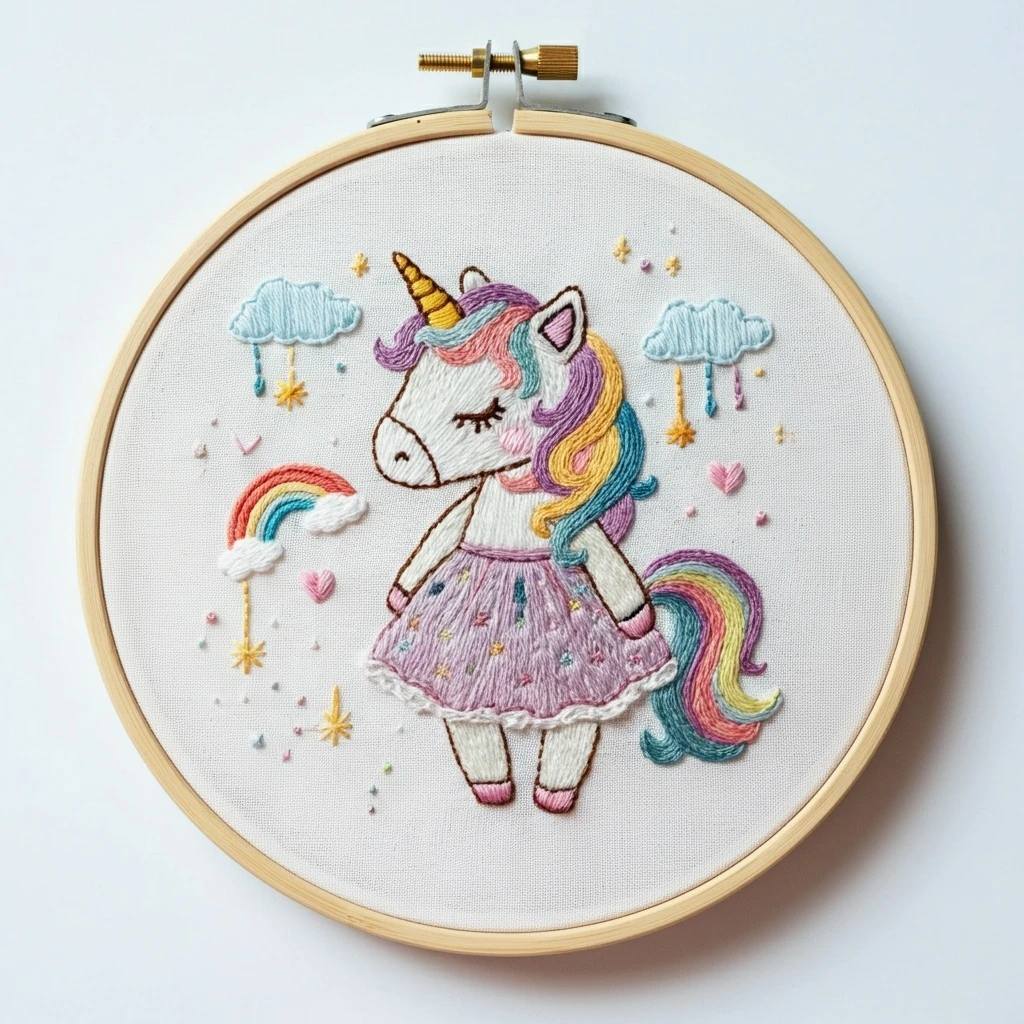
Whimsical Unicorn
A soft fantasy hoop with a pale unicorn, flowing pastel mane, shining horn, and airy floral accents. The stitching approach below keeps the design sweet and dimensional while staying approachable for confident beginners.
Design Color Read
The reference suggests a dreamy unicorn portrait built around creamy whites, blush pinks, lilacs, pale aqua, and warm golden accents. Keep the unicorn body mostly light so the mane, horn, flowers, and tiny magical details carry the color.
Use fine outlining to preserve the whimsical illustration style: a soft gray-lavender line is gentler than black, while tiny touches of gold and white make the horn and sparkle marks feel luminous.
Quick Stitching Strategy
- Stitch the body first with light fills, then add mane sections over the edge for flow.
- Work the horn before nearby hair so its spiral stays crisp.
- Save eyes, nostril, sparkle dots, and flower centers until the end.
- Use shorter stitches around curves to avoid bulky outlines.
Suggested DMC Palette
Stitch Types by Area
| Area | Best Stitches | Practical Notes |
|---|---|---|
| Unicorn face & neck | Long-and-short stitch, satin stitch, split stitch outline | Use 1 strand for shaded fills and 2 strands only for larger smooth areas. Follow the curve of the cheek and neck. |
| Mane | Stem stitch, split stitch, long-and-short stitch | Let strands travel in the direction of the hair. Blend pink, lavender, and aqua by alternating short rows. |
| Horn | Satin stitch, whipped backstitch, couching | Fill the horn in pale gold, then add diagonal spiral lines in a darker gold/brown using 1 strand. |
| Flowers | Lazy daisy, satin stitch, woven wheel, French knots | Use 2 strands for petals, 1 strand for tiny petal outlines, and French knots for cheerful centers. |
| Leaves & stems | Fishbone stitch, fly stitch, stem stitch | Keep leaves small and neat; vary greens to create depth without crowding the face. |
| Sparkles | Straight stitch, star stitch, colonial knots | Use B5200 or 726, and keep knots tiny so they read as light rather than beads. |
Thread Count Guidance
- 1 strand: facial outline, eyelash, nostril, horn spirals, delicate sparkle rays, and fine mane separation.
- 2 strands: most petal fills, mane lines, leaf stitches, and medium outlines.
- 3 strands: bolder flower centers, accent knots, or decorative stars only if the hoop scale is large.
- Blended needle: combine one strand 605 + one strand 211 for a soft cotton-candy mane transition.
Blending Ideas
For the mane, work in narrow curved bands rather than flat blocks. Start with 605 near the flower crown, shift into 211, then feather in 3846 or 955 at the tips. A blended needle of one pink and one lavender strand creates a soft in-between tone.
Outlining Details
Use DMC 3042 for most contour lines to keep the design gentle. Reserve DMC 3371 for the eye and nostril only. Split stitch gives a refined illustrated edge; backstitch is faster and beginner-friendly.
Texture Suggestions
Add small French knots to flower centers, tiny straight stitches for starbursts, and short directional stitches around the cheek for soft fur. Avoid dense knots on the body; the unicorn should remain smooth and airy.
Beginner-Friendly Workflow
- Transfer lightly: use a fine washable pen and keep facial features as delicate as possible.
- Stabilize the fabric: hoop tightly and re-tighten between color changes so satin areas stay smooth.
- Start with pale fills: stitch the face, neck, and horn first with clean hands to protect light floss.
- Build color second: add mane bands, then florals and leaves, working from larger motifs to smaller accents.
- Finish with linework: add the eye, nostril, horn spiral, sparkle marks, and any final outline after fills are complete.
- Control bulk: do not carry dark threads behind pale body areas; weave them off and restart instead.