
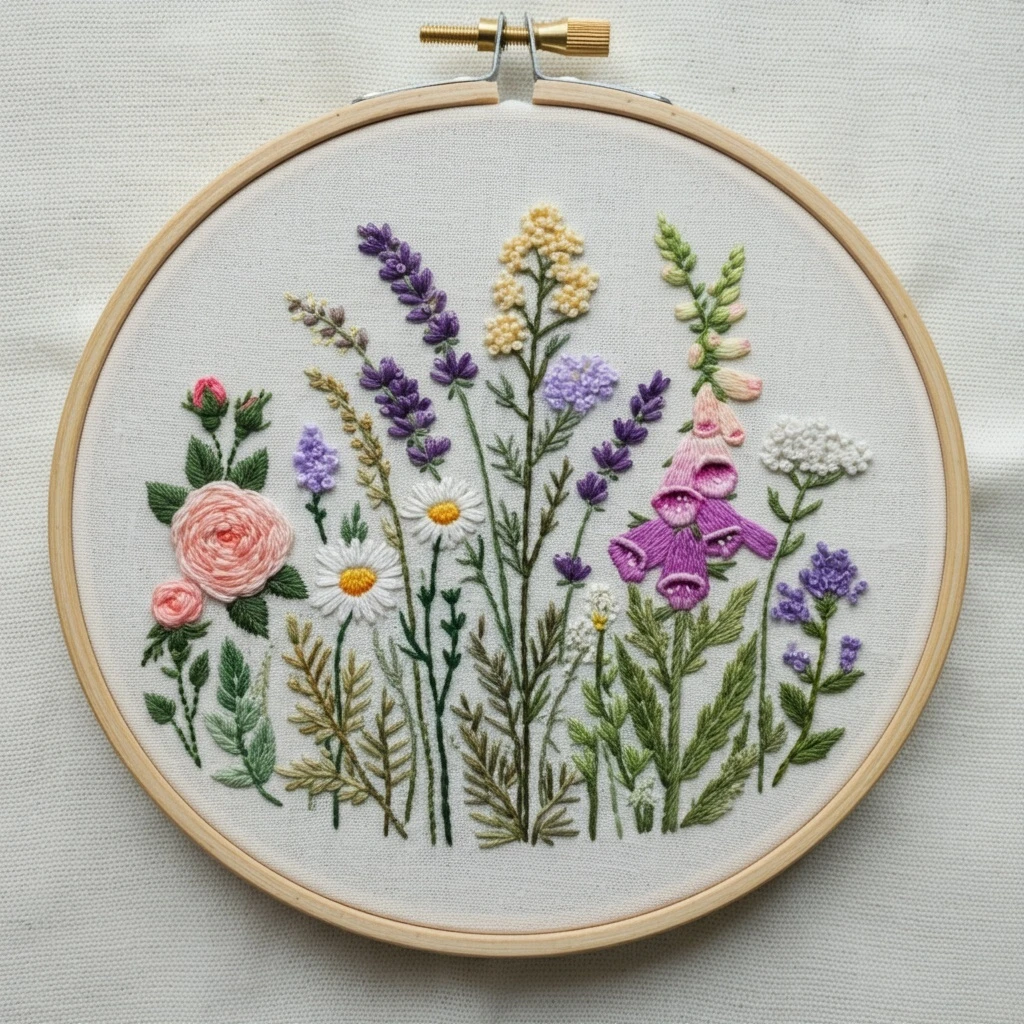
Wildflower Meadow
A polished DMC floss palette and practical hand-embroidery plan inspired by a gathered meadow of pink roses, white daisies, lavender sprigs, foxglove bells, yarrow-style clusters, and fine green stems worked inside a wooden hoop.
Likely DMC Color Palette
Colors are estimated from the visible stitched preview: cream linen, deep and olive greens, blush pink roses, white petals, golden centers, lavender sprigs, rich purple foxgloves, and pale yellow-white clustered blooms. Percentages are visual emphasis estimates, not exact yardage.
Stitching Suggestions
This meadow works best when the stems are fine and directional, the clustered blooms are raised, and the focal flowers have visible petal movement. Keep the lower foliage airy so the arrangement feels natural rather than filled solidly.
| Element | Recommended Stitch | Practical Notes |
|---|---|---|
| Pink rose | Woven wheel, whipped wheel, or loose spiral satin stitches | Begin with 3733 at the center, then move outward with 3713 and 761. Keep the outer wraps relaxed so the rose looks softly layered. |
| Rose buds | Small satin stitch plus split stitch base | Use 3733 for the tucked inner fold and 761 on the outer curve. Add a dark green calyx with one-strand straight stitches. |
| Daisies | Lazy daisy stitch or straight stitch petals | Work each petal from the yellow center outward. Use 3865 with a touch of 644 at the base for quiet shadow. |
| Daisy centers | French knots or colonial knots | Cluster 725 knots with a few 782 knots low on the center. One or two wraps are enough for a neat raised middle. |
| Lavender spikes | Detached chain, lazy daisy, or padded straight stitches | Alternate 552 and 550 on each side of a stem. Add 340 sparingly on the light-facing buds. |
| Foxglove bells | Long and short stitch with split-stitch outline | Outline in 550, fill bell bodies with 3607, then add 3733 in the throat and tiny 3865 highlight dots along the lower lip. |
| White yarrow cluster | French knots, colonial knots, and seed stitch | Use 3865 for the brightest knots, 644 for shadow knots, and a few 677 knots to warm the cluster so it reads dimensional. |
| Yellow plume | French knots over fine stem stitch | Stitch the branching stem first in 895/3012, then scatter 677 and 725 knots unevenly for a fluffy wildflower head. |
| Leaves | Fishbone stitch, fly stitch, and straight stitch | Use fishbone for the larger rose leaves and quick straight stitches for ferny meadow foliage. Vary greens within each plant. |
| Fine stems and grasses | Stem stitch, backstitch, or couching | Use one strand for delicate vertical stems. Two strands only for the main rose stems and thicker foreground grasses. |
Thread Count, Blending & Shading
Thread-count guidance
- 1 strand: fine stems, hairline grass, petal outlines, foxglove detail marks, and delicate leaf veins.
- 2 strands: most petals, medium leaves, lavender buds, daisy petals, and standard stem stitch.
- 3 strands: rose wraps, larger satin areas, and padded foxglove sections when you want stronger coverage.
- 6 strands: avoid for most of this design; it can overpower the meadow scale unless used for a single bold knot accent.
Blending ideas
- Rose petals: combine one strand 761 with one strand 3713 for soft peach-pink transitions.
- Lavender: blend 552 with 340 for mid-tone buds; reserve 550 for undersides and narrow shadows.
- Greens: blend 895 with 3012 for older stems, and 3012 with 3052 for fresh leaf tips.
- White flowers: place 644 beside 3865 rather than overusing pure white everywhere.
Where to Start
Map the stems first
Use one strand of medium green to stitch the tallest stems and main plant lines. This prevents crowded flowers from drifting out of place.
Add focal blooms
Work the rose, daisies, foxgloves, and large lavender stems next. Complete their main shapes before adding tiny filler blooms.
Finish with texture
Save French knots, seed stitches, white clusters, and final dark outlines until the end so they stay crisp and raised.
Beginner-Friendly Practical Tips
Clean stitch control
Keep the fabric drum-tight in the hoop, but do not pull knots so hard that they pucker the linen. For long stems, rotate the hoop so each stitch follows the natural curve of the plant.
Texture without clutter
Let some stems remain simple backstitch lines. If every plant is heavily filled, the meadow loses its delicate look. Raised knots should be concentrated on flower heads and centers.
Outlining details
Use split stitch for smooth rose and foxglove edges, and backstitch for crisp stems. Outline only the shadow side of white petals with 644 to keep them soft.
Finishing order
After stitching, check the design from arm’s length. Add only a few final dark green or violet accents where forms need definition, then stop before the meadow becomes too dense.