
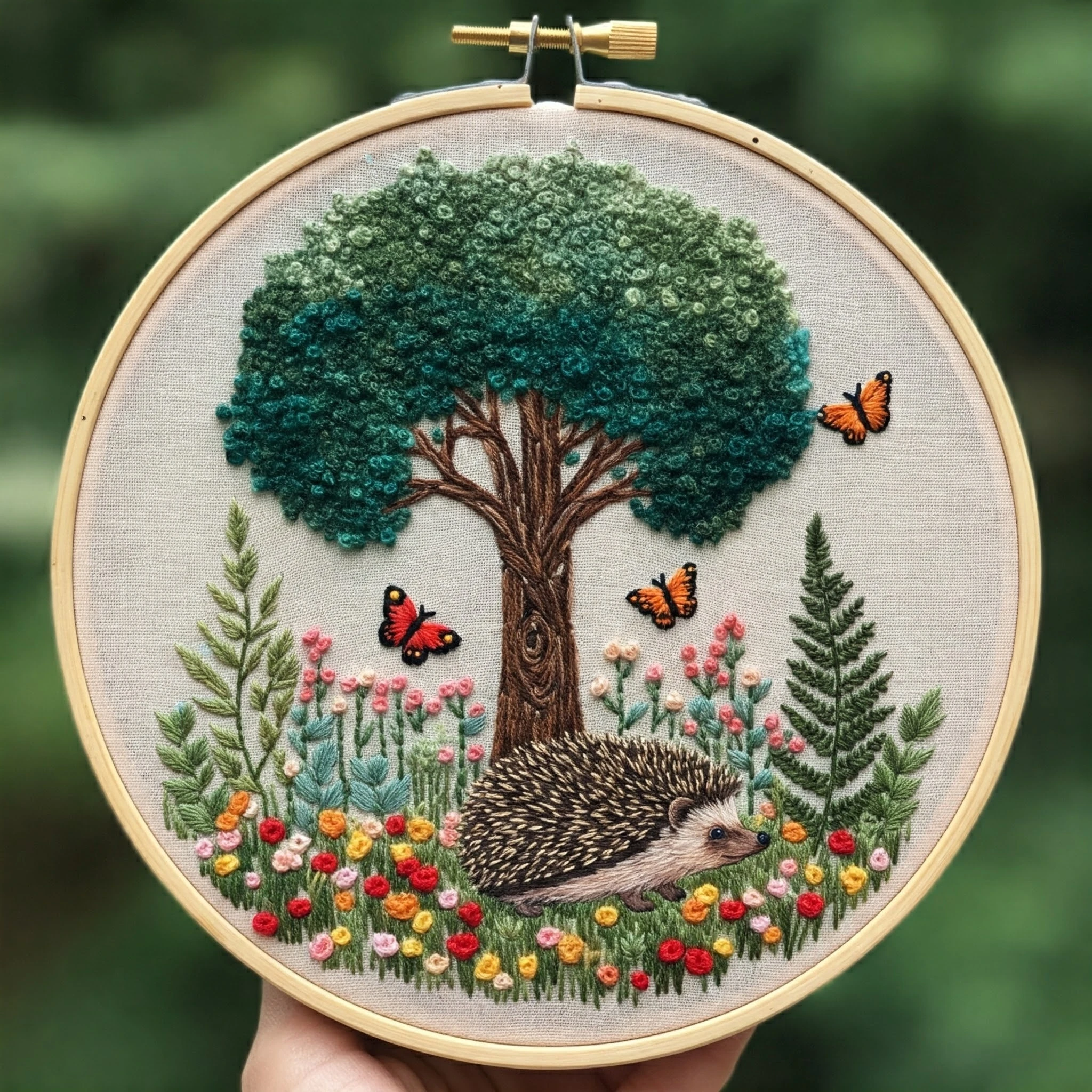
Woodland Hedgehog
A warm forest-floor embroidery guide built around a small hedgehog with tawny quills, soft cream facial highlights, mossy leaves, and rustic botanical accents. The palette favors layered browns, muted greens, and gentle autumn details so the finished hoop feels cozy without becoming heavy.
Design read
This design works best when the hedgehog is the warm focal point and the greenery acts as a loose wreath around it. Keep the face smooth, the quills directional and lively, and the surrounding leaves slightly varied in green so they feel natural rather than flat.
Thread-count guidance
| Area | Strands | Why it works |
|---|---|---|
| Face and belly | 1-2 strands | Fine satin and long-short shading stay soft. |
| Quills | 2 strands | Enough texture for little spikes without bulk. |
| Leaves and stems | 1-2 strands | Thin stems stay delicate; leaves can be filled lightly. |
| Eyes, nose, tiny accents | 1 strand | Prevents facial details from overpowering the animal. |
Suggested DMC palette
Stitch map
| Design element | Recommended stitches |
|---|---|
| Hedgehog face | Long and short stitch, small satin stitch, one-strand split stitch outline. |
| Quill coat | Layered straight stitches, seed stitch, fly stitch, and short detached chain for prickly texture. |
| Leaves | Fishbone stitch for medium leaves; lazy daisy for tiny leaves; stem stitch veins. |
| Stems and tendrils | Stem stitch or backstitch with one strand; couch longer curves if needed. |
| Berries and dots | French knots or colonial knots using two wraps for raised woodland accents. |
| Ground texture | Scattered seed stitch and short straight stitches in mixed browns and greens. |
Blending & shading
- Blend one strand DMC 801 with one strand DMC 975 for a warm quill midtone that avoids harsh striping.
- Use DMC 437 under DMC 738 on the face so the pale muzzle looks rounded rather than flat white.
- Place DMC 898 only where the quills tuck behind the body, around the feet, or beneath foliage.
- Alternate DMC 3011 and 3012 on leaves; add DMC 936 at the base of leaves that sit behind the hedgehog.
- For a softer nursery-style finish, replace some DMC 3371 outlines with DMC 898.
Outlining details
Use one strand for the face outline and two strands only for the outer quill silhouette. Break the outline into tiny dashes rather than one continuous dark border, especially around the cheeks and belly.
Texture suggestions
Let the quills overlap in uneven lengths. Add a few single-strand highlight stitches in DMC 402 or 437 across the coat to make the hedgehog feel fluffy and rounded.
Fabric choice
Natural linen, oatmeal cotton, or warm cream fabric suits the woodland palette. Avoid stark white cloth unless you deepen the greens and browns for contrast.
Beginner-friendly stitching order
Practical tips
- Use shorter floss lengths for the quill area because textured stitches wear thread quickly.
- Keep your hoop fabric drum-tight; loose fabric makes satin and long-short stitches ripple.
- Step back often to check the silhouette. A hedgehog reads correctly when the face stays soft and the back edge stays spiky.
- Do not overfill every space. Small fabric gaps between quill strokes make the texture look intentional.
Finishing notes
Press the finished work from the back on a folded towel so knots and quills keep their dimension. Frame in a wooden hoop or simple walnut-toned frame to echo the woodland browns. If gifting, add a tiny stitched initial near the ground line in DMC 3011 so it blends naturally with the foliage.