
DMC palette & hand embroidery notes
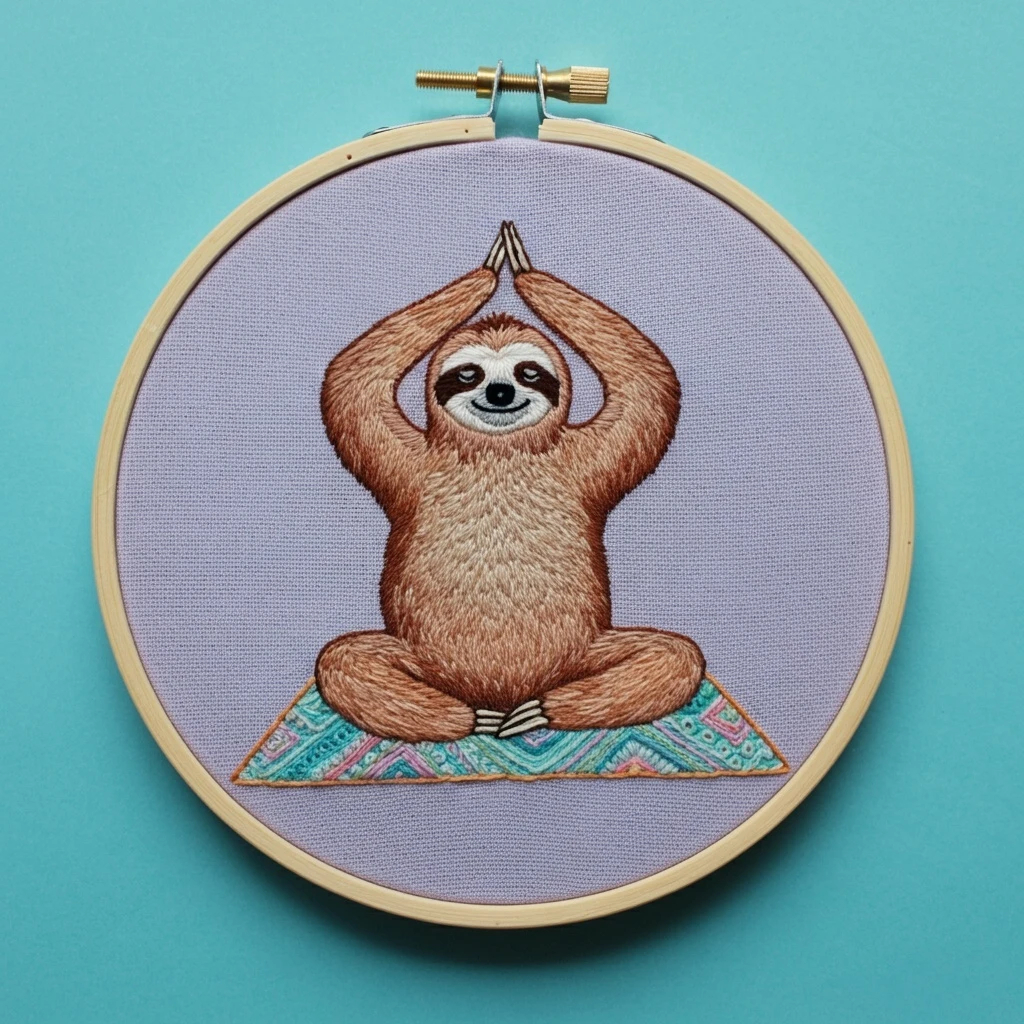
Zen Sloth
A calm woodland hoop with a soft, sleepy sloth mood: warm cocoa fur, creamy facial markings, leafy greens, gentle florals, and relaxed rounded lines. The stitching approach should feel plush, slow, and meditative, with layered texture rather than hard outlines.
Design read
This design is best treated as a small character portrait with surrounding nature details. Keep the sloth rounded and cuddly, reserve the highest contrast for the eyes, nose, claws, and main facial mask, and use lighter stitch density in the background leaves so the animal stays central.
Visual focus
The face, paws, and relaxed posture should be the crispest areas. Use subtle split-stitch outlines and directional long-and-short stitches to keep the expression soft.
Color mood
Warm browns, beige, cream, olive, sage, and tiny blush or floral accents create a peaceful woodland meditation feel.
Texture goal
Build fur with staggered, broken rows rather than solid satin blocks. Leaves can be cleaner and flatter to contrast with the sloth’s fuzzy body.
Suggested DMC color palette
Use the palette as a practical floss map. The browns carry the sloth, creams shape the face, greens support leaves and vines, and small accent colors add warmth without making the design busy.
Stitch plan by area
1Sloth fur
Use long-and-short stitch in loose, directional rows. Alternate 3862 and 3863 for the main coat, then tuck 898 into the lower edges and under the arms. Add a few single-strand fly stitches or short straight stitches on top for fuzzy stray hairs.
2Face and muzzle
Fill the face mask with split stitch or padded satin in 3864, blending small touches of 3865 near the brow and muzzle. Keep stitches short around the eyes so the expression remains neat.
3Eyes, nose, claws
Use 3371 or 938 with one strand. Make eyes with tiny satin stitches or French knots, then place a single 3865 highlight beside each eye. Claws look best as small tapered straight stitches.
4Leaves and vines
Stem stitch the vines in 3011 or 3012. Fill leaves with fishbone stitch for a central vein effect, or use lazy daisy stitches for quick rounded foliage. Add 3053 only on one side of each leaf for light.
Thread-count guidance
| Element | Recommended strands | Reason |
|---|---|---|
| Outer fur and body fill | 2 strands | Gives soft coverage without becoming bulky; allows layered color changes. |
| Face details, eyes, nose, claws | 1 strand | Keeps tiny features expressive and controlled. |
| Leaves and floral accents | 2 strands for leaves, 1-2 for flowers | Leaves need visible shape; flowers should stay delicate. |
| Final outline | 1 strand, occasionally 2 on outer silhouette | Creates a clean edge without flattening the cozy texture. |
Blending, shading & outlining
Blending ideas
- Blend 3862 + 3863 in the same needle for soft middle fur transitions.
- Blend 898 + 3862 for shaded underside areas where the body curls inward.
- Use 3864 + 3865 for creamy muzzle highlights; keep the blend sparse.
- For leaves, blend 3012 + 3053 to create a muted sage highlight.
Outlining details
- Use split stitch around the face mask for a soft, slightly furry edge.
- Use back stitch only for tiny facial features and crisp claws.
- Use stem stitch for vines so the botanical lines feel organic.
- Avoid outlining every fur patch; let color changes define the form.
For the calm “zen” feeling, keep contrast gradual. The darkest colors should appear in small doses at the eyes, nose, paw creases, and the deepest folds, not across the whole figure.
Texture suggestions
Fuzzy body
After the main fill is complete, add scattered one-strand straight stitches in slightly different directions. This gives the sloth a plush surface without needing advanced needle painting.
Soft cheeks
Use tiny satin or split stitches that curve around the muzzle. A few 407 stitches can warm the face, but keep blush very light.
Botanical calm
Use repetitive lazy daisy and fishbone leaves around the sloth to create a relaxing rhythm. Repeat colors rather than adding too many new ones.
Beginner-friendly practical tips
Before stitching
- Transfer the facial features extra clearly; they are the personality of the design.
- Separate floss fully before recombining strands to reduce knots.
- Stitch the background leaves first if they sit behind the sloth, then the body, then the face.
- Keep the fabric drum-tight in the hoop to prevent puckering around dense fur.
While stitching
- Work fur in small patches rather than filling the whole body in one direction.
- Step back often; soft animal portraits read better from a little distance.
- Use shorter thread lengths for dark browns because they show fuzz and wear quickly.
- Finish with the eyes last so they stay crisp and clean.