
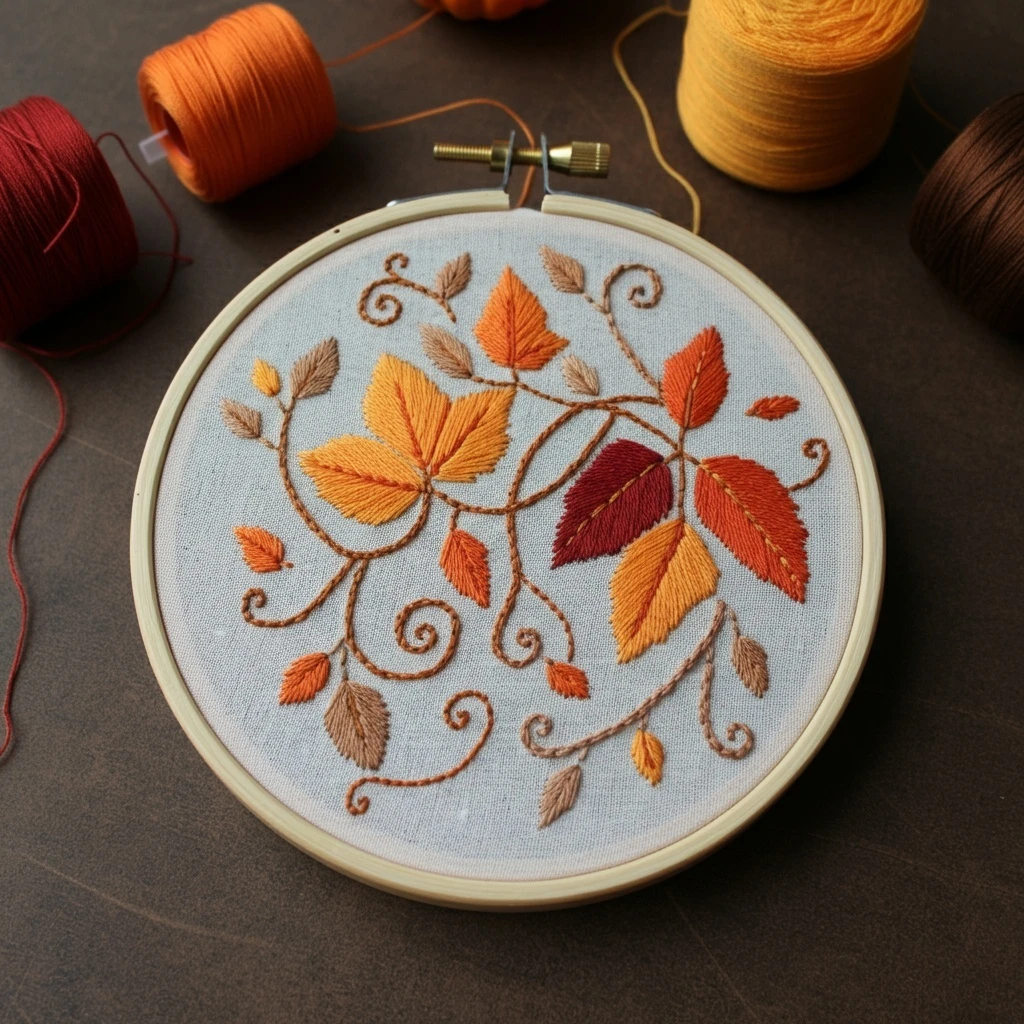
Autumn Leaves
A warm, beginner-friendly embroidery guide for a leafy autumn hoop: glowing maple tones, toasted browns, olive-green accents, and fine vein lines that make each leaf feel crisp, layered, and dimensional.
Suggested DMC Floss Palette
Choose 8–10 colors for a simple version, or use the full set for richer shading and more leaf variety.
Stitch Map
| Area | Recommended stitches | Thread count | Practical notes |
|---|---|---|---|
| Large leaves | Long and short stitch, satin stitch | 2 strands fill; 1 strand edges | Follow the leaf direction from base to tip. Alternate 921, 922, 920, and 783 to create natural mottling. |
| Leaf veins | Stem stitch, back stitch, split stitch | 1 strand | Use 898 or 3371 for main veins; switch to 975 or 738 for softer secondary veins. |
| Small leaves | Fishbone stitch, lazy daisy | 2 strands | Fishbone gives fast texture and a central vein in one pass, ideal for beginners. |
| Branches and stems | Stem stitch, whipped back stitch | 2 strands stem; 1 strand whip | Whip with 975 over 898 for a rounded bark effect without bulky knots. |
| Speckles / seeds | French knots, colonial knots | 1–2 strands | Scatter 742 and 738 knots lightly; avoid making them perfectly even. |
Blending & Shading
Warm leaf blend
921 + 922920 + 783721 + 742
- Use one strand of each color in the needle for instant tonal variation.
- Place darker stitches at leaf bases and where one leaf tucks under another.
- Add bright 742 only on outer tips and upper curves to keep highlights believable.
Natural aging effect
Work irregular patches of 730 or 732 into orange leaves to suggest leaves changing color. A few olive stitches near the center vein make the motif feel more botanical and less flat.
Texture Suggestions
Crisp edges
Outline the final leaf silhouette with 1 strand of 898 or 3371 using split stitch. For a softer printable-pattern look, outline only the underside and inner folds.
Raised details
Use whipped stem stitch for thick central veins and French knots for small berries or seed dots. Keep raised work near the center so the hoop edge remains smooth.
Beginner-Friendly Workflow
Order of stitching
- Stitch stems and central veins first to anchor the layout.
- Fill large leaves from the center vein outward.
- Add small leaves, seeds, and decorative sprigs.
- Finish with selective outlines and final highlights.
Tension and fabric tips
- Use a tightly hooped cotton or linen so satin stitches stay smooth.
- Shorten long satin spans by splitting leaves into sections along the veins.
- Let thread untwist often; orange and brown floss shows twists easily.
- Test knots on scrap fabric before placing them on the finished hoop.
Simple Palette Version
For a quick stitch, use only DMC 921, 922, 783, 898, 975, 730, and 738. This keeps the design cohesive while still giving enough contrast for veins, golden highlights, and muted green accents.