
DMC palette & embroidery tips
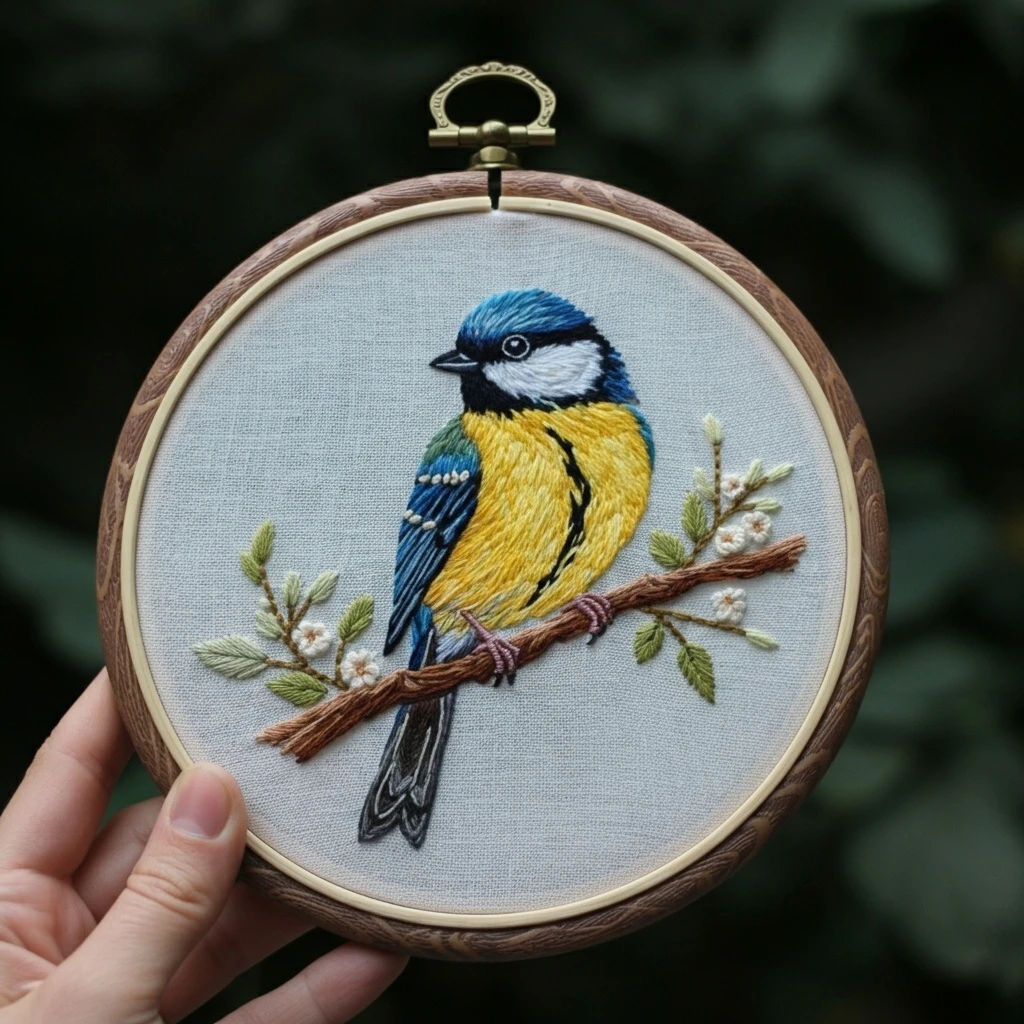
Detailed Blue Tit
A bright garden-bird embroidery with cobalt and sky-blue wing feathers, a sunny yellow breast, crisp black head markings, creamy white cheeks, twiggy bark texture, soft green leaves, and tiny white blossom accents.
Suggested DMC Color Palette
Use the darkest values sparingly for definition, then build the bird with short directional stitches so the plumage keeps a soft, natural texture.
DMC 310
Black
Eye, beak tip, collar, wing dividers, and the deepest tail accents.
DMC 823
Navy Blue – Dark
Deepest cap, outer wing feathers, tail shadows, and blue-black contours.
DMC 798
Delft Blue – Dark
Main blue wing sections and shaded side of the crest.
DMC 3845
Bright Turquoise – Medium
Bright crest highlights and lively blue feather flashes.
DMC 725
Topaz – Medium Light
Golden yellow breast base and sunny central feather strokes.
DMC 783
Topaz – Medium
Lower belly shading and warm folds beneath the wing.
DMC 3865
Winter White
Cheek feathers, flower petals, tiny wing spots, and eye catchlight.
DMC 762
Pearl Gray – Very Light
Soft cheek shadows and pale gray feather transitions.
DMC 413
Pewter Gray – Dark
Tail feather interiors and quiet gray details over black outlines.
DMC 898
Coffee Brown – Very Dark
Branch shadow ridges and darkest bark grooves.
DMC 938
Coffee Brown – Ultra Dark
Twisted twig underside, branch ends, and very fine bark cracks.
DMC 3012
Khaki Green – Medium
Leaf bases, olive bud stems, and muted garden greenery.
DMC 3051
Green Gray – Dark
Leaf shadows and cool underside veins.
DMC 3047
Yellow Beige – Light
Bud tips, blossom centers, and soft fabric-friendly highlights.
DMC 3727
Antique Mauve – Light
Bird feet and subtle rosy shadows on claws around the branch.
DMC 168
Pewter – Very Light
Optional fabric-tone separator for pale cheek edges on gray linen.
Stitch Map
- Blue cap and wing: use short-and-long stitch in the direction feathers grow; alternate 823, 798, and 3845 for depth.
- Yellow breast: fill with loose long-and-short stitches, curving downward from the throat and sweeping toward the belly.
- White cheek: use satin stitch or split stitch rows in 3865, then add a few 762 shadow strokes near the black mask.
- Branch: work stem stitch and split stitch in browns, layering darker ridges over a medium base for bark texture.
- Leaves and blossoms: use fishbone stitch for leaves, detached chain or tiny satin stitches for petals, and French knots for centers.
Thread Count Guide
| Area | Strands | Reason |
|---|---|---|
| Fine outlines, eye, beak | 1 strand | Keeps the head markings sharp and prevents heavy black edges. |
| Feather fill | 1–2 strands | Allows soft blending and small directional feather strokes. |
| Breast fill | 2 strands | Gives a plush yellow body without losing stitch direction. |
| Branch and large leaves | 2–3 strands | Adds tactile texture and visual weight under the bird. |
| Blossoms, buds, catchlight | 1 strand | Keeps tiny pale accents clean and delicate. |
Blending & Shading Plan
Outlining Details
Use split stitch or backstitch with one strand of 310 for the mask, beak, and narrow breast line. For the tail, soften the black outline by couching or adding 413 inside the feathers. Avoid outlining every feather equally; reserve the darkest lines for separation points so the bird remains dimensional.
Texture Suggestions
For fluffy plumage, let stitches overlap like tiny brush marks rather than forming a smooth satin block. Add a few intentionally uneven blue and yellow strokes at the feather edges. On the branch, combine stem stitch with small straight stitches in alternating browns to imitate bark grain.
Beginner-Friendly Practical Tips
- Use a 6-inch hoop with the fabric drum-tight; feather stitches look cleaner when the cloth does not flex.
- Cut shorter lengths, around 14–16 inches, for the blue and yellow fills to reduce fuzz and keep color changes crisp.
- Blend by alternating single stitches of neighboring colors instead of mixing too many strands in the needle at once.
- For the eye, stitch a black satin dot, add a tiny 3865 catchlight, then outline the eye ring with one strand of pale gray or white.
- If the cheek disappears on pale linen, add a whisper-thin 168 or 762 shadow line on the lower edge.
- Press from the back over a folded towel after stitching to protect raised knots, bark ridges, and blossom centers.