
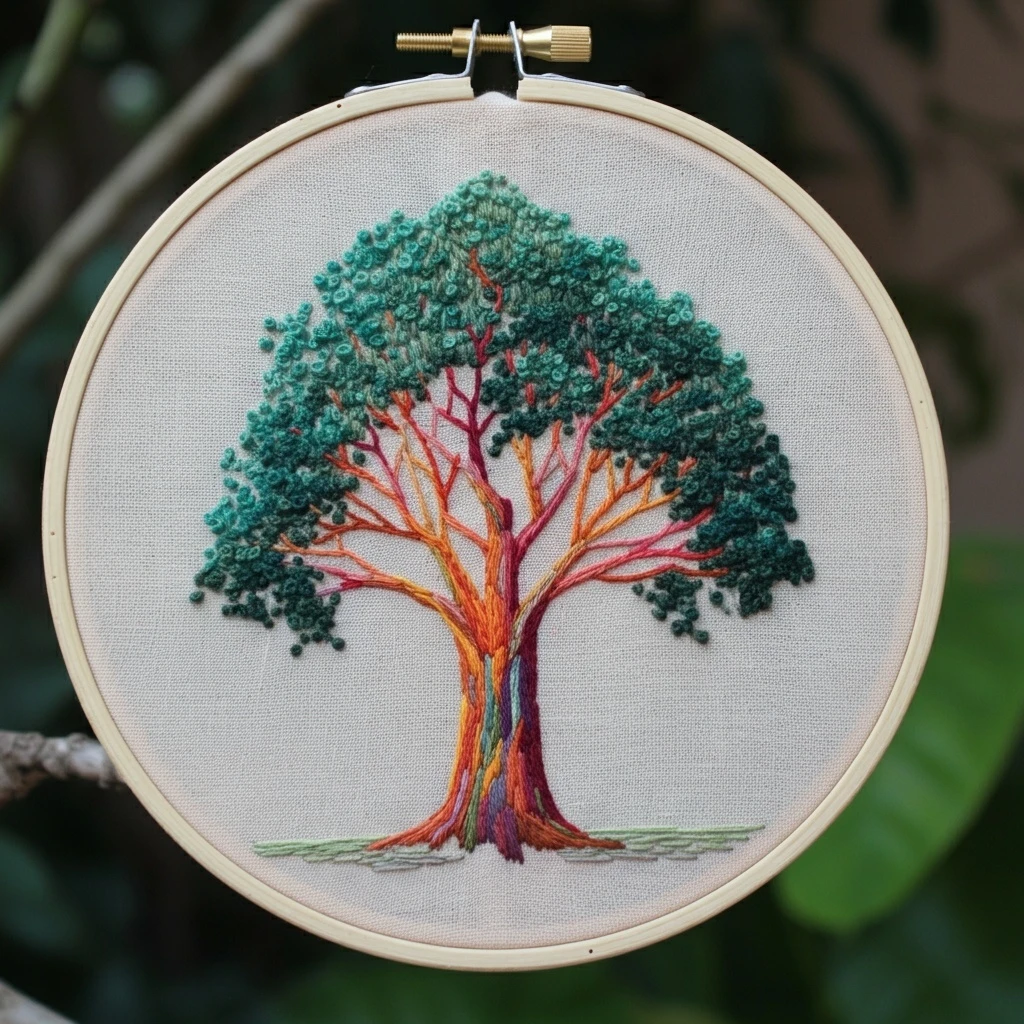
DMC Palette & Stitching Guide
Enchanted Grove Tree
A luminous tree-hoop design built around a rounded teal-green canopy, lively French-knot foliage, and a striking trunk of flame orange, bark brown, burgundy, magenta, and shadowy violet. The mood is woodland, magical, and textural rather than flatly filled.
Likely DMC Color Palette
Palette based on the deep rounded foliage, teal leaf highlights, warm branching structure, multicolor trunk ribbons, pale ground stitches, and natural fabric background. Coverage is a visual estimate, not exact thread usage.
500
Blue Green Very Dark
Deepest canopy pockets, underside shadows, dense lower foliage, and tiny dark knots that make the tree crown feel full.
501
Blue Green Dark
Main evergreen-teal mass of the rounded crown; excellent for French knots and short seed stitches across the middle canopy.
502
Blue Green
Soft transition areas, lighter leaf clusters, and visible highlights along the top and outer canopy edge.
3813
Blue Green Light
Sparkling leaf tips and occasional knots placed on top of darker greens to create the enchanted, airy surface texture.
3363
Pine Green Medium
Earthier green shadows inside the canopy and small leafy clumps near the lower hanging edges.
3052
Green Gray Medium
Ground line, grassy base strokes, and subtle muted greenery so the bottom does not compete with the bright trunk.
900
Burnt Orange Dark
Dominant warm trunk ribbons, exposed roots, and orange branch arms that give the tree its glowing grove effect.
946
Burnt Orange Medium
Bright highlights running up the trunk and branches; blend beside 900 for firelit bark movement.
921
Copper
Warm branch outlines, root shadows, and reddish-brown bark streaks where orange needs extra depth.
915
Plum Dark
Central burgundy trunk vein, dark inner branch forks, and dramatic shadow accents along the right side.
777
Raspberry Very Dark
Pink-red branch lines and vivid root tips; use sparingly to keep the design magical without overpowering the greens.
550
Violet Very Dark
Narrow shadow ribbons in the trunk base and deep accents where branches tuck behind the canopy.
Stitching Suggestions
The design works best when the canopy is raised and dotted, while the trunk stays directional and smooth. Finish with crisp branch lines on top so the tree keeps its graceful silhouette.
| Element | Stitch Type | Practical Notes |
|---|---|---|
| Rounded canopy | French knots, colonial knots, seed stitch | Use 2 strands for most knots. Mix 500, 501, 502, and 3813 randomly, placing darker shades under the crown and lighter knots near the top and edge. |
| Canopy base texture | Short straight stitches and split stitch | Before adding knots, lay scattered short stitches in 501 and 3363 to create a soft green underlayer that hides fabric gaps. |
| Main trunk | Long and short stitch, stem stitch | Work vertical ribbons following the trunk curve. Alternate 900, 946, 921, 915, and 550 so the bark looks braided and enchanted. |
| Branches | Stem stitch, split stitch, whipped backstitch | Use one strand for fine upper twigs and two strands for stronger limbs. Add orange first, then deepen select forks with plum or raspberry. |
| Roots | Split stitch and tapered straight stitches | Fan the roots outward with decreasing stitch length. Keep the outermost root ends thin so they taper naturally into the fabric. |
| Ground line | Straight stitch, running stitch, couching | Use 3052 with a few pale gray-green strokes. Keep this area low and horizontal so it anchors the tree without stealing attention. |
| Dark recesses | Tiny backstitch and single knots | Add 500 and 550 after the main stitching only where extra depth is needed: lower foliage, trunk base, and inner branch crossings. |
Thread Count, Blending & Shading
Strand plan
Use 2 strands for canopy knots, trunk filling, and bold roots. Use 1 strand for upper twigs, fine branch outlines, and delicate correction lines. Use 3 strands only for a few raised foreground knots.
Green blending
Thread the needle with one strand of 501 and one strand of 502 for middle canopy transitions. For glowing highlights, pair 502 with 3813 and place those stitches only on visible edges.
Warm bark glow
Blend one strand 900 with one strand 946 for the bright orange trunk lanes. Switch to 921 plus 915 where the bark narrows into shadowed branch forks.
Outlining details
Outline only selected branches, not every edge. A few whipped-backstitch lines in 777 or 915 will define the structure while keeping the tree loose and organic.
Texture control
Keep knot sizes varied: one-wrap knots for distant foliage, two-wrap knots for foreground clusters, and a few colonial knots for raised leafy sparkle.
Fabric choice
Natural linen, oatmeal cotton, or tea-dyed fabric suits the muted background. Avoid very dark cloth unless you plan to brighten all greens by one shade.
Beginner-Friendly Work Order
This order keeps the design clean and prevents raised knots from snagging while you stitch the trunk.
Practical Embroidery Tips
- Use a sharp embroidery needle for dense knots so the thread passes cleanly through previously stitched foliage.
- Do not pull French knots too tight; a soft, raised knot better matches the fuzzy treetop texture in the preview.
- When changing trunk colors, park the next shade close to the previous one and overlap a few stitches to avoid striped blocks.
- Leave some fabric showing between branches inside the canopy. The negative space helps the branch network read clearly.
- Save the brightest teal and orange highlights for the final pass; they are easiest to place once the overall values are balanced.