
DMC Palette & Stitch Guide
Folk Floral
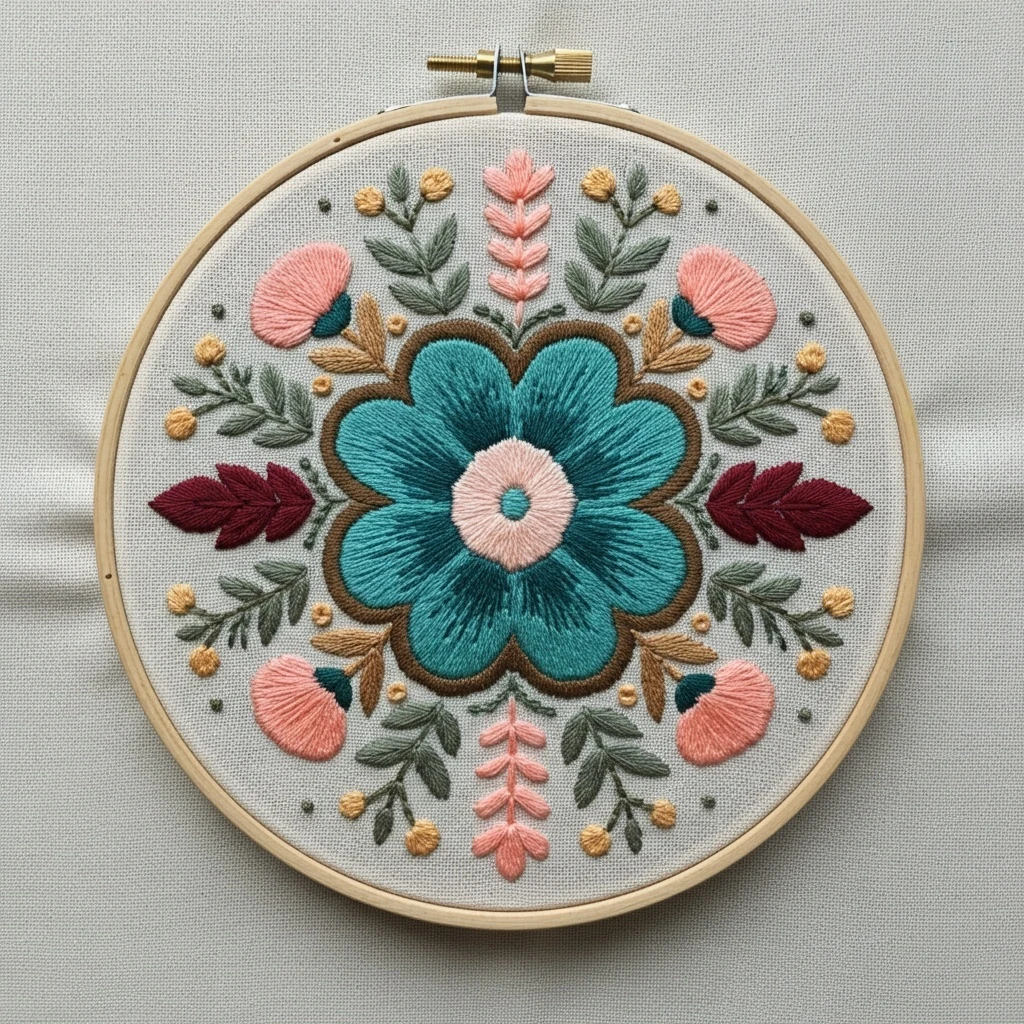
A cheerful, symmetrical hoop design with a bold teal center bloom, coral folk buds, burgundy side leaves, sage greenery, ochre berries, and a warm brown outline. The look is graphic and cozy, so keep stitches tidy, directional, and slightly raised for a hand-crafted folk-art finish.
Design read
Main focus: six-petal teal flower with dark feathered shading and a pale blush center.
Supporting motifs: coral tulip-like buds, burgundy leaves, muted sage sprigs, golden French-knot berries, tan wheat shapes, and brown scalloped outlining.
Suggested DMC Color Palette
Use for the main flower petals; stitch from outer curve toward the center to keep the satin direction graceful.
Add deep strokes near petal bases and between petals for folk-style dimension without overblending.
Best for the upper and lower sprigs plus the large coral side buds; pairs nicely with a peach highlight.
Use for the flower center and soft highlight stitches on coral buds.
Use for the red side leaves; angle each stitch along the leaf vein for rich, velvety texture.
Primary foliage shade for the sage-gray leaves and stems around the wreath.
Use sparingly for shadow veins, tiny dots, and leaf bases to separate repeated greenery.
Golden berries and wheat-like sprays; works beautifully as padded knots or small satin ovals.
Add warm shading to the tan side fronds and a few berry shadows.
Bold scalloped outline around the central flower; use consistent tension for a clean graphic border.
Optional tiny shadow accents at petal joins or under the brown border, used very lightly.
Optional fabric-friendly highlight or correction color for very subtle center sparkle on pale linen.
Where Each Color Works Best
Central flower
Fill the teal petals with DMC 3846, then layer short directional strokes of DMC 3809 from the center outward. Keep the dark teal strokes uneven in length so the shading feels natural and not striped.
long & short stitchsatin stitchsplit outlineCoral buds and blush center
Use DMC 352 as the body color and DMC 353 for the pale circular center and highlight ridges. Fan stitches outward from the base of each bud to mimic the sample’s ribbed petal texture.
fan satinstem stitchtiny seed stitchesLeaves and sprigs
Work the sage sprigs with DMC 936 using fishbone or fly stitch. Add a few DMC 935 stitches on the underside of leaves for a gentle folk-art shadow.
fishbone stitchfly stitchback stitch stemsBerries, fronds, and outline
Use DMC 3821 and DMC 782 for raised berries and wheat shapes. Outline the central flower with DMC 433 in a thick split stitch or two-pass stem stitch.
French knotspadded satinstem stitchStitch Plan
| Area | Recommended stitches | Thread guidance |
|---|---|---|
| Large teal petals | Long-and-short stitch for shaded fills; split stitch first around each petal for a crisp edge. | Use 2 strands for filling. Blend 1 strand 3846 + 1 strand 3809 only at the darkest bases. |
| Brown scalloped border | Stem stitch, split stitch, or whipped back stitch for a raised corded edge. | Use 3 strands for a bold folk outline, or 2 strands plus a second pass for more control. |
| Blush center circle | Radial satin stitch, working from outer edge toward the teal dot; keep stitches like spokes. | Use 2 strands DMC 353; use 3846 for the small center dot. |
| Coral buds | Satin stitches fanned from the base; add one or two highlight strokes over the top. | 2 strands DMC 352, with 1 strand DMC 353 laid over the brightest ridges. |
| Sage leaves | Fishbone stitch for larger leaves; detached chain or fly stitch for small sprigs. | 2 strands DMC 936, with occasional 935 in the center vein or base. |
| Golden berries | French knots, colonial knots, or tiny padded satin circles. | Use 2-3 strands DMC 3821; wrap knots twice for small dots and three times for fuller berries. |
| Burgundy side leaves | Fishbone stitch or satin stitch split by a central backstitched vein. | 2 strands DMC 902; add a few 3371 stitches only at the deepest overlaps if desired. |
Thread Count, Blending & Shading
Strand choices
- 1 strand: fine veins, small dots, and soft highlight strokes.
- 2 strands: most satin, fishbone, long-and-short, and stem stitches.
- 3 strands: berries, heavy outline, and raised folk-style details.
- 4 strands: only for extra-plump French knots on larger hoops.
Blending ideas
- Blend 1 strand 3846 + 1 strand 3809 at the inner teal petal shadows.
- Blend 1 strand 352 + 1 strand 353 on coral buds for a soft salmon transition.
- Blend 1 strand 936 + 1 strand 935 for muted leaf undersides.
- Use 782 tucked under 3821 berries for a warm, dimensional golden tone.
Beginner-Friendly Stitching Order
Practical Tips for a Polished Finish
Fabric and hoop
A natural linen or cotton-linen blend supports the soft folk look. Keep the fabric drum-tight; loose fabric makes satin petals ripple and can distort the central flower.
Needle choice
Use a size 7 or 8 embroidery needle for two strands, and a size 5 or 6 when making fuller knots with three strands.
Outlining detail
For the brown border, make small, even stitches around each scallop. A whipped back stitch is a good beginner option because it hides tiny spacing inconsistencies.
Texture control
Do not overpack the berries or center circle. Raised elements should feel dimensional, but the surrounding satin areas need room to stay smooth.