
DMC palette & hand embroidery tips
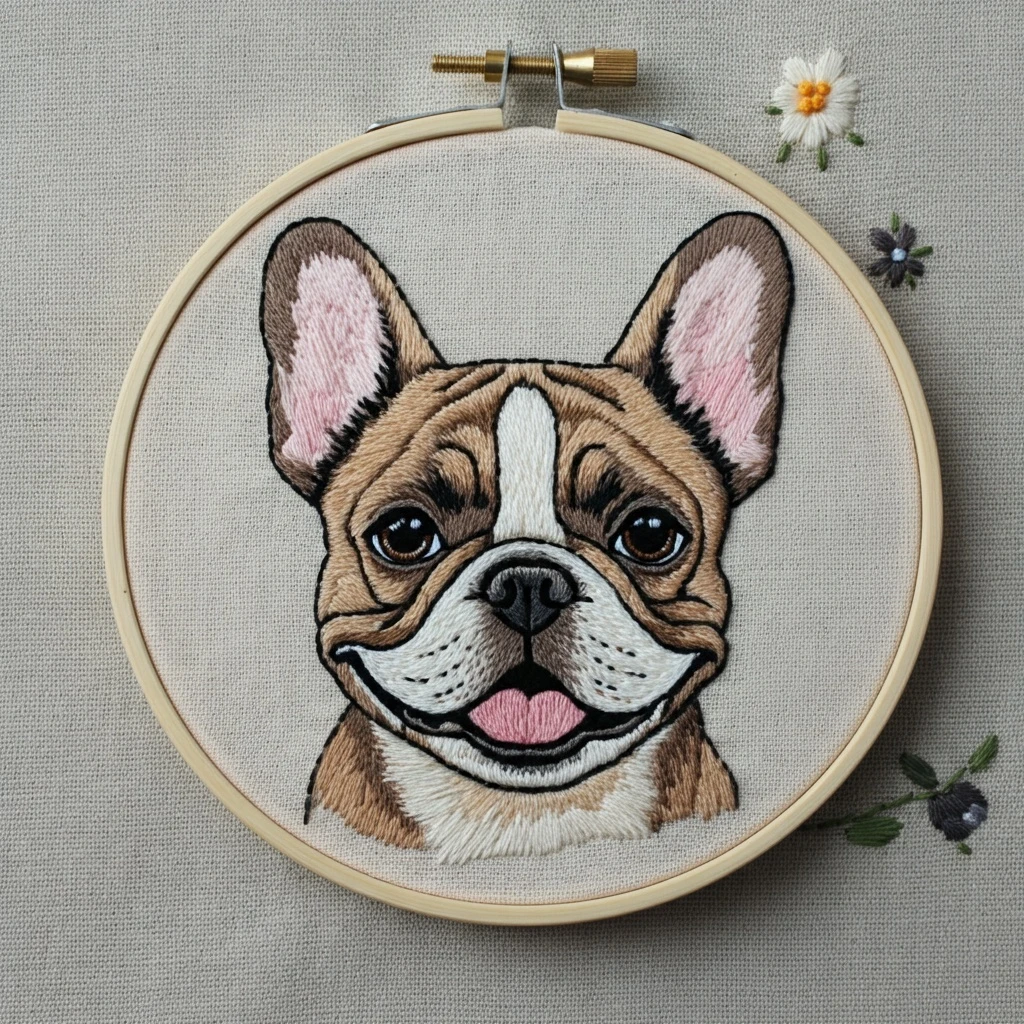
Hand Embroidered French Bulldog Portrait in Hoop
A cheerful pet-portrait guide for the fawn French bulldog artwork: large upright ears with blush-pink interiors, a warm tan wrinkled face, creamy white blaze and muzzle, glossy dark eyes, black nose and smile lines, and a few tiny floral accents around the hoop.
Color story observed from the artwork
The reference image has a soft linen background and a friendly French bulldog centered in a wooden hoop. The strongest visual features are the black stitched outline, fawn-brown head and neck, pale cream blaze and muzzle, rosy inner ears and tongue, dark wet nose, rounded brown eyes, and small white, golden, purple, and green flowers near the hoop edge.
Use this as a practical DMC working palette. For very warm linen, lean into the cream and fawn shades; on bright white fabric, add more beige shadows so the muzzle keeps its shape.
Stitch map by design area
| Area | Recommended stitches | How to work it |
|---|---|---|
| Outer silhouette and ears | Split stitch, back stitch, short straight stitches | Trace the ears and head with 310 using one strand. Fill the outer ears with 3862 and 3863, then add 433 or 3371 at the bases where the ears tuck behind the face. |
| Fawn forehead wrinkles | Long-and-short stitch, stem stitch, tiny couching stitches | Stitch fur downward from the brow and outward around each wrinkle. Use 3863 as the body color, 433 in the folds, and 842 on raised ridges. |
| Eyes | Padded satin, tiny back stitch, single straight highlight | Build the iris with 801 and 3371, ring with 310, and place a B5200 catchlight last. Keep the catchlights matched so the dog looks forward. |
| Nose and mouth | Padded satin stitch, split stitch, seed stitch | Pad the nose lightly, cover with 310, then add 3799/3024 shine strokes on the bridge and nostril tops. Use small 310 seed stitches for whisker dots. |
| Cream muzzle and blaze | Long-and-short stitch, contour stem stitch | Use 712 as the base, B5200 for central highlights, and 3024 for shadows beneath the nose, chin, and muzzle creases. |
| Inner ears and tongue | Soft satin, long-and-short, split stitch outline | Lay 3688 in the light areas and 3716 toward the deepest pink. Feather the edges into beige with single strands so the transition stays natural. |
| Small hoop flowers | Lazy daisy, French knots, fly stitch | Work white petals in B5200, golden centers in 972, purple flowers in 154, and leaf pairs in 934/3345 for a delicate botanical frame. |
Blending and shading notes
Fawn coat dimension
Do not fill the tan areas with one flat color. Begin with 3863, tuck 3862 and 433 into the folds around the brow and cheeks, then add short 842 highlights on the raised wrinkle ridges. Changing stitch direction is just as important as changing color.
Expressive muzzle
The white muzzle is rounded and puffy. Keep it warm with DMC 712, then use 3024 in tiny broken lines under the nose and along the lower lip. A few B5200 strokes at the top of the muzzle make it look lifted.
Soft pink areas
For ears and tongue, alternate 3688 and 3716 rather than blending the strands in the needle. This gives a painterly blush and avoids a single flat pink patch.
Outlining details
- Use the black outline confidently, but keep it one strand around the ears and cheeks so it reads crisp rather than heavy.
- For facial wrinkles, use curved split stitches in 3371 or 433 before adding fur stitches over and beside them.
- Whisker dots look best as tiny seed stitches or single-wrap French knots in 310; avoid bulky knots on the muzzle.
- Outline the tongue with a fine 3371 or 310 line, then soften the top with a pink highlight.
- Use small gaps between floral accents and the hoop border so the motifs feel airy like the reference.
Texture suggestions
Beginner-friendly order of work
- Transfer the main outline lightly, marking eyes, nose, mouth, and major wrinkle lines.
- Work the black facial outlines first in one strand so the expression is secured.
- Fill the cream blaze and muzzle, then the fawn forehead and cheeks.
- Stitch the eyes and nose after surrounding fur is finished, so they remain crisp.
- Add ears, tongue, whisker dots, and final wrinkle accents.
- Finish with the small flowers and leaves around the hoop.
Practical finishing tips
- Use shorter stitches around the eyes and nose; long stitches there can blur the expression.
- Keep all fur stitches slightly uneven in length for a realistic hand-stitched portrait.
- Step back often. If the face looks too striped, add a few bridging stitches in the mid-tone fawn.
- Press from the back on a towel so padded nose, flower knots, and satin stitches stay raised.
- When framing, trim and lace the fabric evenly behind the hoop rather than pulling one side tight.