
DMC palette & hand embroidery guide
Illuminated Forest Fairy House
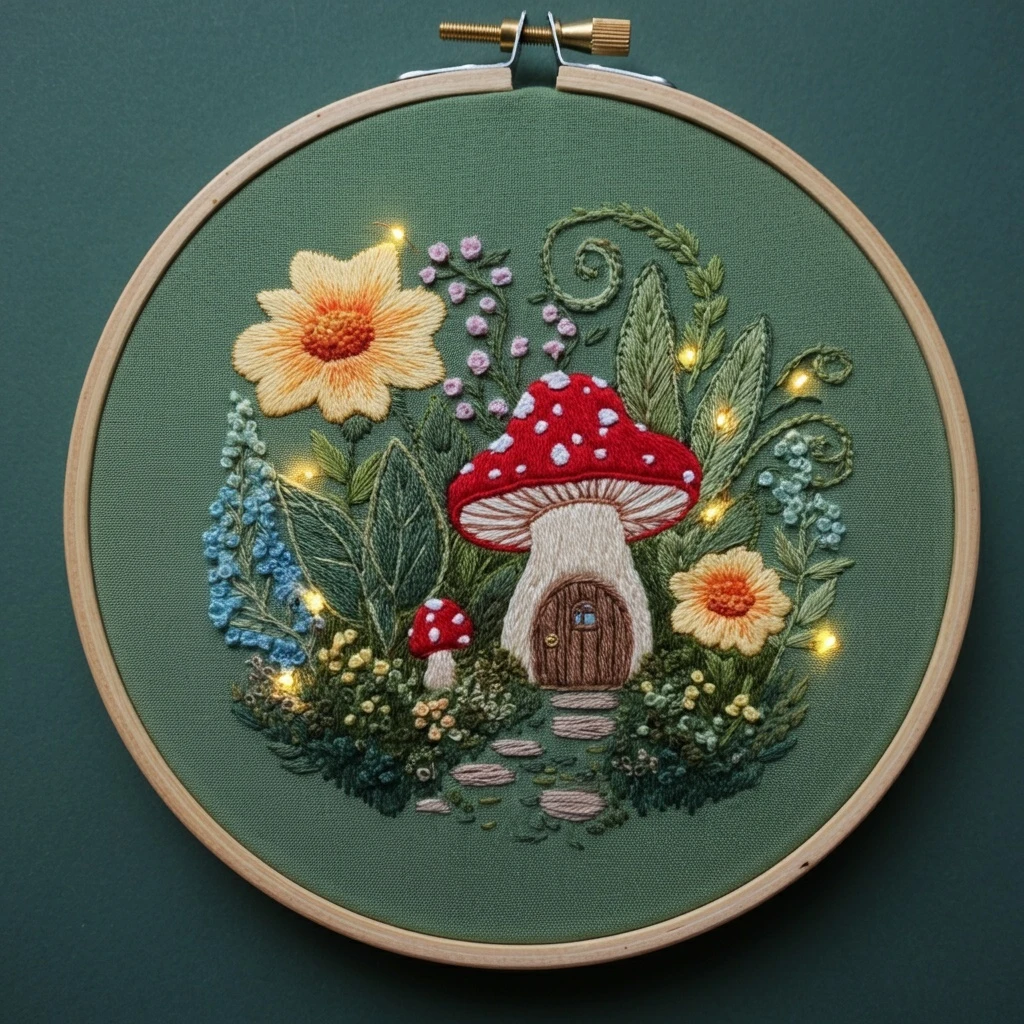
A glowing woodland hoop built around a red toadstool fairy house with creamy mushroom stem walls, a rounded bark door, white cap spots, yellow firefly lights, daisies, blue flower spikes, lavender buds, curled vines, mossy ground cover, and layered sage-green leaves on deep forest-green fabric.
Design color read
The reference image is rich and woodland-dark: the sage green fabric becomes part of the scene, while the embroidery itself concentrates color in a red amanita-style mushroom cap, cream mushroom walls, warm brown door, golden daisies, cool blue flower spikes, lavender bead-like buds, yellow firefly lights, and deep mossy foliage. The composition feels illuminated because the brightest yellows and whites are placed as small points against muted greens.
Preserve that contrast by keeping most foliage medium to dark, then using tiny high-value stitches for mushroom spots, flower centers, and glowing fireflies.
Thread-count snapshot
- Mushroom cap: 2 strands for satin or long-and-short fill; 1 strand for darker rim details.
- Stem walls and gills: 1-2 strands so the cream area stays smooth and not bulky.
- Leaves and vines: 2 strands for fishbone or stem stitch; 1 strand for fine veins and tendrils.
- Flowers and moss: 2 strands for petals; 1 strand French knots for centers, berries, and texture dots.
- Firefly glow: 1 strand for radiating stitches; use 2 strands only for the bright center dot.
Suggested DMC palette
Stitch suggestions
Best order of work
Blending & shading guidance
Toadstool cap
Use 321 as the dominant red and keep 815 at the lower lip, side folds, and the smaller mushroom's shaded edge. For a smoother transition, blend one strand 321 with one strand 815 in the row just above the rim. Add B5200 spots after the red fill is finished so they sit crisp on top.
Cream stem and gills
Keep the main wall soft with 543, then place 3864 beneath the cap and along the sides. Use 3865 and B5200 for gill highlights, but avoid filling every gill line in white. A few brown or mocha separators will make the underside read as ribbed without becoming striped.
Firefly illumination
The glowing lights work best as small, high-contrast points. Stitch the center in 726, surround it with short 744 or 972 rays, then add one tiny B5200 stitch at the center if you want a bright spark. Do not overfill the halo; open fabric around the ray stitches helps the glow look natural.
Woodland greens
Anchor the ground with 935, build leaves with 3345 and 3364, then use 3053 only on edges and veins. The image has many plant shapes, so value separation matters more than perfectly outlining every stem.
Texture notes
- Use a few raised French knots at the mushroom-cap spots if you want the white dots to feel like applique-like bumps.
- Vary moss knots in 935, 3345, and 3053; irregular color placement makes the ground look natural.
- For the daisy centers, cluster copper French knots tightly and add a few 972 knots at the top edge.
- Blue flower spikes should taper at the top. Make lower knots slightly larger and upper knots smaller.
- Keep the door planks vertical, but bend the outer planks with the arch to make the entry feel rounded.
Outlining details
Use tone-on-tone outlines rather than harsh black. The cap can be edged with 815, the stem with 3864, the door with 898, and the leaves with 935 or 3345. For the gills under the cap, stitch fine 1-strand backstitch lines in 839 or 3864, radiating from the center stem toward the cap edge. The white spots need no heavy outline unless they disappear; a half stitch of 3865 on the lower side is enough.
Beginner-friendly practical tips
- Transfer the main shapes first: mushroom cap, stem, door, large leaves, flowers, and light positions. Place tiny moss and buds as you stitch.
- Use shorter thread lengths for dark greens and reds because fuzzy floss is very visible on smooth satin sections.
- Do not pull French knots too tightly; raised buds and moss should sit on the fabric surface.
- If stitching on dark green fabric, test pale colors before starting. Add a second strand of 3865 or B5200 where the fabric shows through.
- Step back after finishing the mushroom house. It should remain the focal point even after the busy florals are added.
Compact stitch plan
Mushroom cap: long-and-short fill in 321 shaded with 815, with B5200 spots added last. Stem house and gills: satin, split stitch, and fine backstitch in 543, 3864, and 3865. Door and path: stem stitch and backstitch in 839 and 898. Leaves and vines: fishbone, stem stitch, and detached chain in 935, 3345, 3364, and 3053. Flowers: satin petals for daisies, French knots for centers, blue spikes, lavender buds, and moss. Illumination: 726 centers with 744 and 972 rays, finished with tiny white sparkles.