
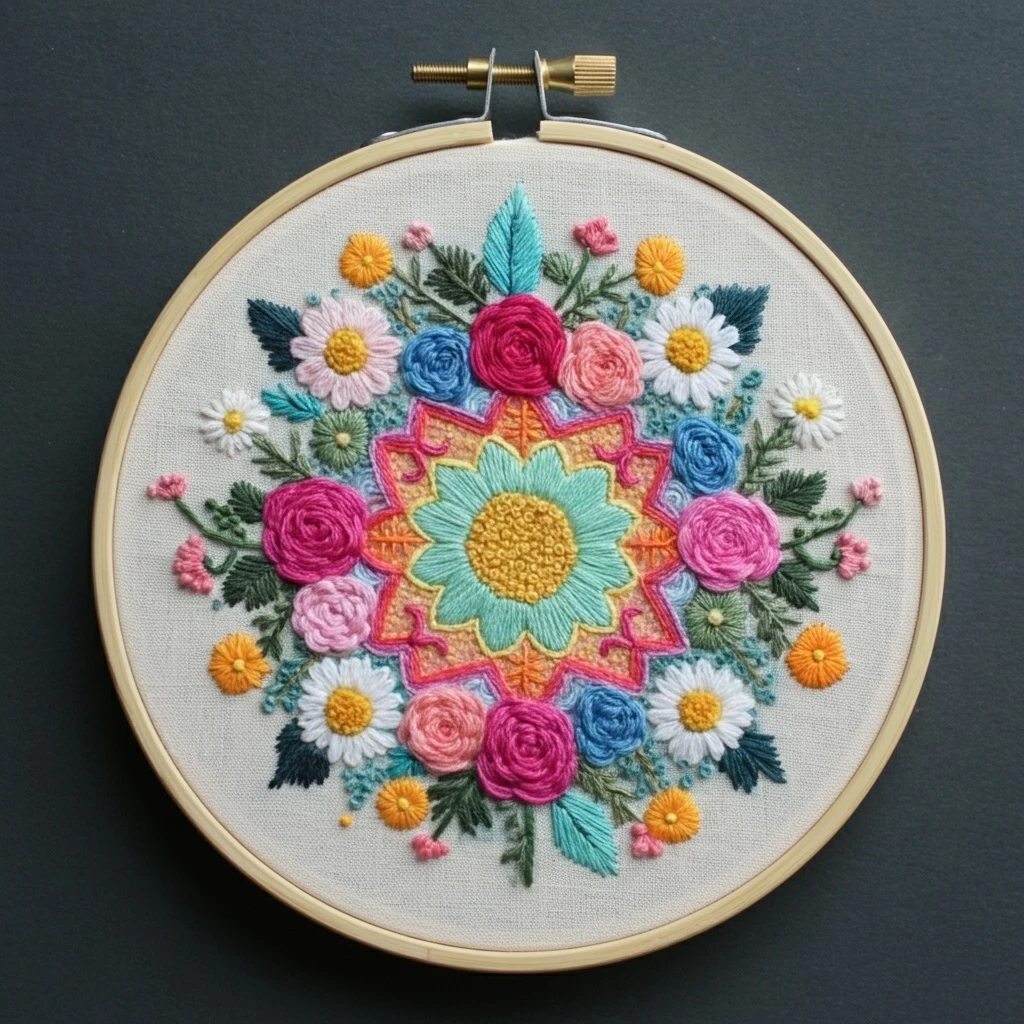
Rainbow Bloom Mandala
A cheerful floral mandala with rainbow-toned petals radiating from a balanced center. The design should feel bright, symmetrical, and joyful: warm pinks and oranges flow into yellow, green, turquoise, blue, and violet, with repeated petal shapes and tiny knot accents keeping the bloom crisp and polished.
Design color read
The composition reads as a circular flower built from rainbow segments. Expect rose and coral petals in the warm side, golden yellow highlights in the sunlit center, fresh green and teal accents through the middle, then cool blue and violet petals completing the ring. The cleanest finish comes from repeating the same stitch structure in every petal while changing the color family gradually around the mandala.
Suggested DMC floss palette
These DMC colors give a clear rainbow effect while staying soft enough for a hand-embroidered floral mandala. Use lighter companions at petal tips and darker shades at the bases for dimension.
Deep rose petal bases, warm ring shadows, and floral definition.
Main pink bloom sections and soft rose petal fills.
Coral petals and warm transition from pink toward orange.
Orange accents, inner petal warmth, and small decorative arcs.
Golden flower center, dot accents, and warm yellow mandala details.
Bright center glints, petal tips, and tiny highlight knots.
Fresh green petals, leaf-like separators, and soft botanical balance.
Deeper green bases, shadows, and small stem-like mandala details.
Teal petals, cool separators, and lively contrast in the rainbow flow.
Soft aqua highlights, tiny dots, and airy light stitches.
Blue petals and cool transition between teal and violet sections.
Violet petals, final rainbow arc, and gentle purple shadow accents.
Stitch map by design element
Mandala center
Use woven wheel, satin stitch, or clustered French knots in gold and pale yellow. Keep it compact and centered.
Rainbow petals
Use long-and-short stitch or satin stitch from base to tip. Repeat the stitch direction on every petal for a clean radial bloom.
Small petal motifs
Use detached chain or lazy daisy stitches, changing color by section while keeping each motif the same size.
Ring outlines
Use one-strand split stitch or stem stitch in matching tonal colors rather than black. This keeps the rainbow soft.
Dot texture
Use French knots or colonial knots in yellow, teal, rose, and violet. Match knot wraps for symmetry.
Outer accents
Use tiny straight stitches or seed stitches in the corresponding color family to create a delicate decorative border.
Thread-count and blending guidance
| Area | Strands | Blending idea | Practical note |
|---|---|---|---|
| Rainbow petals | 2 strands for petal fill, 1 strand for highlights and edges | Use darker shade at each petal base, the main hue through the center, and a lighter neighbor at the tip. | Keep the color order consistent around the circle so the rainbow reads clearly. |
| Center glow | 2 strands for knots or woven center, 1 strand for tiny glints | Mix 3820 and 744, then add a few cream or pale yellow stitches at the brightest points. | Stitch the center first to anchor the geometry, but save final glints until the end. |
| Cool color sections | 1–2 strands | Bridge green into teal with 3013 and 3810, then transition teal into blue with 3811 and 156. | Do not overpack cool colors; small gaps help the mandala stay airy. |
| Dots and outlines | 1 strand for outlines, 2 strands for knots | Use matching tonal outlines for each color family and reserve yellow/white for small bright dots. | Count knot wraps consistently so repeated dots do not look uneven. |
Recommended stitching order
- Transfer the mandala with a clear center point, ring guides, and petal spacing marks.
- Stitch the center first, then the four main axis petals to establish alignment.
- Work remaining petals in rainbow order, stitching opposite motifs to preserve balance.
- Add smaller petal rings, color-matched outlines, and cool/warm separator details.
- Finish with French knots, tiny highlights, and outer seed-stitch accents.
Beginner-friendly practical tips
- Use a printed transfer or carefully drawn guide; mandala symmetry is hard to fix after stitching.
- Thread only 12–15 inches at a time to keep bright colors smooth and unfuzzy.
- Complete all motifs of one color family before moving on if you want consistent tension.
- Use shorter stitches near the center and longer stitches where petals widen.
- Press from the back on a towel to protect knots and raised center texture.
Texture, shading, and finishing notes
The finished design should feel colorful but organized. Let the rainbow sequence bring energy, while repeated stitch types and even spacing keep the floral mandala polished.
Petal dimension
For each color family, place the slightly deeper shade near the center and the lighter shade at the petal tip. This creates a bloom-like glow without complicated blending. Keep highlights small so the colors stay saturated.
Mandala consistency
Choose a stitch system and repeat it by ring: satin or long-and-short for major petals, detached chain for small petals, stem stitch for arcs, and knots for dots. Consistency turns the rainbow palette into a refined design rather than a busy one.