
DMC palette & stitching guide
Seasonal Drinks Ingredients
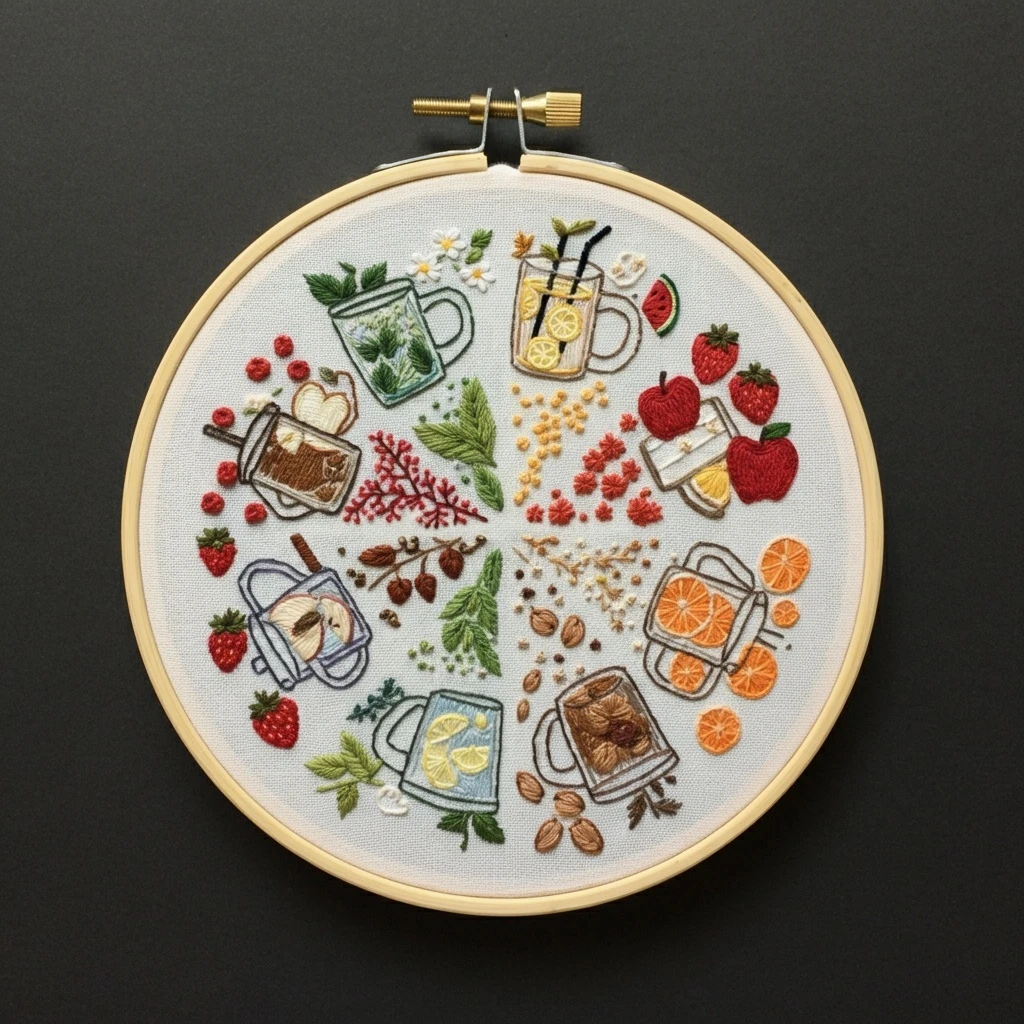
A cheerful hoop of mugs, fruit slices, berries, herbs, spices, loose tea, coffee beans, citrus rounds, and tiny blossom accents. The design reads as a sampler of cozy drinks through the seasons, so the palette balances crisp glass highlights, fresh greens, bright strawberry reds, juicy oranges, creamy lemon yellows, warm browns, and soft fabric neutrals.
Observed color story
Practical DMC floss palette
The reference image uses a light neutral fabric base with many small ingredient studies arranged around the hoop: red strawberries and apples, orange slices, lemon wheels, green mint and tea leaves, brown spices and beans, gray-blue glass/mug outlines, and creamy white blossoms.
Main strawberry, apple, cherry, and small red berry body color. Work with 2 strands for satin stitch or padded satin.
Deep red shadows under berries, apple edges, and berry cluster bases. Blend 1 strand with 321 for rounded fruit.
Bright orange slices and peel segments. Use short radial stitches from rind to center for citrus texture.
Golden drink flecks, pollen dots, citrus highlights, and warm ingredient speckles in the center.
Lemon wheels inside mugs and pale yellow fruit pulp. Keep stitches short so the circular motifs stay crisp.
Darkest herb sprigs, mint outlines, leaf veins, and the tiny greens on berry tops.
Primary leaf fill for herbs and tea leaves. Excellent for fishbone stitch leaves and soft greenery clusters.
Light leaf highlights and young shoots. Add as final stitches over 469 for fresh seasonal foliage.
Coffee, tea, spice sticks, bean outlines, mug contents, and dark ingredient seeds.
Mid-tone cinnamon, toasted drink surfaces, almond shells, and warm outlines around jars or cups.
Highlights on beans, spice pods, and honey-colored liquid. Use sparingly to keep the sampler readable.
Cool mug outlines, glass rims, handles, and subtle metal-gray contours. Use 1 strand for fine linework.
Pale blue glass shadows, cold-drink mugs, and watery highlights. Blend with white for transparency.
Creamy drink foam, pale apple flesh, blossom centers, and soft background-friendly highlights.
White daisies, sparkle points on mugs, glass shine, and final highlight stitches over fruit.
Selective darkest outlines for straws, spice ends, seed dots, and tiny definition marks. Avoid overusing.
Stitch plan
Suggested stitches by design element
Clean transparent outlines
Use 1 strand of DMC 414 or 932 in back stitch for cup rims, handles, and glass sides. Add tiny B5200 straight stitches on upper rims to make the glass feel reflective without filling the whole vessel.
Round, juicy shapes
Use satin stitch for strawberries and apple bodies, changing direction slightly to follow the curve. Add 815 along the lower edge and 321 through the center. Seed dots can be 739 or 742 in single-wrap French knots.
Radial slice texture
Outline each orange or lemon round with split stitch, then stitch wedge divisions from the center outward. Use 740 and 742 for orange, 307 and B5200 for lemon. Keep rind stitches short and neat.
Layered greens
Fishbone stitch works beautifully for mint, tea, and herb leaves. Start with 469, add 3011 toward the tip, and finish the central vein with one strand of 895.
Toasted texture
Use small satin stitches or detached chain stitches for coffee beans and almonds. Add a single darker curved stitch in 801 or 3371 down the center of each bean for depth.
Light sampler details
Flowers can be lazy daisy petals in B5200 or 739 with 742 French-knot centers. Red and golden ingredient clusters look best as French knots in varied sizes.
Thread-count guidance
How many strands to use
Because the design contains many small motifs, strand control is the key to keeping the hoop polished instead of crowded.
Recommended strand counts
- 1 strand: cup rims, glass outlines, straws, tiny seed details, spice twig ends, and fine leaf veins.
- 2 strands: most satin stitch fruit, citrus wedges, leaf fills, drink color, flowers, and medium outlines.
- 3 strands: raised berries, larger French knots, padded apple/strawberry shapes, and bold red focal accents.
- 4 strands only if needed: large texture knots in the ingredient clusters; test first so the small details do not overpower the hoop.
Needle & fabric pairing
- Use a size 7 or 8 embroidery needle for 2-strand work and a size 9 for single-strand outlining.
- Choose a tightly woven cotton or linen in ivory, oatmeal, or pale cream so white flower details still show.
- Keep the fabric drum-tight in the hoop; glass curves and citrus circles become uneven if tension loosens.
- For beginners, stitch one drink vignette at a time before moving around the entire circular composition.
Blending & shading
Color transitions that match the reference
| Area | Suggested blend | Use it for |
|---|---|---|
| Red fruit | 1 strand DMC 321 + 1 strand DMC 815 | Lower strawberry sides, apple curve shadows, and cranberry clusters that need rounded volume. |
| Orange slices | DMC 740 outlines with DMC 742 inside segments | Warm citrus pulp with brighter segment lines; add one B5200 stitch at the center for sparkle. |
| Lemon wheels | 1 strand DMC 307 + 1 strand B5200 | Pale lemon slices floating in drinks; keep the rind in 307 and the interior a lighter blend. |
| Leaves | DMC 469 base, DMC 3011 tips, DMC 895 veins | Mint and herb sprigs with natural direction changes; stitch from stem to leaf tip. |
| Warm drinks & spices | DMC 801 shadows + DMC 977 mid-tone + DMC 3826 highlights | Coffee, cocoa, cinnamon, tea, beans, and toasted ingredient details. |
| Glass & mugs | DMC 932 single-strand shadow with B5200 highlight | Cool glass impression without heavy fill; use broken lines rather than fully solid borders. |
Order of work
Beginner-friendly stitching sequence
Stitching order
- Transfer the design lightly; avoid heavy marks inside the transparent mug shapes.
- Stitch all cup and glass outlines first with 1 strand so the composition is anchored.
- Fill larger fruit and citrus motifs next, working from darker shadow to lighter highlight.
- Add leaves and herbs, keeping stitch direction consistent with each stem.
- Finish with French knots, small seed stitches, flower centers, and sparkle highlights.
Practical finishing tips
- Use shorter thread lengths, about 14–16 inches, especially for reds and browns that show fuzz quickly.
- Rotate the hoop while stitching citrus circles so the radial stitches stay even.
- Do not carry dark thread behind pale lemon, white flower, or glass areas; it can shadow through the fabric.
- Press finished work face down on a towel to preserve raised knots and padded fruit texture.
Texture ideas
Small details that make the sampler feel lively
Raised accents
French knots are ideal for tiny berries, drink bubbles, spice granules, and pollen. Use one wrap for delicate dots and two wraps for chunkier berry clusters. For strawberries, add a few tiny straight stitches in 739 or 742 instead of too many knots so the fruit does not become bulky.
Outline control
Use split stitch where you want a soft, rounded contour and back stitch where the line should look crisp, such as cup rims and straw edges. For the darkest details, reserve 3371 for the final pass only; this keeps the design bright and avoids a cartoon-heavy outline.