
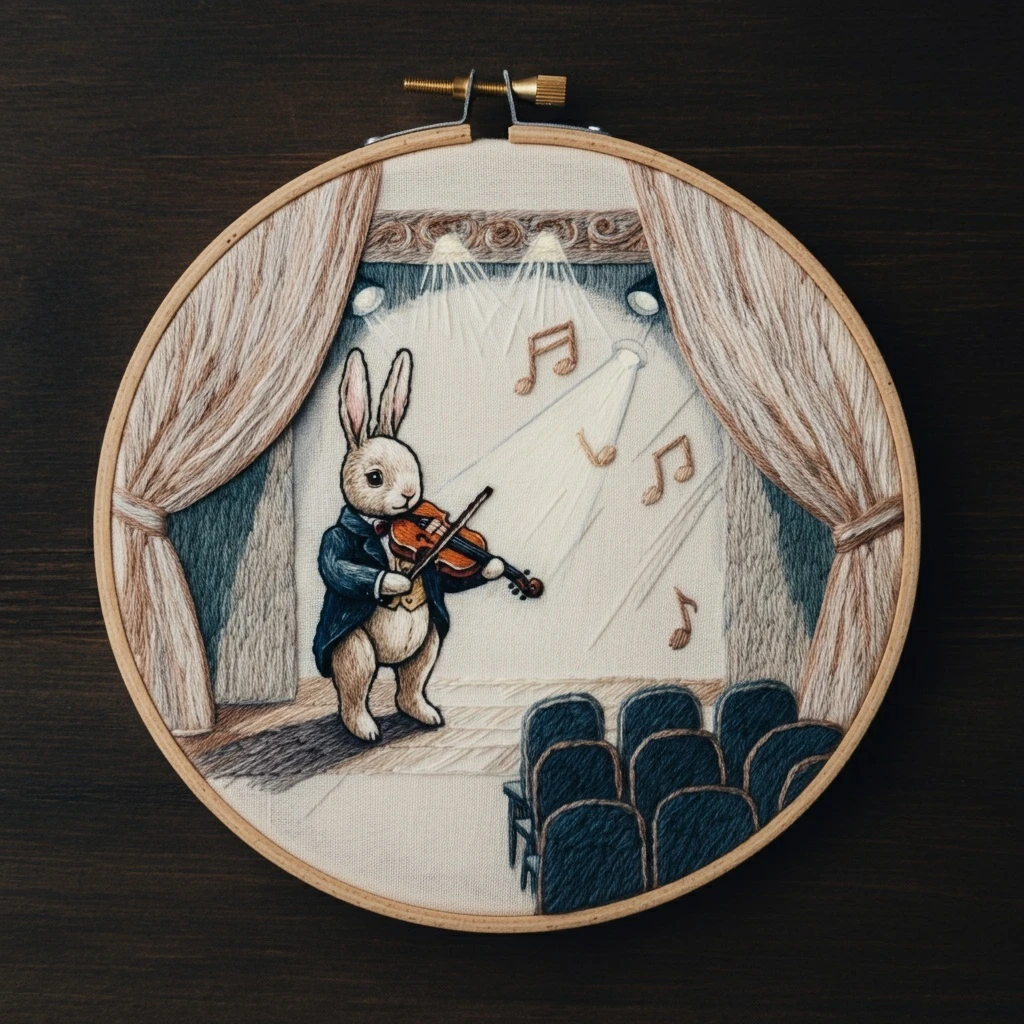
The Concert Soloist
A refined DMC palette and practical stitching plan for a charming hoop scene: a rabbit violinist on a softly lit concert stage, framed by textured curtains, teal audience seats, warm wood trim, musical notes, and gentle spotlight beams.
Likely DMC Color Palette
Palette based on the rabbit performer, violin, stage curtains, overhead lights, pale stage floor, shadowed theatre seating, musical notes, and warm wooden hoop/stage accents. Coverage percentages are visual estimates, not exact thread usage.
Stitching Suggestions
| Element | Suggested Stitch | Practical Notes |
|---|---|---|
| Rabbit fur | Long and short stitch, split stitch | Use 1 strand around the face and ears for soft fur direction. Blend 822 with 841 through the cheeks and body; add 3862 only where the ears, side body, and feet need depth. |
| Face and tiny features | Backstitch, single straight stitches, French knot | Use 3371 sparingly so the expression stays gentle. One tiny French knot or padded satin dot works well for the eye; keep whisker lines to one strand. |
| Violin and bow | Satin stitch, split stitch, couching | Fill the violin with 400 and glaze small highlights with 976. Couch one dark strand for the bow or strings so they stay straight and controlled. |
| Concert jacket | Long and short stitch, stem stitch edging | Work 924 as the main jacket shade, then layer 926 on lapels and sleeve tops. Use darker outlines only after the fill is complete. |
| Stage curtains | Long straight stitch, stem stitch, whipped backstitch | Follow the vertical fall of the drapes. Alternate 822, 841, and 3862 in uneven lines for a woven curtain texture, then whip selected fold lines for raised ridges. |
| Spotlights and beams | Very loose straight stitch, couching, seed stitch | Use 1 strand of 3865 and 745. Keep stitches open with visible fabric between them; heavy filling will make the light look solid instead of luminous. |
| Audience seats | Satin stitch or long and short stitch, backstitch | Fill seat backs with 924, add 926 along top curves, then outline with 3371 or 645. Keep the seats darker than the stage so the soloist remains the focus. |
| Musical notes | Stem stitch, backstitch, small satin stitch | Use 400 or 3862. Stitch notes after the light beams so they sit visibly on top without becoming too heavy. |
| Stage floor and shadows | Straight stitch, sketch stitch, split stitch | Use fine 645 and 841 hatching. Angle the shadow away from the performer and leave open space in the lit floor for a stage-like glow. |
Thread Count, Blending & Shading Plan
Thread-count guide
- 1 strand: rabbit facial details, whiskers, violin strings, musical-note stems, spotlight beam lines, fine curtain texture.
- 2 strands: main rabbit body, jacket fill, stage curtains, seat backs, violin body, most outlines.
- 3 strands: only for raised curtain tiebacks, extra-dark seat fronts, or padded stage molding if you want stronger relief.
Blending ideas
- Blend one strand 822 with one strand 841 for rabbit fur that feels warm without turning orange.
- Blend one strand 3865 with one strand 745 in the center of each spotlight for a creamy stage glow.
- Blend 924 with 926 for the jacket and theatre seats, then reserve solid 924 for the deepest curves.
- Use 400 plus 976 in short directional stitches to mimic polished violin varnish.
Outlining details
Outline the rabbit, violin, bow, jacket edge, and front row seats with a restrained 1-strand backstitch in 3371. For curtain folds, use 3862 instead of black-brown so the fabric stays soft. For distant stage lines and light beams, choose 645 because it reads as shadow without creating cartoon-heavy borders.
Texture suggestions
Let the texture change by material: feathery split stitches for fur, smooth satin stitches for violin varnish, sketchy long stitches for curtains, dense dark filling for seats, and airy single-strand lines for the spotlights. This contrast will make the small theatre scene feel dimensional.
Where to Start
Begin with the pale stage and spotlight areas so the brightest spaces remain clean. Next stitch the rabbit body and face, then add the jacket and violin so the performer becomes the focal point. Work the curtains from top to bottom, fill the seats last, and finish with musical notes, violin strings, facial details, and the crispest outlines.
Beginner-friendly order
- Mark the spotlight beams lightly and keep them open.
- Fill rabbit body and jacket before adding tiny features.
- Stitch the violin carefully with short satin stitches.
- Add curtains and seats, balancing dark and light areas.
- Finish with music notes, outlines, eye, nose, and bow/string details.
Practical tips
- Use shorter stitches around the rabbit’s face so curves stay smooth.
- Do not overfill the spotlight beams; open fabric is part of the effect.
- Keep theatre seats simple and dark so they recede behind the soloist.
- Rotate the hoop while stitching curtains to follow the natural drape direction.
- Test musical-note thickness on scrap fabric; they should be visible but delicate.
Encouraging Finish
The success of this design comes from contrast: a tiny polished soloist against soft curtains, glowing beams, and deep teal theatre shadows. Keep the rabbit and violin carefully detailed, let the curtains remain sketchy and textured, and save the darkest outlines for the final pass so the scene comes into focus like a stage performance under warm lights.