
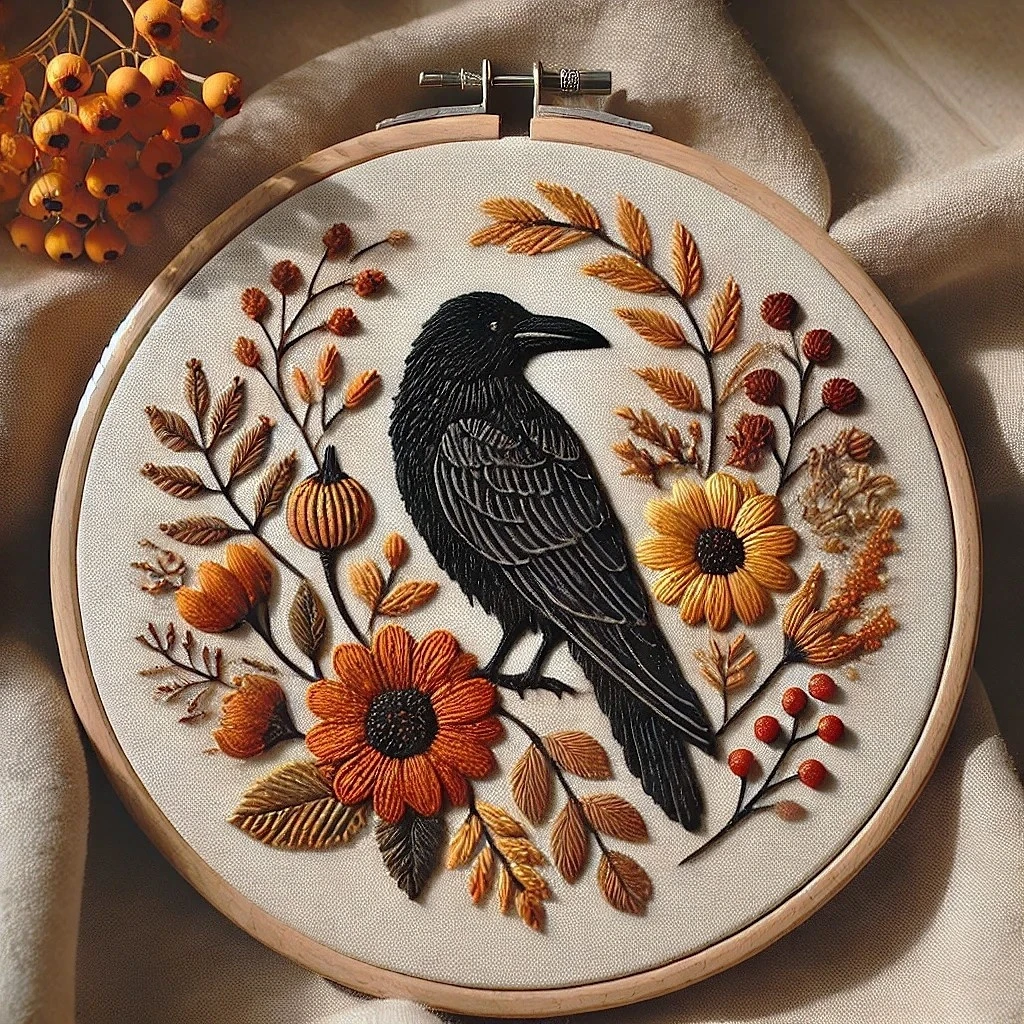
Autumn Raven
A polished embroidery planning page for a moody autumn raven design: a deep black bird perched on a rustic branch, surrounded by copper leaves, ochre glow, mossy accents, and warm seasonal shadows.
Suggested DMC Floss Palette
This palette balances raven-dark neutrals with warm autumn foliage. Use all shades for a dimensional finish, or simplify to three raven tones, three leaf tones, one branch brown, and one highlight color.
Stitch Map
| Design area | Best stitches | Thread count | How to use them |
|---|---|---|---|
| Raven body | Long and short stitch, satin stitch, split stitch | 1–2 strands | Fill with 3799 first, then add 310 only in the deepest underside shadows. Follow the curve of the breast and back so the stitch direction reads as feather structure. |
| Wing feathers | Fishbone stitch, closed fly stitch, layered straight stitch | 1 strand for separations; 2 strands for fill | Use 823 and 413 as narrow highlights along the wing. Keep strokes tapered and slightly overlapping to avoid a striped look. |
| Head and beak | Satin stitch, tiny back stitch, split stitch outline | 1 strand | Use 310 around the beak and eye, then soften the crown with 3799. Work a tiny 3820 eye glint last. |
| Branch and twigs | Stem stitch, split stitch, couching, seed stitch | 2 strands; 1 strand for bark marks | Build the branch in 869, outline the underside with 898, and add short bark marks crossing the main stem at irregular angles. |
| Autumn leaves | Fishbone stitch, detached chain, satin stitch, fly stitch | 2 strands | Use 921 and 922 as the main leaf colors. Add 783 on the tips and veins; tuck 730 into darker leaves for an aged autumn effect. |
| Background glow | Running stitch, seed stitch, light long and short stitch | 1 strand | Use sparse 783 and 3820 stitches around the bird, leaving fabric visible so the raven silhouette stays crisp. |
Blending Ideas
Raven feather sheen
3799 + 8233799 + 154310 + 3799
- Use one strand of 3799 with one strand of 823 for cool highlights on the back and wing.
- Add 154 only in small shadow patches; too much purple can make the bird look decorative rather than natural.
- Reserve pure 310 for edge definition, talons, the eye area, and the deepest wing folds.
Autumn leaf variation
921 + 922922 + 783730 + 869
Blend warm copper and topaz for fresh fallen leaves. Use olive-brown blends for older curled leaves behind the raven to give the design depth.
Outlining & Detail
Keep the silhouette clean
Outline the raven with one strand of 310 using split stitch or tiny back stitch. For a softer edge, outline the top edge in 3799 and reserve 310 for the underside, beak, talons, and tail tips.
Make the branch feel woody
After the branch fill is complete, add uneven 898 bark marks and tiny seed stitches. Keep bark details shorter near the raven feet so the perch does not become visually busy.
Texture & Shading Guidance
Layer order
- Stitch any pale background glow first with 1 strand.
- Complete the branch and main leaves before the raven feet.
- Fill the raven body from mid-tone to dark: 3799, then 823/413 highlights, then 310 shadows.
- Add eye, talons, feather divisions, and final leaf veins last.
Beginner-friendly control
- Use a sharp needle for tight feather turns; a blunt needle can split previous stitches too much.
- Keep raven highlight stitches very narrow. Large grey areas will make the bird look dusty instead of glossy.
- For neat leaves, stitch the center vein first, then work fishbone stitches from the edge toward the vein.
- Press thread with a laying tool or needle tip whenever using 2 strands in satin areas.
Practical Thread-Count Guide
For a 6 inch hoop
Use 2 strands for the branch, leaves, and large raven fill. Use 1 strand for feather separations, beak outline, eye glint, talons, leaf veins, and small bark texture.
For a smaller hoop
Work the entire raven in 1 strand except the largest body area, which can use 2 strands if the fabric weave is visible. Replace tiny detached-chain leaves with simple straight stitches.
Finishing Tips
Contrast check
Before adding final black outlines, view the hoop from arm's length. The bird should read clearly against the autumn colors; if not, deepen the underside with 310 and brighten nearby leaves with 783.
Avoid bulky knots
Ravens rely on smooth sheen, so avoid French knots on the bird itself. Save knots for small leaf clusters or background texture, and keep them away from the eye and beak.
Simple Palette Version
For a quick beginner version, use DMC 310, 3799, 413, 823, 898, 921, 922, 783, and 3820. This keeps the raven dimensional, the branch readable, and the autumn leaves bright without overwhelming the design.