
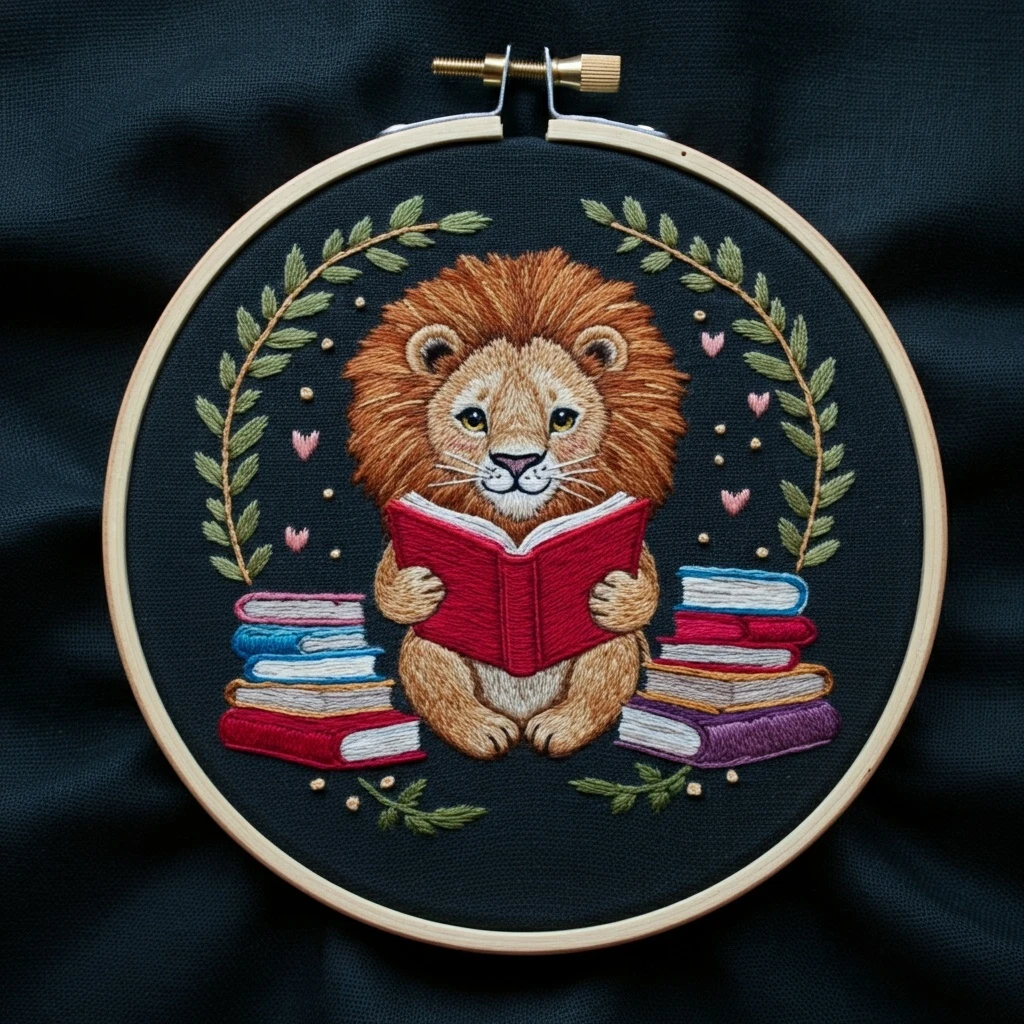
Bookish Lion Reading
A warm, storybook embroidery design featuring a round-faced lion with a copper mane, cream muzzle, bright red open book, stacked books, leafy branches, little pink hearts, and bead-like golden dots on dark fabric.
Polished DMC Color Palette
The palette below balances the image’s coppery lion, cream face, scarlet reading book, turquoise and magenta book stacks, muted green branches, soft pink hearts, ivory pages, and dark outlining. Use the darker shades sparingly for definition so the lion stays soft rather than cartoon-heavy.
Deep mane shadows, outer tufts, ear depth, and warm fur breaks.
Main lion mane color; stitch in radiating long-and-short strokes.
Mane highlights, cheek fur flicks, and paw highlights.
Face base, paws, body, and warm transitions into the mane.
Facial contour lines, paw curves, and soft body shading.
Muzzle, belly, inner ear rings, and rounded face highlights.
Tiny sparkle strokes on muzzle, brow, paws, and page edges.
Book pages, eye glints, whisker anchors, and page highlights.
Fine mane accents, nostril detail, mouth line, and branch shadows.
Eyes, pupils, nose points, and the crispest final outline only.
Main red book cover and darker book-spine accents.
Bright red book highlights and lively edges on lower books.
Tiny hearts, nose blush, and pink book details.
Blue book covers, decorative stripes, and cool contrast accents.
Blue cover highlights and cool page shadows.
Purple book cover, lower right stack shadows, and spine depth.
Leaf midtone and the main leafy wreath color.
Leaf highlights and soft texture on upper branches.
Gold dots, book-page warmth, and small branch highlights.
Page separation lines and subtle white-book shadows.
Stitch Map by Design Element
Lion mane
Use long-and-short stitch with 1 strand for directional fur. Work from the outside edge inward, alternating 919, 921, and 922. Let some stitches overlap unevenly to mimic the shaggy halo in the reference.
Face, muzzle, and paws
Use split stitch or very fine stem stitch for facial fur lines. Fill with 1-strand long-and-short in 3826, 434, 738, and 739. Keep the muzzle lighter and reserve 898 for the smallest smile, nostril, and paw creases.
Open red book
Satin stitch the covers with 2 strands of 816, then add 321 on the upper planes. Use a central backstitch spine, tiny diagonal stitch strokes for cover texture, and 3865/762 for page rims.
Book stacks
Use padded satin for the colorful covers and straight stitch for page bands. Keep each book outlined in a darker neighbor shade: 898 for tan edges, 816 for red spines, 550 for violet, and 3845 for blue.
Leafy branches
Stem stitch the arcing twigs in 898 blended with 783. Add leaves with fishbone stitch using 469 at the base and 3052 at the tips. Vary leaf angles so the wreath feels natural.
Hearts and gold dots
Stitch hearts with two lazy-daisy petals or tiny satin stitches in 3722. Gold dots can be French knots in 783; add a second wrap for larger dots and one wrap for delicate background speckles.
Thread Count, Blending & Texture Guidance
| Area | Recommended strands | Texture approach | Practical note |
|---|---|---|---|
| Mane | 1 strand for fur; 2 strands only at the outer silhouette | Long-and-short, directional straight stitches, occasional split stitch | Rotate the hoop as you stitch so the mane radiates from the face instead of forming vertical lines. |
| Face and body | 1 strand for shading, 2 strands for rounded edge definition | Fine long-and-short with split-stitch outlines | Blend 3826 + 738 in alternating rows around the cheeks for a plush, rounded face. |
| Red book | 2 strands for filled cover, 1 strand for page and fold detail | Satin stitch, backstitch, and short straight highlight strokes | Stitch the book after the paws so the cover edge can tuck neatly behind them. |
| Book stacks | 2 strands for covers, 1 strand for page lines | Satin stitch, whipped backstitch, couching for long horizontal lines | Use a laying tool or needle tip to keep satin stitches parallel on the book spines. |
| Leaves and branches | 2 strands for leaves, 1 strand for twig line | Fishbone leaf stitch, stem stitch, tiny straight stitches | Put the darker leaf color along the branch side and lighter color toward the leaf tips. |
| Eyes, nose, whiskers | 1 strand | Tiny satin, seed stitch, backstitch, single straight stitches | Use 310 last and sparingly. Whiskers look best in 3865 with only one strand. |
Suggested Stitching Order
Transfer and stabilize
Use a light-colored transfer pencil or water-soluble stabilizer for dark fabric. Keep the hoop drum-tight; dark linen shows puckering quickly, especially around satin-stitched books.
Build the lion from light to dark
Start the face with 739 and 738, then add 3826 and 434 contour strokes. Save 898 and 310 facial details until the face shape feels balanced.
Layer the mane
Place 921 as the main mane field, add 919 at the deepest outer edges and under the ears, then flick 922 over the top for shine. Avoid filling the mane like a solid block.
Stitch the book and book stacks
Use clean satin blocks for the red book so it contrasts with the textured fur. Stitch page bands in 3865 and shade with 762; this keeps the books readable on dark fabric.
Add wreath, hearts, and finishing knots
Work the branches symmetrically, then add hearts and French knots. Finish with the finest outlines, whiskers, and eye glints so the character expression remains crisp.
Beginner-Friendly Practical Tips
Keep the lion soft
For the face, use many short 1-strand stitches instead of heavy outlining. If a line looks too strong, place a lighter tan stitch over one end to soften it.
Make the red book pop
Outline the book with 816 or a single strand of 898 only where it overlaps the paws. Leave the upper page edges bright with 3865 so the book reads as open.
Avoid bulky backs
Because the design has many small color changes, end threads often and avoid carrying floss behind the dark background. Long carried threads may shadow through lighter page areas.
Use blending selectively
Try one needle with 921 + 922 for a few mane highlights and one needle with 3826 + 738 for cheek transitions. Do not blend the tiny facial details; they need clean definition.