
DMC palette & hand embroidery guide
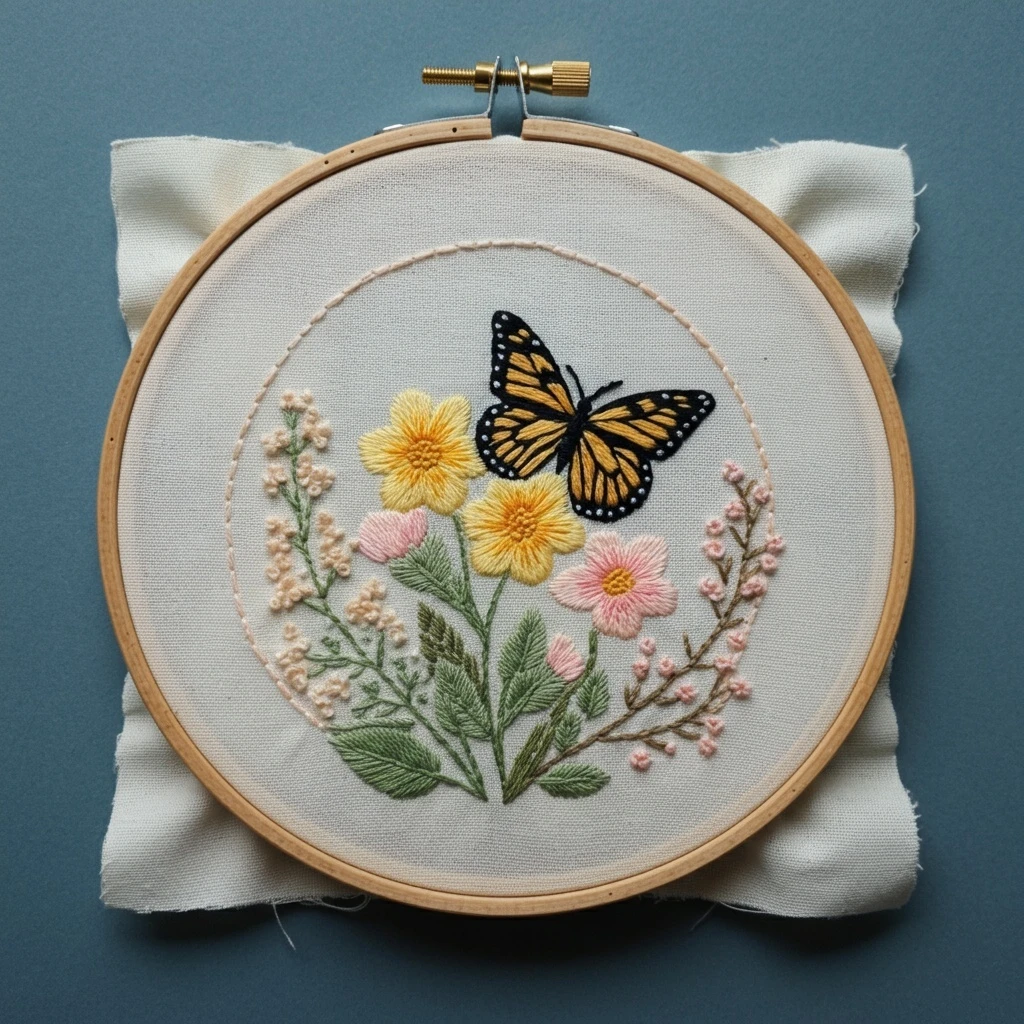
Design 565: Monarch Butterfly & Floral Wreath
A soft linen hoop design with a black-and-gold monarch, sunny yellow blossoms, pale pink flowers, sage foliage, twiggy wreath branches, and scattered cream buds. The palette below keeps the butterfly crisp while allowing the flowers and leaves to feel airy, handmade, and dimensional.
Suggested DMC palette
The artwork reads as warm yellow-orange against calm greens, pale blush, cream buds, brown twig stems, and strong black butterfly outlines. Keep the number of colors moderate so the small floral wreath stays clean.
Primary monarch wing panels and the brighter flower-petal centers; use where the design needs golden warmth.
Deep orange wing shadows, petal bases, and warm flower-center accents.
Outer yellow petals and highlight strokes on the butterfly where wings catch light.
Monarch body, wing borders, antennae, and the cleanest final outline details.
Tiny wing dots; place after the black outline so the spots remain crisp and bright.
Blush flowers and small buds; pair with a darker pink at petal bases for dimension.
Pink petal shadows, bud undersides, and a few accent knots in the wreath.
Creamy flower clusters and soft bud highlights on the left stem.
Main leaf fill and soft stems; a gentle sage that matches the fabric-friendly botanical look.
Leaf veins, underside shadows, and deeper fern-like fronds near the bottom of the wreath.
Twig branches and muted outlines where black would be too harsh.
Dotted hoop-circle guide and subtle stitch accents that echo the natural wooden hoop.
Stitch plan by design area
- Monarch wings: fill orange panels with satin stitch or short long-and-short stitches, then add black split-stitch borders. Work the black last except for the body.
- Wing dots: use one strand of B5200 for small straight stitches or tiny French knots. Keep spacing irregular like the reference.
- Yellow blossoms: use fishbone stitch or satin stitch from petal tip to center. Blend 743 at tips into 742 and 976 near the center.
- Pink flowers: use two-strand satin petals with 3713; tuck 3722 at petal bases and around the center for soft depth.
- Leaves: work leaf stitch or fishbone stitch with 3013, then add one-strand 3363 veins.
- Wreath branches: use stem stitch with 645, varying from one to two strands for delicate twigs.
Thread-count guidance
| Area | Strands | Why |
|---|---|---|
| Butterfly outline/body | 1-2 strands | One strand for wing veins and antennae; two for the outer border and body. |
| Wing color panels | 2 strands | Gives smooth coverage without making the small panels bulky. |
| Petals | 2 strands | Enough sheen for satin stitches while preserving petal separation. |
| Leaves and stems | 1-2 strands | Two for filled leaves, one for veins and wispy branch tips. |
| Bud clusters | 2 strands | French knots look plump and consistent with two strands. |
Blending, outlines & shading
Butterfly color blending
For a natural monarch effect, stitch wing panels from the black edge inward: begin with 976 near the border, switch to 742 through the middle, and place a few 743 strokes near the open center. Keep stitches angled with the wing veins so the fill follows the butterfly shape.
Floral shading
Place darker colors closest to the flower centers and where petals overlap. Use 743 and 742 for yellow petals, 3713 and 3722 for pink petals, and a small ring of 976 or 742 French knots in each flower center.
Texture suggestions
| Texture | Recommended stitch | Practical note |
|---|---|---|
| Raised flower centers | French knots or colonial knots | Use 742 mixed with 976; cluster knots tightly at the center and loosen toward the edge. |
| Soft bud sprays | French knots | Alternate 948, 3713, and 3722 so the buds do not look flat. |
| Leaf ribbing | Fishbone stitch plus straight-stitch veins | Keep center veins darker and outer fills lighter for a natural leaf fold. |
| Wreath circle | Running stitch or whipped backstitch | Use 842 with one strand for a delicate stitched guide that does not compete with the flowers. |
| Butterfly antennae | Single-strand backstitch | Use a short, light touch so the antennae taper gracefully. |
Beginner-friendly order of work
- Transfer the wreath circle, stems, flowers, and butterfly with a fine washable pen.
- Stitch stems and major leaves first so flower petals can sit neatly over them.
- Fill the large yellow and pink blossoms, then add their knot centers.
- Work butterfly orange panels before the black borders; this prevents orange stitches from covering the crisp outline.
- Add French-knot buds, white wing dots, and final single-strand details last.
Practical hoop tips
- Use a light neutral linen or cotton fabric; the design depends on airy negative space.
- Keep the fabric drum-tight, especially when placing satin stitches on butterfly wings.
- Use shorter satin stitches on the wing panels; long stitches snag and distort more easily.
- Rotate the hoop while stitching leaves and petals so your stitch angle stays comfortable.
- Press finished work face down on a towel to protect knots and raised petals.
Finishing approach
For the most polished result, let the monarch be the sharpest element: black split-stitch outlines, clean white dots, and warm orange fills. Keep the surrounding flowers softer with two-strand satin stitch, tiny knots, and muted sage leaves so the wreath frames the butterfly without overpowering it.