
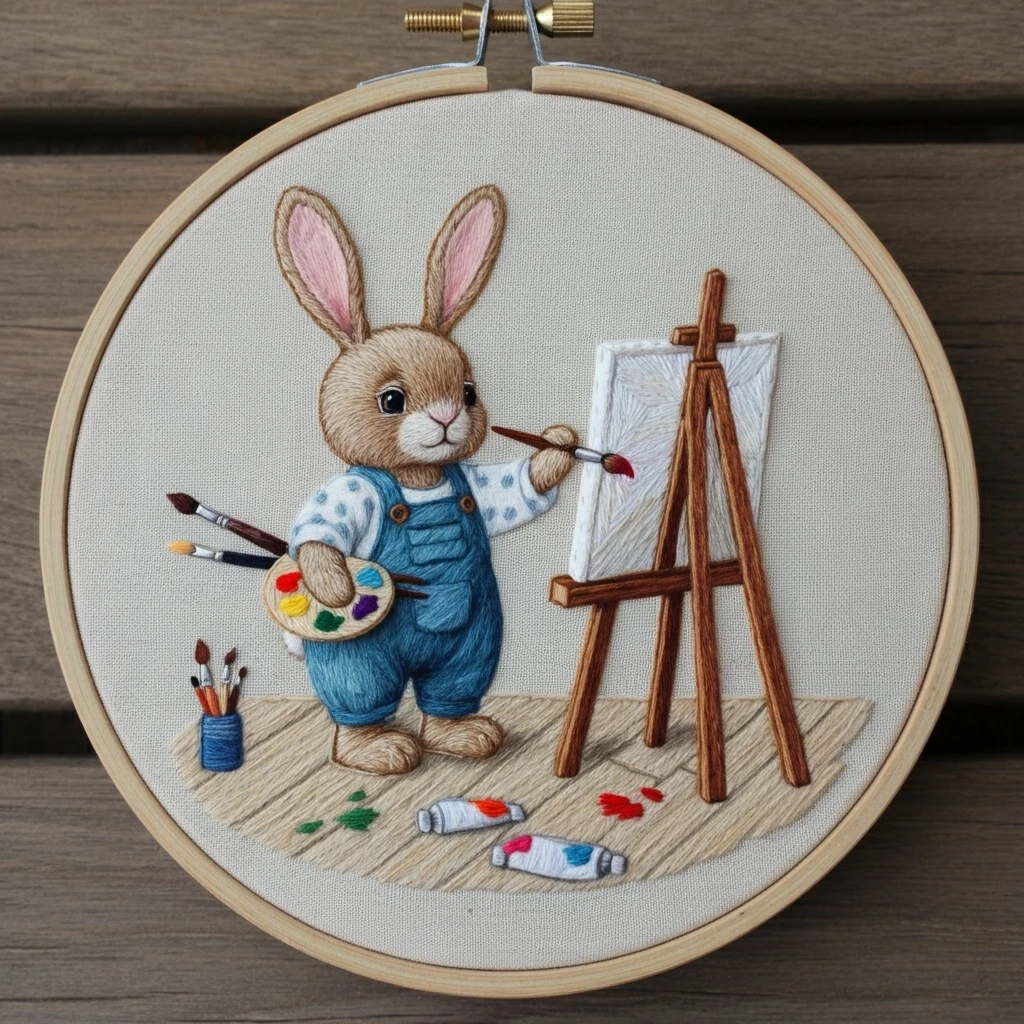
Embroidered Bunny Artist In Hoop
A gentle, storybook-style hoop design: a soft bunny artist framed by a warm wooden hoop, with creamy fur, blush ear details, tiny art tools, playful paint accents, and delicate outline work.
Design color read
The composition reads as a charming bunny portrait inside a hoop. Keep the rabbit light and plush with cream, pearl gray, and warm beige; reserve darker browns for eyes, whisker dots, paintbrush handles, and the hoop edge.
Artist details benefit from small pops of color: lavender, dusty rose, pale blue, soft sage, and golden ochre suggest paint blobs, a tiny palette, floral accents, or creative accessories without overpowering the bunny.
Suggested DMC floss palette
Stitch suggestions
- Split stitch: use 1 strand for the bunny's face outline, ears, paws, palette edges, and small curved features.
- Long-and-short stitch: shade the fur with short directional rows, moving from DMC 3865 into 822 and 644 in shadowed areas.
- Satin stitch: fill inner ears, paint blobs, apron or bow sections, and the small palette shape with 1-2 strands.
- Stem stitch: trace the hoop curve, paintbrush handles, and any sweeping decorative lines.
- French knots: create eyes, tiny paint dots, flower centers, and playful texture on the palette.
- Seed stitch: scatter a few 1-strand marks along the fur edge so the rabbit feels fluffy rather than flat.
Thread-count guidance
Blending & shading plan
For plush fur, blend 3865 + 822 in alternating 1-strand stitches along the cheeks, forehead, and belly. Add 644 only under the chin, behind the ear, and where paws overlap.
For soft ears, start with 151 in the center, feather outward with 822, then finish the outer rim with 3865. Keep the transition broken and stitchy rather than perfectly striped.
For the hoop and wooden tools, alternate 437 with single fine strokes of 898. A few uneven lines make the wood grain feel hand carved.
Outlining & detail order
Work large soft sections first: bunny fur, ears, hoop, and any clothing or apron area. Then stitch the palette, brush, paint dabs, and decorative extras.
Leave the eyes, nose, mouth, whiskers, and tiny highlights until the very end. Use one strand of DMC 898 and test each feature with a single small stitch before committing to a darker line.
For a gentler look, replace some dark outlines with DMC 414 or a single strand of 437, especially around the body and ears.
Texture ideas for a polished finish
Beginner-friendly practical tips
- Stabilize lightweight fabric with a thin backing if you plan to use satin stitch for paint blobs or dense fur shading.
- Start with the palest floss first so darker fibers do not drag into the white bunny sections.
- Keep stitches short around the face; long stitches can snag and distort the bunny's expression.
- Use a washable marker or fine pencil for tiny facial details, but stitch them only after the filled areas are complete.
- Press from the back on a folded towel to protect French knots, satin paint spots, and hoop texture.