
DMC palette & embroidery guide
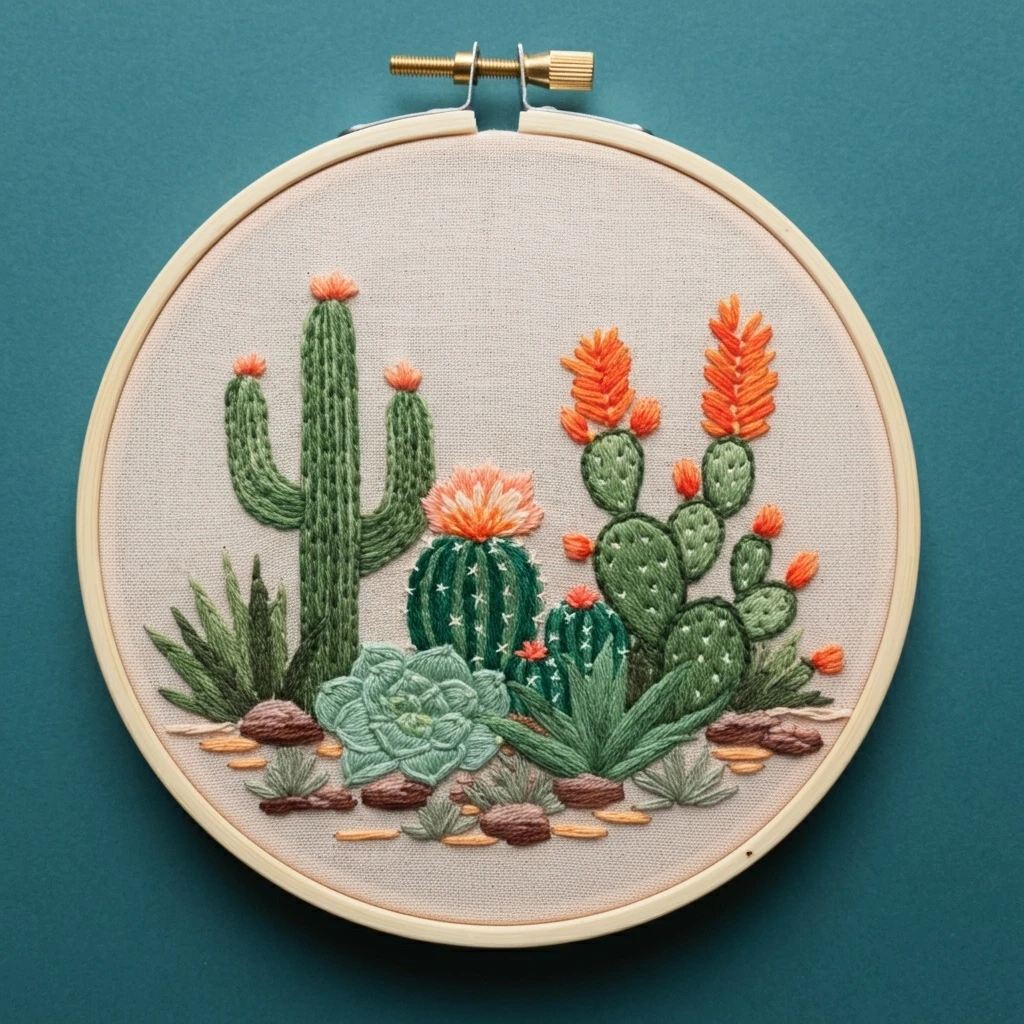
Desert Oasis
A warm hoop design full of sculptural cacti, jade succulents, coral-orange desert blooms, soft sand, and grounded pebble textures. This palette keeps the greenery dimensional while letting the flower plumes glow like sunset against natural linen.
Color story observed from the design
The composition is built around several cactus shapes: a tall saguaro, rounded barrel forms, prickly pear pads, a pale rosette succulent, spiky agave leaves, small grasses, terracotta rocks, and bright orange flower clusters. Use the deepest blue-greens for shadowed cactus ribs, muted sage for dusty pads, mint for the rosette, and peach-to-orange accents for the desert blooms.
For a softer finished hoop, stitch the background fabric in natural linen, oatmeal, or tea-dyed cotton and let the unstitched cloth act as the desert air.
Suggested DMC floss palette
Stitch plan by design element
| Area | Recommended stitches | Practical notes |
|---|---|---|
| Tall saguaro cactus | Long and short stitch, stem stitch ribs, split stitch outline | Work vertical ribs first in 3362/501, then add darker 500 lines in the valleys. Keep arm curves smooth with short stem stitches. |
| Round barrel cacti | Satin stitch sections, long and short shading, tiny straight spines | Shade from 500 at the lower grooves to 501 and 3052 at the top. Add 3865 spines last with one strand. |
| Prickly pear pads | Padded satin, split stitch edging, seed stitch dots | Use two strands for the padded body, then outline each oval with a darker split stitch to keep the shapes crisp. |
| Succulent rosette | Fishbone stitch, satin stitch, back stitch vein lines | Use 3813 and 3053 for the petal surfaces, with a whisper of 3052 near the petal bases for shadow. |
| Orange blooms | Detached chain, straight stitch fans, turkey work trimmed short | Layer 352 near the tips, 721 through the middle, and 720 at the center for a lively cactus-flower glow. |
| Agave leaves and grasses | Fishbone stitch, fly stitch, straight stitch clusters | Keep the leaves narrow and directional. Alternate 3362, 3052, and 3053 so the clumps do not look flat. |
| Rocks and sandy ground | Satin stitch, couching, seed stitch, small straight stitches | Use 801 for the underside of rocks, 976 for light edges, and scattered tan stitches for desert texture. |
Thread-count guidance
- Outlines: 1-2 strands for split stitch or back stitch; use one strand around small cactus pads and flower buds.
- Filled cactus bodies: 2 strands for smooth satin or long-and-short fill. Use 3 strands only for bolder ribs on larger shapes.
- Spines and tiny dots: 1 strand of 3865 or a pale green keeps details delicate and prevents bulky knots.
- Rocks and ground texture: 2 strands for satin stones, 1 strand for scattered sand stitches.
Blending ideas
- Blend one strand 500 with one strand 501 for deep shaded ribs.
- Blend one strand 3052 with one strand 3053 for dusty cactus highlights.
- Blend one strand 721 with one strand 352 for soft coral flower tips.
- Blend 3813 with 3053 on the succulent to connect mint petals with the surrounding greens.
Outlining details
Outline the largest cactus silhouettes with split stitch in 501 or 3362 before filling. For the pale succulent, outline after filling with 3052 so the leaves remain tidy but not harsh.
Shading approach
Imagine the light coming from above. Place darker greens along lower curves, under cactus arms, and between ribs; reserve mint and sage highlights for upper left edges and leaf tips.
Texture suggestions
Use tiny straight stitches for spines, loose fly stitches for grasses, and a few raised satin rocks. This contrast makes the design feel lush without overcrowding the hoop.