
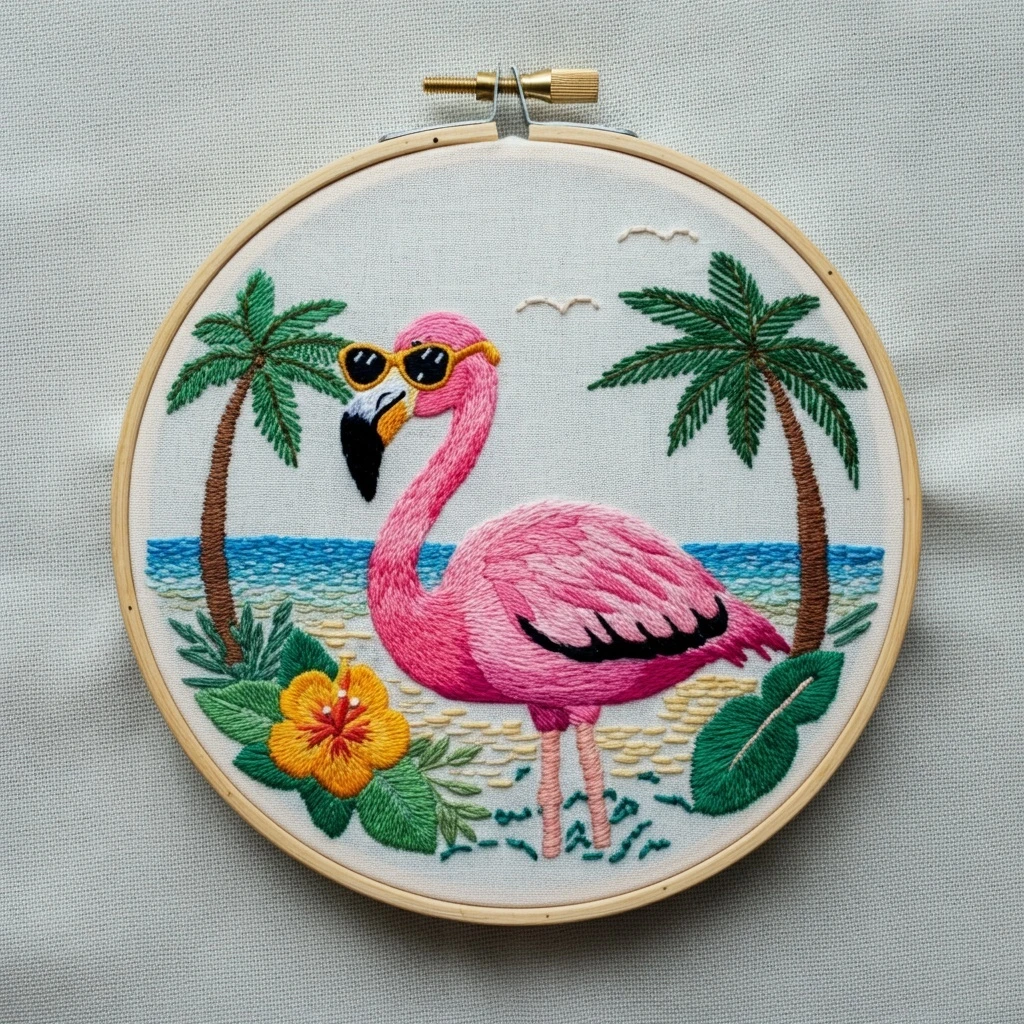
Tropical Flamingo
A cheerful beach-hoop design with a bright pink flamingo in sunglasses, palm trees, ocean bands, sandy shoreline texture, tropical greenery, and a golden hibiscus accent. Colors are estimated from the visible embroidery preview and matched to practical DMC floss choices for hand embroidery.
Likely DMC Color Palette
The palette leans tropical: layered flamingo pinks, strong black and golden sunglasses, blue ocean rows, warm sand, palm-trunk browns, deep jungle greens, and a sunny hibiscus flower. Coverage percentages are visual estimates from the preview.
Soft highlights on the flamingo body, upper wing, neck shine, and leg light areas.
Main flamingo fill for the neck, head, chest, and smooth midtone feather areas.
Deeper feather direction lines, belly underside, tail shadows, and neck turns.
Darkest pink at tail tips, wing root shadow, and small high-contrast feather accents.
Sunglass lenses, beak tip, wing scallops, eye shine shadows, and crisp final outlines.
Sunglass frames, beak warm section, hibiscus center glow, and sunny accents.
Hibiscus petals and small warm highlights along the glasses and sandy stitches.
Ocean horizon rows, darker water ripples, and cool contrast behind the flamingo.
Water highlights, pale surf breaks, and lighter blue stitches mixed into the sea band.
Palm fronds, deep leaves around the flower, and strong tropical foliage shapes.
Mid-green leaf veins, small ground sprigs, and blended palm-frond highlights.
Palm trunks, bark bands, trunk shadows, and grounding details beside the sand.
Beach pebbles, sand dashes, shoreline texture, and small neutral background marks.
Tiny eye highlights, beak highlight, flower details, birds, and sparkle stitches.
Hibiscus throat, petal veins, and small warm-red punctuation stitches.
Stitching Suggestions
| Element | Stitch Type | Practical Notes |
|---|---|---|
| Flamingo body | Long and short stitch | Follow the feather direction from neck to chest and from wing root toward tail. Blend 963, 604, and 602 so the bird looks rounded rather than flat. |
| Neck and head | Stem stitch base plus long and short fill | Use curved rows that travel with the S-shape of the neck. Keep the outer edge smooth with 1 strand of darker pink or split stitch. |
| Wing scallops | Backstitch or split backstitch | Use 310 sparingly for the black feather scallops. A clean final pass makes the flamingo read clearly from a distance. |
| Sunglasses | Satin stitch, padded satin, backstitch | Fill lenses with 310, add tiny 3865 highlights, then outline frames with 742. For raised frames, lay a foundation stitch before satin stitching over it. |
| Beak | Satin stitch | Work black at the tip, white in the central section, and tangerine near the face. Keep stitches short so the beak remains sharp and graphic. |
| Ocean band | Running stitch and straight stitch rows | Layer horizontal broken lines in 3844 and 3846. Vary stitch length so the water looks lively, not striped like a border. |
| Sand texture | Seed stitch and small straight stitches | Use 842 with a few 725 highlights. Scatter stitches unevenly around the feet and shoreline for a beach-pebble effect. |
| Palm trunks | Stem stitch or split stitch | Curve the trunk with vertical brown rows, then add short horizontal bark bands in a darker brown. Keep trunks narrow to preserve the hoop’s airy feel. |
| Palm fronds | Fishbone stitch and fly stitch | Use 699 for shadowed fronds and 989 for highlighted ribs. Stitch from the center vein outward to get crisp tropical leaves. |
| Hibiscus flower | Long and short stitch, satin stitch, French knots | Fill petals with 725 and 742, shade the center with 347, then add tiny knots or straight stamens for the raised flower detail. |
| Foreground leaves | Fishbone stitch | Use 2 strands for broad leaves and 1 strand for veins. A pale center vein keeps each leaf from becoming a solid green block. |
| Flying birds | Backstitch | Use 1 strand of 842 or 3865 and keep each curve minimal. These should stay light and distant. |
Thread-Count Guidance
- 2 strands for most flamingo fill, ocean rows, flower petals, palm trunks, and large leaves.
- 1 strand for fine outlines, feather direction marks, sunglasses highlights, bird silhouettes, leaf veins, and delicate shoreline details.
- 3 strands only where you want extra texture, such as chunky sand pebbles or a bold palm trunk edge.
- Use shorter thread lengths for pink areas; repeated passes through dense fill can fuzz light pink floss quickly.
Blending & Shading Ideas
- Blend one strand 963 with one strand 604 for soft flamingo highlights on the chest and upper wing.
- Blend one strand 604 with one strand 602 for the neck underside and the lower body curve.
- Add 915 only in narrow shadow strokes near the tail and wing base so the pink stays bright and tropical.
- Mix 3844 and 3846 in alternating broken rows to make the ocean feel sunlit without adding too many colors.
Outlining & Texture
- Outline the flamingo last with split stitch in a matching pink instead of black, except for the wing scallops and beak.
- Keep sunglasses crisp: black satin first, golden frame second, tiny highlight last.
- For palm fronds, leave tiny gaps between stitches to mimic individual leaflets.
- Use scattered seed stitches near the feet to ground the flamingo and prevent the legs from looking like they float.
Beginner-Friendly Order
- Start with the ocean and sand because they establish the horizon behind the main bird.
- Stitch the palm trunks and major leaves next, then complete the hibiscus flower.
- Fill the flamingo body in pink layers, working from light to dark and following the printed feather direction.
- Finish with the sunglasses, black wing details, beak, tiny birds, and final highlight stitches.