
DMC Color Palette & Hand Embroidery Notes
Winter Bloom Bouquet
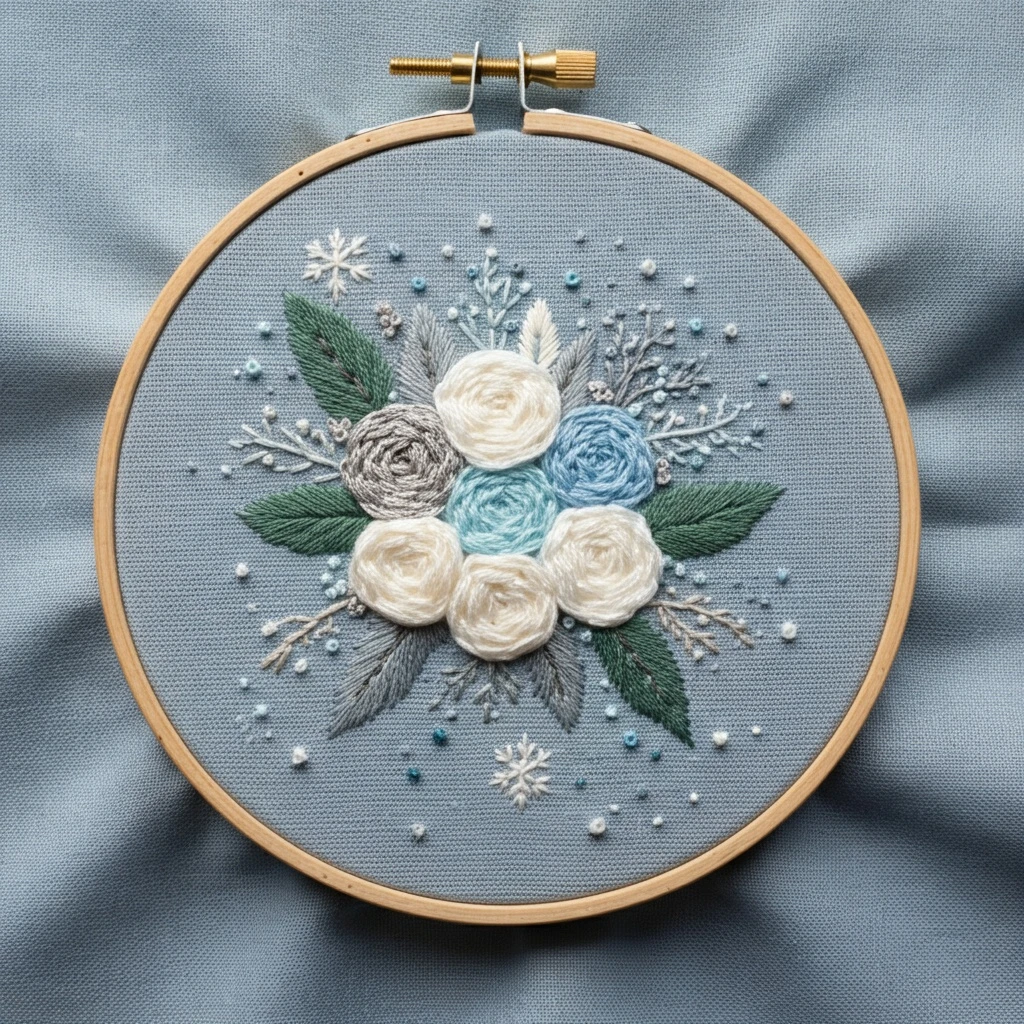
A cool, snowy bouquet worked on blue-grey linen: creamy dimensional roses, soft blue blooms, dark evergreen leaves, frosted grey foliage, tiny pearl berries, and stitched snowflake accents.
Design read
The reference has a softly symmetrical bouquet inside a hoop. The visual weight sits in the central cluster of raised, spiral flowers: warm ivory roses, one icy aqua bloom, one powder-blue bloom, and a taupe-grey rose. Around them are long dark green leaves, smoky grey needle leaves, pale twig sprays, bead-like snow dots, and small snowflakes. The fabric background is a muted blue-grey, so the palette should stay wintry rather than spring-bright.
Suggested DMC palette
Stitch plan by design area
| Area | Recommended stitches | Thread guidance |
|---|---|---|
| Dimensional roses | Woven wheel roses, whipped woven roses, or compact spiral couching. Add tiny straight-stitch glints along the top of the spiral. | Use 4-6 strands for the woven base. Blend Ecru + 822 for cream shadows; 3753 + 3768 for blue shadows; 648 + 647 for the taupe rose. |
| Dark leaves | Fishbone stitch or long-and-short stitch from the center vein outward. Keep strokes angled like a pine or winter leaf. | 2-3 strands. Start with 500 near the midrib, move into 501, and add one-strand 927 highlights only on the upper edge. |
| Grey needle foliage | Fine straight stitches, feather stitch, or split stitch stems with individual needle strokes. | 1-2 strands in 924, 927, and 647. Leave space between strokes so the fabric shows through. |
| Snowflakes and twig sprays | Straight stitch spokes, fly stitch tips, detached chain leaves, and small backstitched stems. | 1-2 strands B5200, Ecru, 927, or 822. Use B5200 only on the brightest snow points. |
| Berries and snow dots | French knots, colonial knots, or seed beads if desired. | 2 wraps with 2 strands for small dots; 3 wraps with 2 strands for larger pearls. Mix B5200, 3756, 747, and 3810. |
Blending, shading, and outlining
Cream flower depth
Keep the ivory flowers warm by using Ecru as the dominant thread, then tuck 822 into the lower spiral rows. Add B5200 only as a final highlight on the highest loops so the blooms read as winter-white, not flat white.
Cool blue flowers
For the blue rose, blend one strand 3753 with one strand 3756 in the outer petals, then shift to 3768 in the center spiral. For the aqua bloom, blend 747 + 3810 for a frosty turquoise center.
Fine outlines
Use one strand of 647 around the taupe rose, one strand 3768 for the blue rose, and one strand 500 along the darkest leaf bases. Do not outline every petal; selective outlining keeps the bouquet soft.
Texture contrast
Let the roses be raised and plush, while the twig sprays stay flat and delicate. This contrast makes the bouquet look layered without crowding the small filler details.
Beginner-friendly practical tips
Order of work
- Transfer the main flower circles lightly.
- Stitch stems and leaves first.
- Add filler sprays and knots.
- Finish with woven roses last.
Thread counts
- 1 strand: outlines and fine twig tips.
- 2 strands: most stems, snowflakes, knots.
- 3 strands: fishbone leaves.
- 4-6 strands: raised roses.
Neat finish
- Keep knots small around the outer halo.
- Use shorter thread lengths for ivory floss.
- Rotate the hoop while making woven roses.
- Steam from the back, never crush raised petals.
Quick reference recipe
Palette mood: snow white, warm ivory, taupe grey, powder blue, icy aqua, smoky green, and deep evergreen.
Signature stitches: woven wheel roses, fishbone leaves, back stitch stems, straight-stitch snowflakes, French knot berries, feather-stitch fillers.
Most useful blends: Ecru + 822 for creamy petals, 3753 + 3768 for blue depth, 747 + 3810 for aqua bloom shadows, 501 + 500 for evergreen leaves, 927 + 924 for frosted grey foliage.
DMC matches are practical approximations based on the visible reference colors and may be adjusted for fabric color, lighting, and personal thread stash.