
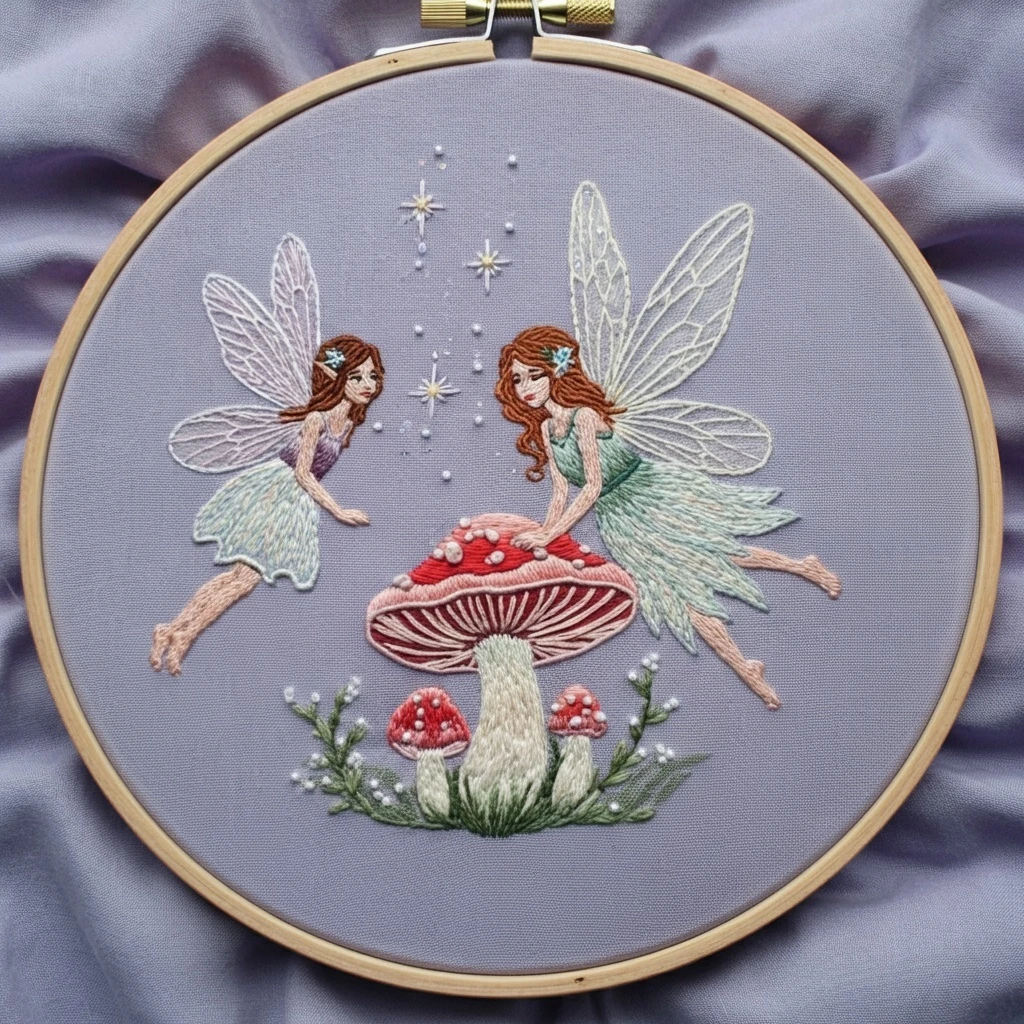
Embroidered Fairies And Mushroom Scene
A whimsical woodland design filled with tiny fairies, glowing wings, red toadstools, mossy greenery, blush flowers, and magical sparkle. These DMC matches are estimated from the visible hoop preview and chosen to create a soft fairy-tale finish with clear focal points and layered texture.
Likely DMC Color Palette
Matched to fairy wings, dresses, rosy flowers, glowing sparkles, mushroom caps, pale stems, mossy greens, earthy branches, and soft blue-lilac atmosphere.
Stitching Suggestions
Stitch the larger mushrooms and forest structure first, then add fairies, flowers, moss, and final magical sparkles.
| Element | Stitch Type | Practical Notes |
|---|---|---|
| Fairy wings | Long and short stitch with split-stitch veins | Use 3756, 153, 3042, and 598 in soft translucent layers. Add one-strand 340 or 3042 for delicate wing veins. |
| Wing sparkle | Tiny straight stitch | Use B5200, 3865, and 3823 in small scattered glints after the wing fill is complete. |
| Fairy dresses | Satin stitch or long and short stitch | Use 3689, 3688, 153, or 340 depending on the dress area. Keep shapes small and neat so the figures remain delicate. |
| Fairy hair and skin | Long and short stitch | Use 739 and 436 for warm skin and golden hair, with 801 only in the deepest hair shadow if needed. |
| Mushroom caps | Long and short stitch | Blend 666, 321, and 817 from highlight to shadow. Curve the stitches around the cap to emphasize the rounded mushroom dome. |
| Mushroom spots | Satin stitch | Use 3865 or B5200 for crisp white cap spots. Place darker red around some spots so they appear naturally embedded in the cap. |
| Mushroom stems | Long and short stitch | Use 739 and 436 as the main stem tones, then add 801 or 898 beneath the cap and at the base for depth. |
| Underside gills | Split stitch | Use 436, 801, and 898 in short radiating lines under open mushroom caps. Keep these strokes fine and slightly broken. |
| Flowers | Lazy daisy and French knots | Use 3689, 3688, 153, 744, and 3823 for tiny blooms, centers, and filler flowers around the scene. |
| Leaves | Fishbone stitch | Use 3362 at the base, 3347 in the body, and 3348 at the tips for layered leafy movement. |
| Moss and ground cover | Seed stitch and fly stitch | Use 3052, 3347, and 3348 in uneven patches to suggest moss, grass, and soft forest texture. |
| Branches and twigs | Stem stitch | Use 801 and 898 for branch lines, then add tiny 436 highlights on the light-facing side. |
| Magic dust or stars | French knots and star stitch | Use 3823, 744, 3865, and B5200 in scattered clusters around the fairies and above the mushrooms. |
| Final outlines | Single-strand backstitch | Use 3362, 340, 801, or 898 selectively around fairy silhouettes, mushroom edges, and leaf overlaps without outlining everything. |
Thread Count, Blending & Texture
Use strand changes to separate delicate fairy elements, rounded mushroom forms, soft moss, and tiny decorative sparkle.
Fairy delicacy
Use 1 strand for faces, hands, wing veins, and tiny outlines. Small fairy features look more refined with lighter thread weight.
Mushroom rounding
Curve the cap stitches around the dome. This simple directional change makes the toadstools look more dimensional immediately.
Wing translucency
Blend pale blue, lilac, and white lightly, leaving some fabric visible so the wings feel airy rather than solid.
Forest-floor texture
Mix seed stitch, fly stitch, and a few French knots in different greens for soft moss and natural ground variation.
Magical sparkle
Use warm yellow and white for fairy dust, but place it sparingly. A few well-spaced knots and star stitches feel more magical than dense scatter.
Beginner control
Complete one focal cluster at a time—mushroom, nearby greenery, then fairy—so the composition stays balanced and easy to read.
Recommended Stitching Order
This order keeps the larger forms stable and protects the tiniest fairy and sparkle details until the end.
Helpful Notes for a Polished Finish
A restrained finish keeps the scene whimsical, readable, and full of fairy-tale charm.
- Use firm hoop tension so small fairy figures and mushroom caps stay smooth and cleanly shaped.
- Avoid outlining every fairy or flower heavily; selective dark accents are enough to keep the design soft.
- Do not carry dark red or green thread behind pale wings or white mushroom spots where it may show through.
- Vary sparkle sizes and spacing so the magic dust feels scattered naturally through the scene.
- Use shorter thread lengths for pale wing and sparkle colors to keep them clean and untangled.
- Press the finished hoop face-down on a towel to protect French knots, star stitches, and raised moss or flower-center texture.