
DMC palette & stitching tips
The Happy Parrotlet Realistic Hand Embroidered Bird
A cheerful hoop design centered on a fluffy green-yellow parrotlet perched on a warm brown branch, framed with ferny leaves, soft peach blossoms, and tiny raised buds. The palette below is estimated from the visible preview and matched to practical DMC floss shades for realistic feather texture.
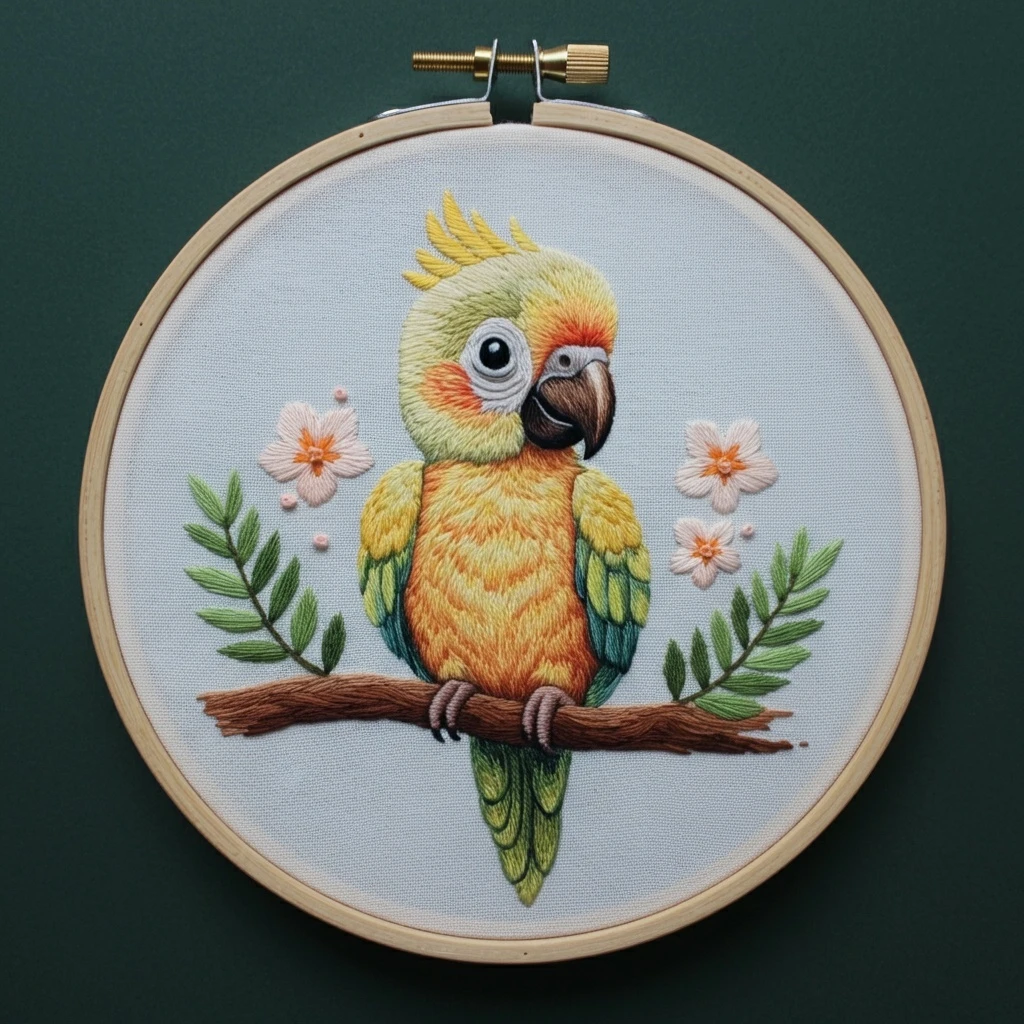
Visual focus: pale yellow crest, olive-green body, orange cheek and brow, dark curved beak, glossy eye, leafy side sprays, peach flowers, and textured branch.
Likely DMC Color Palette
Use these colors as a flexible guide rather than a strict kit list. Coverage percentages are visual estimates from the preview, not exact thread usage.
Main sunny yellow for the crest, chest highlights, wing feather tips, and the brightest body fluff.
Golden shadows through the belly, lower crest, and deeper yellow wing sections; blend with 725 for volume.
Soft olive wash for the face, neck, and pale green feather transitions around the head.
Mid olive shading for body contours, wing layers, leaf shadows, and natural feather breaks.
Darker leaf veins, wing sides, tail separation, and the shaded edge beneath the bird.
Teal-blue accent on lower wings and tail sides; use sparingly for the parrotlet’s cool green contrast.
Bright orange cheek, flower centers, warm eyebrow glow, and small chest flecks.
Deepest orange shadows at the brow and cheek, plus a few short strokes in the belly for realism.
Flower petals and soft facial warmth; pair with white or pale beige to keep petals airy.
Eye highlight, pale ring around the eye, tiny flower highlights, and feather sparkle on the face.
Branch body, toes, beak warmth, and natural bark ridges; mix with darker brown for depth.
Beak split, eye pupil, nostril, deepest branch cracks, and tiny anchoring outlines.
Stitching Suggestions
| Design Area | Best Stitches | Practical Notes |
|---|---|---|
| Head and crest | Long and short stitch, straight stitch | Angle stitches outward from the crown. Keep crest tips narrow and pointed, using 725 over 783 for sunny raised tips. |
| Face feathers | Single-strand long and short, split stitch | Use 3013 and 3052 in short directional marks around the eye. Avoid heavy outlining so the cheek stays soft and fluffy. |
| Orange cheek and brow | Long and short stitch | Blend 741 into 900 at the shadow edge. Let a few orange strokes extend into yellow feathers to mimic realistic color mixing. |
| Eye | Satin stitch, backstitch, tiny straight stitch | Fill the pupil with 3371, ring with pale gray-white, then add one clean 3865 catchlight last for life. |
| Beak | Satin stitch with split-stitch outline | Curve the satin stitches along the beak form. Use 839 for warm brown areas and 3371 only for the deepest split and lower shadow. |
| Chest and belly | Long and short stitch, seed stitch accents | Build a soft yellow base, then add scattered 783, 741, and 3052 feather strokes. Keep stitches vertical and slightly curved. |
| Wings and tail | Fishbone stitch, long and short stitch, backstitch | Work each feather as a separate small shape. Use darker green near the overlaps and turquoise accents along lower side feathers. |
| Branch and feet | Stem stitch, satin stitch, couching | Layer brown stem stitches lengthwise for bark. Wrap toes in curved satin stitches and add a dark line where claws meet the branch. |
| Leaves | Fishbone stitch, detached chain, stem stitch | Use one strand for fine leaflets and two strands for stems. Alternate greens so the sprays do not look flat. |
| Flowers and buds | Lazy daisy, satin stitch, French knots | Use 948 for petals, 741 for centers, and small pink-peach knots for floating buds. Keep flower stitches lighter than the bird. |
Thread Count, Blending & Texture
Use 1 strand for the face, eye ring, beak detail, and fine feather breaks. Use 2 strands for the chest, wings, crest base, leaves, flowers, and branch fill.
For the belly, try one strand 725 plus one strand 783. For olive feather shadows, blend one strand 3013 plus one strand 3052.
Save French knots for flower centers and tiny buds. For the crest, lay a few longer straight stitches over the filled crown to create a lifted tuft.
Outline only the eye, beak, feet, branch cracks, and select feather separations. A fully outlined bird can lose the realistic fluffy look.
Follow the body shape: crown stitches radiate upward, face stitches curve around the eye, chest stitches drop downward, and wing stitches follow each feather.
Keep the fabric drum tight. Realistic long-and-short stitching looks smoother when the fabric does not sag between dense feather areas.
Suggested Stitching Order
Helpful Finishing Notes
A size 7 or 8 embroidery needle works well for two-strand fills; switch to size 9 or 10 for single-strand details around the eye and beak.
Keep face stitches very short, about 3–6 mm. Longer stitches suit the chest and tail, but vary their length to avoid striped bands.
Because the design has many color changes, park threads only across tiny distances. Re-thread rather than dragging dark floss behind pale fabric.